About Andrew Cusack
 Writer, web designer, etc.; born in New York; educated in Argentina, Scotland, and South Africa; now based in London.
 read more
News
Blogs
Reviews & Periodicals
Arts & Design
World
France
Mitteleuropa
Knickerbockers
Argentina
The Levant
Africa
Cape of Good Hope
Netherlands
Scandinavia
Québec
India
Muscovy
Germany
Academica
“Brideshead” Regurgitated

Well, the trailer for the film adaptation of Evelyn Waugh’s classic novel “Brideshead Revisited” is out, and the film is slated for a summer release here in the States. (Trailer | Official Site). Waugh fans can but lament that, whereas Waugh said the book was essentially about “the operation of divine grace”, the screenwriter of this adaptation openly admitted that the script “turns God into a villain”.
Rather than being bold and creating a genuine work of cinematic art to match the novel, they’ve decided to take the easy and conformist route and do a God-hating rompy flick. (Because we can’t have too many of those!). A shame, of course, but entirely predictable. Shall we at least have a look at the cast?
New Yorker Elected Mayor of London

Congratulations to that most-honoured son of the Empire State, Mr. Alexander Boris de Pfeffel Johnson MP, more commonly known as Boris, on his election to the mayoralty of Greater London. Mr. Johnson was born on these sacred shores some forty-four years ago on a pleasant June day. Boris has politics in the blood as his father Stanley is a former Conservative MEP, but let us hope he does not take after his great-grandfather, Ali Kemal Bey, who made enough unfortunate decisions during his brief tenure as interior minister of the Ottoman Empire that he was knicked from the barber shop of the rather-smart Tokatlian Hotel in Constantinople and lynched shortly thereafter.
Strangely enough, this is not exactly the closest connection New York and London have ever had. Sir Gilbert Heathcote, 1st Baronet was Lord Mayor of London in 1710 while his brother Caleb Heathcote was Mayor of the City of New York, exhibiting how interconnected our transatlantic British world was in those days. Caleb Heathcote was also Lord of the Manor of Scarsdale, which is just five minutes north of here on the train. Created in 1703, Scarsdale was the last manor granted in the entire British Empire. There were about a dozen manorial lordships here in New York, bringing the proud heritage of feudalism to the New World. The Manor of Gardiner’s Island survives to this day as the only manor in America in which the land is still entirely owned by the descendants.
The bulk of manorial privileges (incorporating the pre-existing patroonships from the olden Dutch days) were, alas, abolished in the 1840s, with the final holdouts taken care of in some legislation of 1911, but the Lord of the Manor of Pelham was presented with a fatted calf each St. John’s Day from the City Council of New Rochelle (honoring the Huguenots’ agreement purchasing the land from the Pells) well into the twentieth century.
The Heathcote name survives, in Derbyshire I believe, but not in America. Caleb Heathcote married the daughter of Col. William Smith, Chief Justice of the Province of New York, but had only daughters.
Herald-Tribune Drops Iconic ‘Dingbat’
Famous Emblem from 1886 is Dropped in Move to ‘Modernize’
 The International Herald Tribune has unceremoniously dumped its unique 142-year-old nameplate logo, affectionately known as the “dingbat”. The graphic made its first appearance in the New York Tribune on April 10, 1866. The Tribune later merged with the New York Herald to become the New York Herald Tribune. The Herald had previously founded a separate European edition based in Paris. While the New York newspaper died in 1967, its weekly New York supplement survives as New York magazine and the Paris edition became the International Herald Tribune, jointly owned by the Whitney family and the New York Times. The Whitneys sold their stake to the Washington Post, which in turn ran the paper in alliance with the Times until 2002, when the New York Times Company became the sole proprietor of the IHT.
The Paris-based newspaper’s executive editor Michael Oreskes said he hoped that dropping the dingbat would make the front page “cleaner, more modern, more streamlined”. Vanessa Whittall, the Herald Tribune‘s communications manager, meanwhile said “by removing the traditional ‘dingbat’ graphic between Herald and Tribune we have created a more contemporary and concise presentation that is consistent with our digital platforms.”
The New York Times Company has been beset with problems in recent years, with both profits and circulation falling; one Manhattan outlet reported seeing an 80% drop in sales of the Sunday New York Times. Shareholders have claimed that the general downturn for newspapers has only been exacerbated by Arthur Ochs Sulzberger, Jr.’s poor management. The decline of the Times has been mirrored in the IHT, which it now markets as its international edition.
Under the Times‘s control, the IHT has been seen to become more of a newspaper for Americans abroad than an American newspaper for an international audience. The blogger of “Think!: The blog for readers of the International Herald Tribune” questioned the prominence the paper devotes to American stories: “How a piece about baseball in the Netherlands (where I lived for three years) got more play directly next to an article about a cyclone in Burma that has killed around 100,000 people is a little hard to follow.”

Above, the traditional nameplate. Below, the ‘modern, streamlined’ nameplate.

The decision to remove the dingbat certainly has its critics. Juan Antonio Giner, the founder of a media consulting group and blogger at Innovationsinnewspapers said the move was “not a big revolution or a smart strategic decision for a dying newspaper”. Mr. Giner compared the management’s decision to “play with such a traditional, magnificent, beautiful, well-done logo” as “like moving the chairs on a sinking Titanic”.
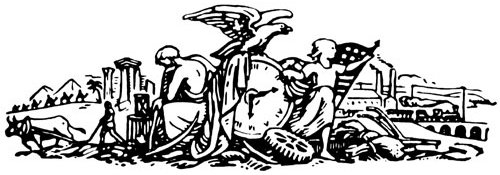
The original dingbat, above, with the most recent incarnation below.
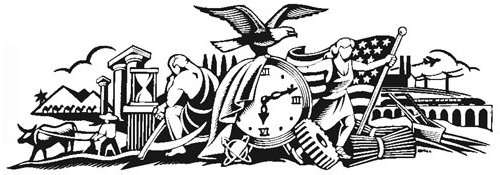
In “The Paper: The Life and Death of The New York Herald Tribune”, the definitive history of the deceased journal, Richard Kluger described the dingbat:
“in the middle of the crudely drawn tableau is a clock reading twelve minutes past six – no one knows why (conceivably it was the moment of Horace Greeley’s birth); to the left, Father Time sits in brooding contemplation of antiquity, represented by the ruin of a Greek temple, a man and his ox plowing, a caravan of six camels passing before two pyramids, and an hourglass; to the right, a sort of Americanized Joan of Arc, arms outstretched beneath a backwards-billowing Old Glory, welcomes modernity in the form of a chugging railroad train, factories with smoking chimneys, an updated plow, and an industrial cogwheel (over which the incautious heroine is about to trip); atop the clock, ready to take off into the boundless American future, is an eagle – all for no extra cost.”
“It was a baroque snapshot of time arrested,” Mr. Kluger continued, “an allegorical hieroglyph of the newspaper’s function to render history on the run”.
The deputy managing editor Robert Marino said of the dingbat, “I’m kind of sorry to see it go, but that’s progress.” Many of the Herald Tribune‘s readers will remain unconvinced.
Slot Zeist
A country house in the Province of Utrecht

Utrecht is the smallest of Dutch provinces, being little more than a remnant of the once-powerful Prince-Bishopric of Utrecht. The city of Utrecht is the province’s capital and namesake, not to mention the primatial see of all the Netherlands. Just outside the provincial capital is the town of Zeist with its splendid little ‘palace’, Slot Zeist. The house was built from 1677 to 1686 on the ruins of Kasteel Zeist, the castle of the von Zeist family which died out in the fourteenth century (or survived through the Borre van Amerongen family, depending on how you look at it).
The myths of Simon Blackburn

(I will now be contributing to Taki’s Daily over at Taki’s Magazine regularly).
Cry God for Britain, Harry, and St. Aidan?
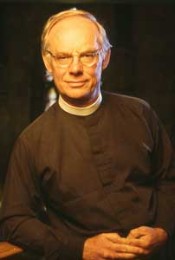
“St Aidan unites three of the countries by having lived there,” Dr. Bradley says, “and is, I believe, a better symbol for Britishness” [than the George, Andrew, and Patrick, the patrons of England, Scotland, and Ireland respectively].
“It’s like Billy Bragg says in his song ‘Take Down the Union Jack’ about Britain; ‘It’s not a proper country, it doesn’t have a patron saint’. Aidan was the sort of hybrid Briton that sums up the overlapping spiritual identities of Britain.
“He also makes a good patron saint of Britain because of his character. He was particularly humble and believed in talking directly to people. When he was given a horse by King Oswald of Northumbria, he immediately gave it away because he was worried that he would not be able to communicate properly.
“He was also not shy of reprimanding the mighty and powerful about their failings. He saw it as part of his job to remind secular rulers not to get above themselves. At a time when we are thinking about what makes Britishness, he had a sense of openness and diversity for his time that I think makes him a good candidate as the patron saint of Britain.”
Find out more in this article:
“Home-grown holy man” (The Independent, 23 April 2008)
On a somewhat similar note, here’s Aelianus (one of our favourite bloggers) writing on British Identity last September.
And you thought subsidising the poor was bad…
Millions of tax dollars taken from hard-working Americans are going to subsidise one of the wealthiest school districts in the country
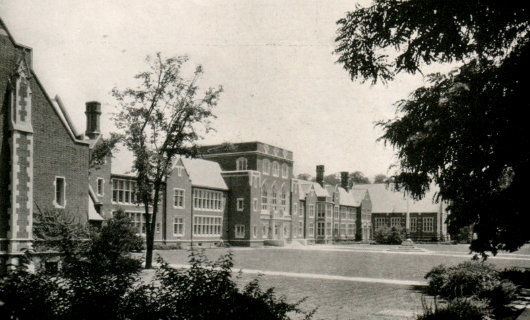
The Bronxville School (as it is called, since all grades from kindergarten to 12th are in the same building) ostensibly has a number of things going for it. It has a rather splendid collegiate gothic building in an excellent setting in one of the handsomest villages in all of the Empire State. Its school district is a mere square-mile, meaning most students can walk to school and it doesn’t even have a bus system. It has a private foundation funded independently by parents and alumni to support the school. What more could a public school possibly need?
Well, according to the geniuses down in Washington, D.C., $5.4 million in federal grants. The school, you see, is built on a site which frequently floods. Our main street in Bronxville is called Pondfield Road for a reason: the field with the pond is the open space where the school now stands. It’s been flooding for decades and so floods should come as no surprise. The nor’easter that blew through town a year ago flooded the school severely, closing it for over a week. The flooding was particularly bad during the last nor’easter because the school had spent a great deal of money (privately-raised, not from the public purse) to replace its natural football field with a lower-maintenance fake turf alternative. They did this instead of saving the money for, oh, say, one of those floods that happens every so often.
The money has been secured from the Federal Emergency Management Agency by our congresswoman, Nita Lowey (D). “When a natural disaster occurs, the federal government has a responsibility to help communities recover,” said Lowey, who neglected to provide any legal or moral backing for such an untruthful and baseless claim.
The school district of one of the wealthiest communities in the country is filching off the hard-working people of America in order to clean up the mess that is a direct result of its own poor spending decisions and inability to plan properly. Is there no shame?
Norumbega No. 4

Where can you find a model for the laity, a renegade bishop, a row of classical townhouses, an historic electoral victory for the Right, a loyal princess and a wayward prince, a call for partition, and some splendid ceremonial?
Why, the latest Norumbega of course!
La principessa, non la senatrice

 Isn’t it a shame that the citizens of Rome & Lazio neglected to choose Princess Alessandra Borghese as their senator? Our favorite inhabitant of the Palazzo Borghese is a sound Catholic, is good friends with the Pope, and was seen from afar during our first pilgrimage to Rome; good enough reasons to get my vote. While the UDC won a respectable 36 seats in the population-based Chamber of Deputies (an acceptable loss of 3 seats since the last election), la Principessa was a candidate for the regionally-based Senate, in which the UDC won only 3 seats, a loss of 18 since the 2006 elections.
Another young royal vied for a parliamentary seat in the recent Italian election, but you will have to wait until the next Norumbega for our little overview of the results.

John Zmirak is “The Church’s Comedian”
Note: This was just sent me by a mutual friend of Herr Zmirak and myself. At first thought it was a wry parody of a ZENIT article but, lo and behold, it is actually a real ZENIT article praising this loyal son of the Empire State (who proudly boasts of his descent from subjects of the Hapsburgs).
Stand-up Apologist
John Zmirak Called to Be Church’s Comedian
by Elizabeth Lev
VATICAN CITY, APRIL 23, 2008 (Zenit.org).- In his 1980 novel “The Name of the Rose,” Umberto Eco dedicated a lengthy erudite section to the question, “Did Jesus Laugh?” Reading the works of Catholic author John Zmirak, he probably laughs a lot.
John Zmirak, a Queens-born author, journalist and apologist, regaled students and adults alike last week in Rome during the launch of his new book “The Grand Inquisitor.”
I spoke to Zmirak about how he reconciled a rapier wit with an ironclad faith, and was fascinated to hear the story of how this prickly pear of piety sprouted in the heart of 1970s Queens.
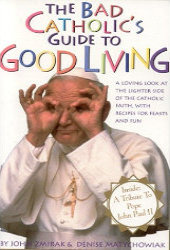 The first of Zmirak’s guides follows the liturgical calendar, covering the various feasts and seasons with his jovial wit and banter.  In the second guide, John gives us a jaunty and alcohol-tinged A-to-Z journey through the Faith.  But John Zmirak bears the scholar’s cap as well as the jester’s. Here’s his introduction to the life and work of Wilhelm Röpke, the Swiss architect of Germany’s postwar economic miracle. |
While other adolescents challenged authority by flaunting curfews or smoking, Zmirak was a youthful rebel for God. During his sophomore year, his religion teachers at his local Catholic high school began teaching notions contrary to the faith. Not being particularly well formed, Zmirak absorbed the doubts and contradictions until one day he was told that the transubstantiation — the change of bread and wine into the body and blood of Christ — wasn’t real.
The 15-year-old student balked, remembering vividly his mother explaining that when the bells rang “the bread turns into God.” (This by the way, is a reminder of the centrality of the role of parents in the formation of children.)
Zmirak found a Catechism and read the Church’s teaching for himself. Outraged, the teenager began a letter-writing campaign to his local bishop, persevering in the face of indifference and even hostility. One can almost imagine Zmirak as an early Christian martyr, proclaiming his faith and poking fun at his persecutors even as he faced the lions in the arena.
Zmirak’s unique perspectives and fine mind won him a scholarship at Yale, where he faced the full gale of secular intelligentsia. But he soon realized that it wasn’t the finely reasoned arguments against the tenets of Catholicism that were weakening the faithful, but ridicule.
Zmirak has an unusual take on what undermined the faith of Catholics in America. “It wasn’t eroded by earnest atheists and intellectual attacks,” he states. “What broke down ordinary people was a thousand clever comedic skits.”
So George Carlin and Saturday Night Live’s Father Guido Sarducci are responsible for the rise of the “cafeteria Catholics?” Zmirak says yes. “If you get people laughing, whatever your message is, it slides in unnoticed under the door.”
And thus Zmirak found his vocation. He thought that if humor could be used against the Church, then it could be used for it.
Two of the author’s most popular books are “The Bad Catholic’s Guide to Good Living” and “The Bad Catholic’s Guide to Wine, Whiskey and Song.” Like handbooks for fraternity boys, these books dream up parties, games and drinking activities, all laced with good humor and anchored in Catholic belief.
The good-living guide is dedicated to the fine sense of humor of the Pope John Paul II. Zmirak points out that the Pope not only brought down the Iron Curtain, but also won hearts with his refreshing comedic moments. Even a generation raised on Seinfeld and Monty Python found him accessible.
His guide follows the liturgical calendar with hilarious takes on the individual feasts and recipes and party ideas to celebrate them. In the pages of his book, every day is a reason to make merry in the Catholic world.
The “Guide to Wine, Whiskey and Song” is the rarest of things — a successful sequel. From A to Z, Zmirak runs through the most well-stocked liquor cabinet imaginable, tracing every form of spirit and elixir back to its Christian origin. In the finest of traditions, he also provides drinking songs, the funniest being Monty Python’s “Philosopher Song” reworked to feature heretics.
Zmirak’s latest effort, “The Grand Inquisitor” is a different genre for him, a graphic novel. Dubbed the anti-“Angels and Demons,” the story is set during a conclave, involves kidnapped cardinals, but champions the cause of orthodoxy and fidelity to the magisterium.
“The Grand Inquisitor” features all the staples of a good noir thriller — dark, graphic design, striking portraits and flashes of razor sharp wit — but contrary to genre which invariably transmits an anti-Christian message, Zmirak’s story is rooted in love for the Church.
After several days with John Zmirak, it became clear that a deep faith and great intelligence provide ballast for what seems to be Christendom’s first stand-up comic. A refreshing reminder of how it takes all kinds to make the Catholic Church.
St. George
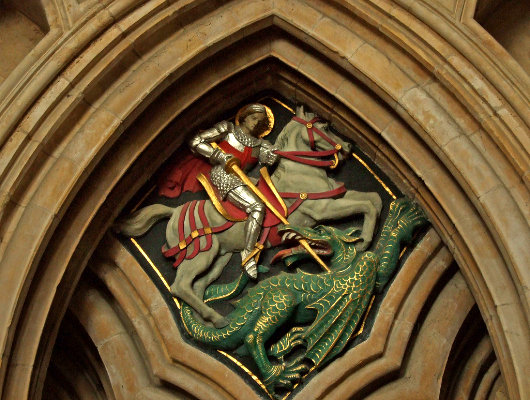
Today is St. George’s Day.
On this day in 303, St. George was killed; in 997, St. Adalbert of Prague died; in 1014, Brian Boru defeated the Vikings at Clontarf; in 1348, the Order of the Garter was founded by Edward III; in 1564,William Shakespeare was born; in 1616, both Miguel Cervantes and William Shakespeare died; in 1635, the Boston Latin School was founded; in 1661, Charles II was crowned at Westminster; in 1725, St. Gerard Majella was born; in 1775, J.M.W. Turner was born; and in 1794, Guillaume-Chrétien de Lamoignon de Malesherbes was guillotined for his defense of King Louis XVI before the Convention.

There is hope for America
A vignette from the Holy Father’s recent youth rally in Yonkers:
From For God, For Country, and For Yale, via Benedicite, Pater reverende.
Our Lady of Esperanza
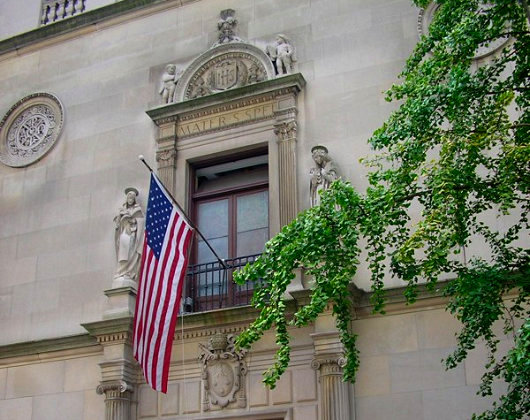
The Church of Our Lady of Esperanza, 156th Street & Broadway. The Church was built by Archer Huntington at the urging of Doña Manuela de Laverrerie de Barril and designed by Huntington’s brother Charles. The sanctuary lamp was a gift from King Alfonso XIII of Spain. The present façade dates from 1924, when the Church was expanded under the direction of Lawrence G. White, the son of Stanford White of McKim Mead & White and himself a partner in his father’s firm.
The right direction

What’s this? A building built from the ground up by a developer in New York, and designed to look like a New York building? Something to look forward to at 211 Elizabeth Street.

(more…)
“Valkyrie”

No, this isn’t a photograph of the latest Norumbega staff meeting, it’s a publicity shot from the upcoming United Artists film, “Valkyrie”. The film tells the story of Claus Philipp Maria Schenck von Stauffenberg, the heroic German Catholic noble who was the mastermind behind the July 20 plot against Hitler. Needless to say, there has been much anticipation over this film, especially since the lead role went to Tom Cruise, who has never quite got the knack of acting. Like Jeremy Irons, he seems to believe that completely different characters require little or no change in performance, but is mysteriously still making films nonetheless. (Cruise at least has the excuse of being a Scientologist to explain his success… what’s Jeremy Irons’s?).

Despite the poor choice of Mr. Cruise play Count Stauffenberg, the rest of the cast includes some pretty inspired choices. Playing Countess Nina von Stauffenberg is Carice von Houten (above), whom you will remember from “Zwartboek”. She’s joined by fellow “Zwartboek” actor Christian Berkel (top photo, seated far left), who played the evil General Kaütner in the Dutch film, the character responsible for the downfall of the good German, General Müntze, who was played by Sebastian Koch (better known for his role in the hit “Das Leben der Anderen”) who (pause for breath) actually played Count Stauffenberg himself in a 2004 German television production called “Stauffenberg”. Speaking of downfalls, Berkel (we’re back to him now) also played a nasty Nazi in the 2004 film “Downfall” depicting the last few days in Hitler’s bunker. [Correction: Berkel actually played Dr. Ernst-Günter Schenck, one of the good guys.] Some more of the cast…
(more…)
The Library of Congress
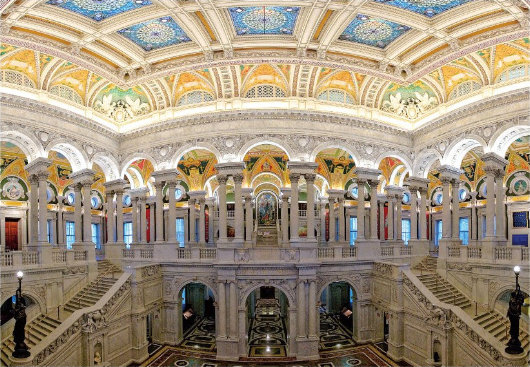
The national library is one of our underappreciated architectural achievements. Henry Hope Reed put together a handsome tribute to and record of the building. What a shame it is located in Washington, D.C.
‘Gadzooks!’ indeed
Introducing cusack.norumbega.co.uk, my new blog over at Norumbega. One of the inherent problems I always faced with andrewcusack.com was that once I had a nice, handsome post up top, I rarely wanted to disturb it with any further posts. This was especially so if I had just a very brief blog post in mind, given that once a post is made it has sometimes been weeks before I can make another one.
Part of the thinking behind Norumbega is that I will have the fortnightly features section for the somewhat swankier blog posts with my own side-blog for little things that can be updated whensoever I feel the need. So does this mean that andrewcusack.com — Banned by the Scottish Executive! Tori Truett’s lunchtime reading! Repository of miscellaneous arcana! — is like to die? Nay, good Sir. It is still here and so it shall remain. Some of the longer articles will be improved and then regurgitated over at Norumbega; everything that is here shall remain here. It’s a bit like the Lord Great Chamberlain… I’m not entirely sure what function it will serve but I have no doubt it should not be gotten rid of.
Perhaps now would be the appropriate time to thank certain people.
Firstly, Alex Singleton, founder of the Globalisation Institute, who first thought up the idea of yours truly having a proper blog and obtained andrewcusack.com for me when my technical expertise in that department was nil.
Secondly, Col. & Mrs. Matthew G. Cusack. My aunt and uncle were kind enough to pay for two whole years of this site while I was but a poor, penniless student in Scotland. I am grateful to them for much more than I can ever possible enunciate, but I thought this was at least one thing that I could mention specifically.
And I hope you are grateful to them as well!
Gadzooks!
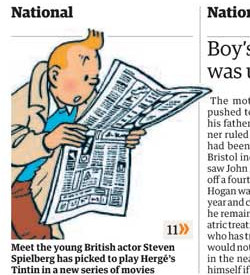 Tintin aficionados (such as your present scribe) have always had a certain nervousness with regards to putting the Belgian boy wonder on the big screen. Hergé’s creation is brilliant in the original comic books, acceptable in the 1990’s television cartoon version, but has produced only some thoroughly suspicious live-action film versions. (Namely, the 1961 “Tintin and the Golden Fleece” — not that Golden Fleece — and the 1964 “Tintin and the Blue Oranges”; neither of them based on books).
There was mention in the Economist some years ago of Spielberg doing a Tintin film and casting Leonardo diCaprio (!?!) in the lead role. I happened to cut it out of the Economist and so I have it somewhere amongst my clippings, but Hogarth claims his rheumatism and the current climate (“with respect, sir, wasn’t this humid before the war”) prevent him from classifying and filing my gigantic collection of clippings so I may have to wait until retirement to find it.
Word now comes, via the Guardian, that Herr Spielberg, fresh from his fourth and presumably final Indiana Jones adventure, is indeed to embark upon a Tintin film, and that he will cast the 17-year-old Briton Thomas Sangster as the heroic reporter. Cinephiles will recall Master Sangster from the 2003 Richard Curtis romantic-comedy “Love Actually” — which could have been a lovely, if typically sappy, film were it not for an entire subplot revolving around something rather lewd and not worthy of mention.
Unfortunately, my first reaction is that young Sangster is ill-suited for the role of Tintin. Firstly, he’s too young. I have always thought Tintin was permanently about 21, whereas Sangster will have just reach 18 when the film is in production. At a mere age of 18, can we really expect him to be undermining Bolshevism in the early Soviet Union? Or saving the ancient Syldavian monarchy from the threat of the dreaded Iron Guard? Or helping his pal General Alcazar regain the dictatorship of San Theodoros? I think not. But at 21, it seems much more possible.
(Of course, there are several more questions that any earnest Tintinophile feels compelled to ask. Will it be an adaptation or an original script? If an adaptation, of which book? Having a particular love of Scotland, I hope it’s The Black Island. Being a monarchist, I hope it’s the splendidly mitteleuropan King Ottokar’s Sceptre. But then perhaps, somewhat topically, they will choose Tintin in Tibet. And who will the rest of the cast be? Captain Haddock? Professor Calculus? Thompson and Thomson? Oh my…)
Well, we will just have to wait and see. After Herr Spielberg finishes his Tintin film, it appears that Peter Jackson (of “The Lord of the Rings” fame) will have a go at directing one himself. And there’s nothing to say he’ll use the same cast. Spielberg’s film is due in late 2009.
The Late Great Bank of New York

Doesn’t it often seem that as soon as something you actually like comes along, it’s only a short amount of time before it’s gone again? This is how I feel about the latest, and indeed last, logo and general visual identity of the Bank of New York. Readers are no doubt aware that the Bank of New York is the oldest bank in America (founded by Alexander Hamilton) and that its was the first share traded on the New York Stock Exchange when that great financial market was founded beneath a buttonwood tree in 1792.
In 2005, the Bank of New York finally dumped their 1980’s-feel, dated-but-traditional logo in favor of a new design put together by the New York brand house of Lippincott (then still known as Lippincott Mercer). The logo suggested an old stock or bank note but its polychromatic scheme gave it a modern vibrancy. The adjacent logotype was along similar lines: “Bank” and “New York” in a tasteful, restrained modern with “The” and “of” in a delightfully traditional fluid colonial script.

But on July 1, 2007, the ancient Bank of New York merged with a foreign interloper, the Mellon Financial Corporation of Pennsylvania and the disgusting hybrid child of the marriage is cumbersomely monikered: “The Bank of New York Mellon”. How awkward and ungainly! Along with the merger came a new logo, also designed by Lippincott, which you can see on the BNYM website. This pitiful modern arrowhead design says little, other than one might suffer bodily harm at its handling.
The 2005 Bank of New York logo evoked a sense of solidity. “I have deep roots and firm foundations,” it seemed to say, “but am nonetheless modern and adapting to change”. Think of the feel, the smell, of a worn bank note and then compare it to the dull, prickly arrowhead which threatens injury. The old logo you stick in you pocket and gain a sense of security from. The new logo you worry a ninja might hurl at you.
It was an error even to change the name, if you ask me. “The Bank of New York” has such a simplicity and a solidity to it, which the new name rather lacks. It is just like the old New York law firm of Dewey Ballantine, which suffered a takeover recently and is now known as “Dewey and LeBoeuf”. Rather sounds like a pair of huckster Louisiana lawyers hoping to make a few off the innocent inhabitants of the Bayou. So stick to the tried and the true, folks. It usually works.
Search
Instagram: @andcusack
Click here for my Instagram photos.Most Recent Posts
- West Point July 30, 2026
- Brunel’s Unbuilt Capitol February 3, 2026
- Cricket at Fordham January 27, 2026
- Palacio Barolo Revisted January 14, 2026
- Learning to Love Liguria January 14, 2026
Most Recent Comments
Book Wishlist
Monthly Archives
Categories