About Andrew Cusack
 Writer, web designer, etc.; born in New York; educated in Argentina, Scotland, and South Africa; now based in London.
 read more
News
Blogs
Reviews & Periodicals
Arts & Design
World
France
Mitteleuropa
Knickerbockers
Argentina
The Levant
Africa
Cape of Good Hope
Netherlands
Scandinavia
Québec
India
Muscovy
Germany
Academica
Avenida de Mayo
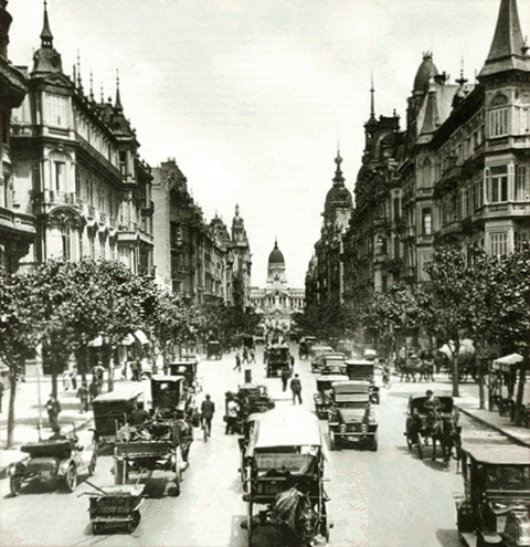
Looking down the Avenida de Mayo towards the Argentine Congress in the 1910s.
Celebrating a Great Scot: David Lumsden
I can’t tell you how often I come across something and think to myself “I must ask Lumsden about that”, and then suddenly realise that no such thing is possible anymore. I only had the privilege of knowing this gentle giant of a man towards the end of his life, but am grateful even for that relatively short friendship. Below is the address given by Hugh Macpherson at the Thanksgiving Service for the Life of David Lumsden of Cushnie that took place at St. Mary’s Church, Cadogan St., London on Monday, 27th April 2009. May he rest in peace.
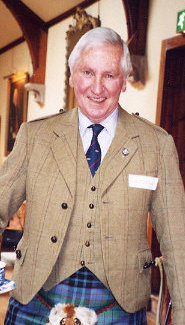 It is difficult to mark the passing of such a remarkable personality as David Lumsden. We have done with the requiems and the pibrochs and must now look forward to celebrate an extraordinary life lived to the full.
David was a man of many parts and passions. He was a renaissance man with a wide variety of interests, and if he did not know the answer to any particular question, he certainly knew where to look it up, and in a few days there would be an informative card in the post. He had a lively curiosity and sense of adventure.
Perhaps the ruling passion in his younger life was that of rowing. He rowed at Bedford School and when he went up to Jesus College Cambridge, he joined the boat club, eventually becoming Captain of Boats. There were, I think, eventually eight “oars” on the walls of his various houses. I think that David was one of the few people I know who went to Henley to actually watch the racing, and when one went into the trophy tent his name could be found on some of the trophys. The expedition to Henley was one of the fixed points of David’s year.
He travelled round the country rather like the “progress” of a monarch of old. This progress encompassed the Boat Race, Henley, the Royal Stuart Society Dinner, the Russian Ball, spring and autumn trips to Egypt, the Aboyne Games, the 1745 Commemoration, the Edinburgh Festival, and numerous balls and dinners, including of course the Sublime Society of Beef Steaks.
Rather like clubs, David and I had a “reciprocal” arrangement: When I was in Scotland I lodged with him, and when he was in London he lodged with me, and I can tell you that there were many times when I simply could not keep up with his social whirl, in fact once or twice I distinctly fell off! I remember one particularly splendid and bibulous dinner at the House of Lords at which we were decked in evening dress and clanking with all sorts of nonsense — after many attempts to hail a taxi, David turned and said to me “You know we are so drunk they won’t pick us up. We’ll have to stagger back.” And so we wound a very unsteady path back to Pimlico, shedding the odd miniature en route.
At Cambridge, David also formed a lasting friendship with Mgr. Alfred Gilbey, Catholic Chaplain to the University, who was to have a lasting influence on David’s faith and life, and, I think, introducing him to the Sovereign Military Order of Malta, where he eventually became a Knight of Honour & Devotion.
David’s faith was an important part of his life. When he was in London he would attend this church on a Sunday morning to hear the 11.30 Latin Mass, which finished conveniently near to the opening time at one of his favourite watering holes in the Kings Road. (more…)
The Principality of South Africa
“… or some such thing.”

History has shown that good ideas often come from the humblest of sources. One such example, though regrettably one of a suggestion not put into practice, was a proposal submitted by D. M. Perceval, the humble clerk of the Advisory Council of the Cape of Good Hope colony in 1827 to his higher-ups in the Colonial Office in London. Perceval wrote to request an official seal for the British colony at the end of Africa, but he went a step further with his fairly normal request, extraordinarily suggesting that “the opportunity might be taken to erect [the Cape of Good Hope] into the Principality of South Africa, or some such thing, for the present name is really too absurd for the whole country.”
The title “Prince of South Africa” would have been part of the British Crown, and presumably available as a courtesy title for offspring, just as the eldest son is often (such as now) created Prince of Wales. Would the second son then be “Prince of South Africa”, or would the title stay with the Sovereign? “By the grace of God, King of Great Britain & Ireland, Emperor of India, Prince of South Africa, &c.” It does have a nice ring to it. (more…)
Seanad Éireann
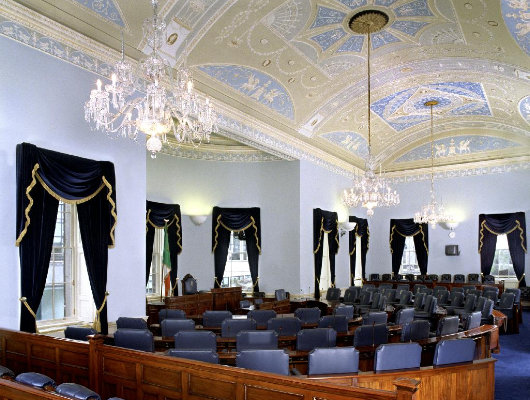
Ireland’s senate is a curious creature. Its first members were co-opted & appointed and these included seven peers, a dowager countess, and five baronets and knights, twenty-three Protestants, and a Jew. Among this cast of characters were W. B. Yeats, General Sir Bryan Mahon, and the physician-poet-author Oliver St. John Gogarty. In 1937, however, the Seanad Éireann took its current form, and since the abolition of the Bavarian upper house in 1999, the Seanad is (so far as my research can discover) the last corporately organised parliamentary body in Europe.
There are sixty members of the Irish senate, who are chosen by a variety of means. (more…)
Austin Reed
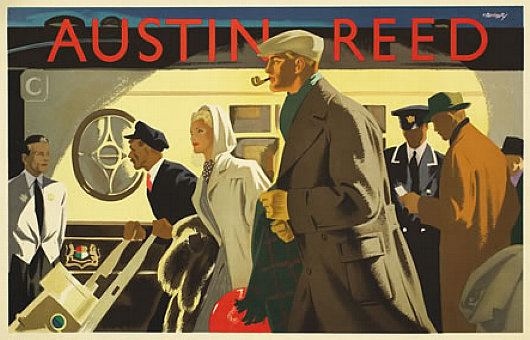
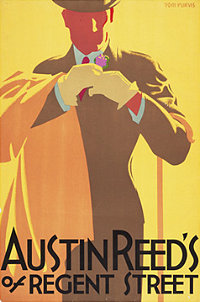 The London mens’ clothier Austin Reed was founded in 1900 and set up shop in Regent Street in 1926 as the first men’s department store. The clothes were aimed at the upper middle class male, and the firm commissioned some of the best illustrator-designers of the day to promote its brand. The above poster, “Wagon-Lits”, is by a designer named Bomarry, about whom I can find absolutely nothing — surprising in this Age of Google.
The remaining posters presented here are from the Bristol-born Tom Purvis, one of the finest commercial artists of the twentieth century. Purvis came from an artistic family, being the son of the sailor & nautical artist T. G. Purvis. Much of his output was work for LNER — the London & North Eastern Railway — producing posters advertising the various attractions to be found along the LNER’s routes from London to Edinburgh (via York & Newcastle) and on to Aberdeen and Inverness; the railway also had an extensive coverage of East Anglia. In 1936 he was among the first to be given the title of Royal Designer for Industry, but he gave up poster design after the Second World War to concentrate on portraits and religious themes. (more…)
Black Rod — Swart Roede
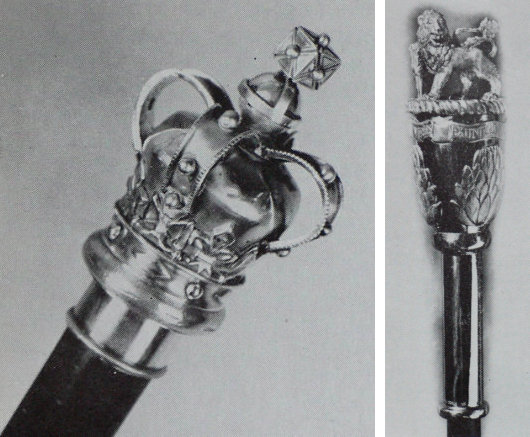
In my post on the 1947 Royal Visit to Cape Town, I mentioned just in passing the title of the Draer van Swart Roede — or the Gentleman Usher of the Black Rod, as he is known in English. Well, here is the Black Rod itself. The original South African Black Rod (left) dates from the Parliament of the Cape of Good Hope and was adopted as the Black Rod of the Union Parliament when South Africa was unified in 1910. After the abolition of the monarchy in 1961, a new Black Rod (right) was commissioned which featured protea flowers topped with the Lion crest from the South African coat of arms.
Black Rod (the person, not the staff) was the Senate’s equivalent of the House of Assembly’s sergeant-at-arms (ampswag). The first Gentleman Usher of the Black Rod in history was appointed in 1350 and the position still exists today in the British Parliament of today. Black Rod is sergeant-of-arms of the House of Lords, as well as Keeper of the Doors. The Usher’s best-known role is having the doors of the House of Commons ceremonially slammed in his face when he acts as the Crown’s messenger during each State Opening of Parliament, a ritual derived from the 1642 attempt of Charles I to arrest five members of parliament.
In South Africa, die Swart Roede traditionally wore wore a black two- or three-pointed cocked hat, a black cut-away tunic, knee breeches, silk stockings and silver-buckled shoes, but this costume of office has undergone a process of modernisation since the 1950s. After the vast expansion of the electorate in 1994 and introduction of an interim constitution, Black Rod’s title was officially shortened to “Usher of the Black Rod” to make it “gender-neutral”. (Regrettably, the Canadian Senate has also mimicked this innovation, though it is often unofficially ignored.) When a new, permanent constitution was enacted in 1997, the Senate was replaced by the National Council of Provinces as the upper house of parliament. A new Black Rod (the staff, not the person) was introduced in 2005, but is of such a garish design that it is best left uncommented upon.
Recent Promulgations from the Holy See
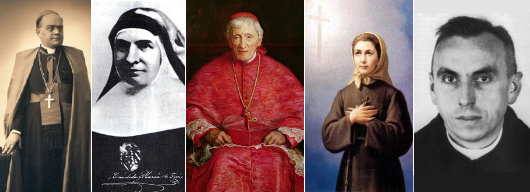
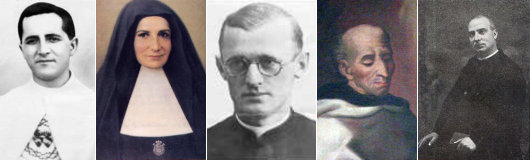
Decrees recently promulgated in the Vatican move sixteen candidates for sainthood forward in their cause. The most famous of the twelve is the English cardinal & convert from Anglicanism, John Henry Newman (above, center). A miracle attributed to the intercession of Cardinal Newman has been accepted by the Congregation for the Causes of the Saints. The Congregation has also accepted individual miracles attributed to the intercession of: Blessed Cándida Maria de Jesús Cipitria y Barriola (above, second from left; 1845-1912), the Spanish founder of the Congregation of the Daughters of Jesus; the Servant of God Angelo Paoli (below, second from right; 1642-1720), an Italian Carmelite priest; the Servant of God Maria Alfonsina Danil Ghattas (1843-1927), a cofounder of the Congregation of the Sisters of the Most Holy Rosary of Jerusalem.
Eight martyrs were proclaimed in the recently-promulgated decrees: all of them of the twentieth century and all of them victims of totalitarianism. Fr. Teófilo Fernández de Legaria Goñi (below, far left) and four companions (all professed priests of the Congregation of the Sacred Hearts of Jesus and Mary), as well as the diocesan priest Fr. José Samsó i Elías (below, far right), were all killed by the Communists in 1936 during the horrible persecution of the Church during the Spanish Civil War. Fr. Georg Häfner (above, far right), a German diocesan priest, was killed in the concentration camp of Dachau in 1942 under the Nazi regime. Bishop Zoltán Lajos Meszlényi (above, far left), an auxiliary bishop of Esztergom, was killed at Kistarcsa in Hungary by the Communist authorities in January 1953.
Proclamations of heroic virtue — the first step on the road to being recognised as a saint — were issued for: Fr. Engelmar Unzeitig (below, center; 1911-1945), a German priest of the Mariannhill missionaries; Anna María Janer Anglarill (below, second from left; 1800-1885), the Spanish founder of the Institute of Sisters of the Holy Family of Urgell; Maria Serafina del Sacro Cuore di Gesu Micheli (1849-1911), the Italian founder of the Institute of Sisters of the Angels; Teresa Manganiello (above, second from right; 1849-1876), an Italian laywoman of the Third Order of St. Francis.
The Band-leader & the Sergeant-Major
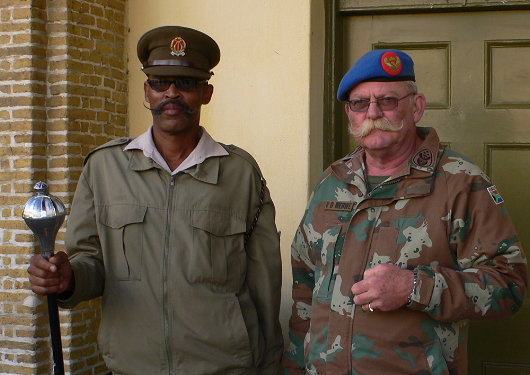
I came across these two characters in the Castle in Cape Town, the oldest building in South Africa and still home to the Cape Town Highlanders and Cape Garrison Artillery.
The Prime Minister of China who became a Benedictine Abbot
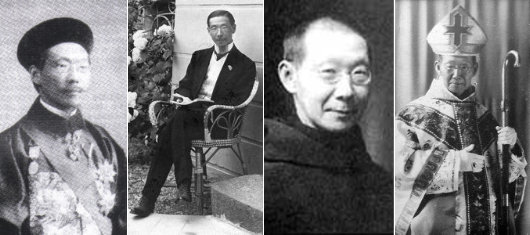
CHRISTIANITY HAS A LONG and varied history in China stretching over at least one-and-a-half millenia. The ancient country has even had Christian leaders, such as the Congregationalist founder of the Chinese Republic, Sun Yat-sen, and his Methodist successor, Gen. Chiang Kai-shek (head of the Kuomintang for nearly forty years). Still, until I read this fascinating story in the Catholic Herald I had no idea that there was a Prime Minister of China, Lou Tseng-tsiang (陸徵祥), who ended his days as a Benedictine monk by the name of Dom Pierre-Célestin. Lou was born a Protestant in Shanghai in 1871, but married a Belgian woman and eventually converted to Catholicism. Serving his country in the diplomatic arena, he accomplished extensive reforms of the Ministry of Foreign Affairs, avoided becoming part of any of the various factions that divided the government, and was one of the founding members of the Chinese Society of International Law. Lou bravely stood up to the indignities imposed upon China through the 1919 Treaty of Versailles by refusing to sign the shameful document which sewed the seeds of future disaster.
Xu Jingcheng, Lou’s mentor and sometime Ambassador to the Court of the Tsars in St. Petersburg, instructed the up-and-coming diplomat that “Europe’s strength is found not in her armaments, nor in her knowledge — it is found in her religion. … Observe the Christian faith. When you have grasped its heart and its strength, take them and give them to China.”
After the death of his wife, Lou became a Benedictine monk at the abbey of Sint-Andries in Flanders, and was eventually ordained a priest in 1935. A decade later, Pope Pius XII — who cared deeply for the Church in China and finally settled the long-standing dispute over Chinese ancestor-honouring rituals in favour of the practices — appointed him titular abbot of the Abbey of St. Peter in Ghent. Sadly, the Chinese Civil War prevented Dom Pierre-Célestin from returning to China, and he died in Flanders in 1949.
The words of Lou’s mentor that Europe’s strength is her faith found recent confirmation from Professor Zhao Xiao, a prominent Chinese economist at the University of Science & Technology Beijing. Prof. Zhao, a member of the Chinese Communist Party, began studying the differences between the economies of Christian societies and those of non-Christian societies. As a result of his investigations, he argued that Christianity would provide a “common moral foundation” for China that would help the economy by reducing corruption, narrowing the gap between rich and poor, preventing pollution, and promoting philanthropy.
“A good business ethic or business morality,” Prof. Zhao says, “can provide for a type of motivation that transcends profit seeking. Why do people want to do business? The main goal would be to earn money. The purpose of a company is to maximize profits. But this can cause companies to look for quick results and nearsighted benefits. It can cause companies to disregard the means and earn money at the expense of destroying the environment, society and the livelihood of others, or endangering the entire competitive environment of the trade.”
“If my motivation for doing business is the glory of God, there is a motivation that transcends profits. I cannot go and use evil methods. If I used some evil methods to enlarge the company, to earn money, then this is not bringing glory to God. Therefore, this is to say that it [bringing glory to God] can provide a transcendent motivation for business. And this kind of transcendental motivation not only benefits an entrepreneur by making his business conduct proper but it can also benefit the entrepreneur’s continued innovation.” (more…)
Heaven in Herefordshire
In the weekly South African edition of the Telegraph, I came across a brief note marking the death of England’s oldest publican, Flossie Lane of ancient Leintwardine in Herefordshire. From the internet, I find the full version of her obituary, which is reproduced below. The Sun Inn, with its “Aldermen of the Red-Brick Bar” sounds like a splendid haven.
Flossie Lane, who died on June 13 aged 94, was reputedly the oldest publican in Britain, and ran one of the last genuine country inns
For 74 years she had kept the tiny Sun Inn, the pub where she was born in the pre-Roman village of Leintwardine on the Shropshire-Herefordshire border.
As the area’s last remaining parlour pub, and one of only a handful left in Britain, the Sun is as resolutely old-fashioned and unreconstructed today as it was in the mid-1930s when she and her brother took it over.
According to beer connoisseurs, Flossie Lane’s parlour pub is one of the last five remaining “Classic Pubs” in England, listed by English Heritage for its historical interest, and the only one with five stars, awarded by the Classic Basic Unspoilt Pubs of Great Britain.
She held a licence to sell only beer – there was no hard liquor – and was only recently persuaded to serve wine as a gesture towards modern drinking habits.
With its wooden trestle tables, pictures of whiskery past locals on the walls, alcoves and a roaring open fire, the Sun is listed in the CAMRA Good Beer Guide as “a pub of outstanding national interest”. Although acclaimed as “a proper pub”, it is actually Flossie Lane’s 18th-century vernacular stone cottage, tucked away in a side road opposite the village fire station.
There is no conventional bar, and no counter. Customers sit on hard wooden benches in her unadorned quarry-tiled front room. Beer – formerly Ansell’s, latterly Hobson’s Best at £2 a pint – is served from barrels on Flossie Lane’s kitchen floor. (more…)
A humble house in Buenos Aires
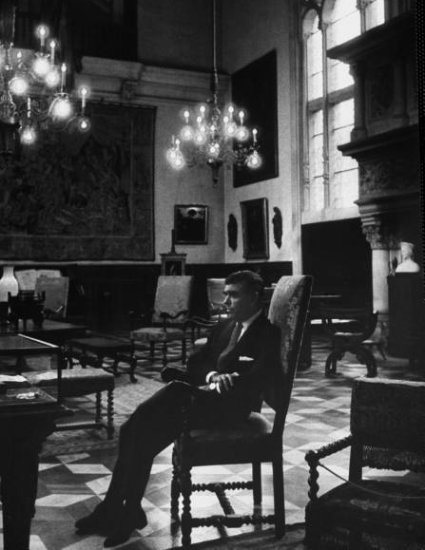
Landowner Ignacio Pirovano rests in his family’s Buenos Aires townhouse, 1964.
L’etoile du Nord
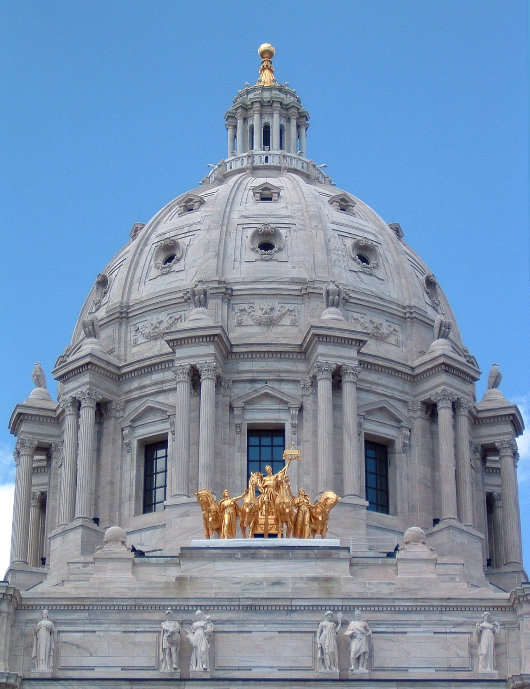
The dome of the Minnesota State Capitol, one of the finest government buildings in the New World.
Homage to Jean Seberg
 One of the earnest stalwarts of the blog was wandering around the Metropolitan recently when he came upon this curious “multi-media art work” by Barbara Bloom entitled Homage to Seberg. Bloom is a photographer, designer, and “installation artist” who was the subject of her own show at the International Center of Photography last year. This work was created in 1981 and forms part of the temporary exhibition “The Pictures Generation” at the Metropolitan Museum of Art.
The installation includes a copy of the Herald Tribune, the newspaper sold by Jean Seberg’s character in the 1960 Godard film À bout de souffle, resting one of the butterfly chairs so popular during the 1960s. Readers will remember Jean Seberg & the Trib from our post on the continued decline of the International Herald Tribune and the follow-up from the Guardian‘s media blog.
What I didn’t know was that Ms. Seberg was American, Iowa-born, and a supporter of the Black Panthers. Sadly, she died in Paris in 1979 of an overdose of barbiturates and alcohol in an incident the French authorities ruled a probable suicide. (more…)
Lord Clark
This clip of Kenneth McKenzie Clark, Baron Clark, OM, CH, KCB, FBA is from the end of his BBC documentary series Civilisation. Here Lord Clark complains about the lack of a true center, as he then could see none. Thankfully, Lord Clark found that center shortly before the end of his life, and was received into the Catholic Church.
“The great achievement of the Catholic Church,” said Lord Clark in Civilisation, “lay in harmonizing, civilising the deepest impulses of ordinary, ignorant people.”
Our Cardinal at the Oratory
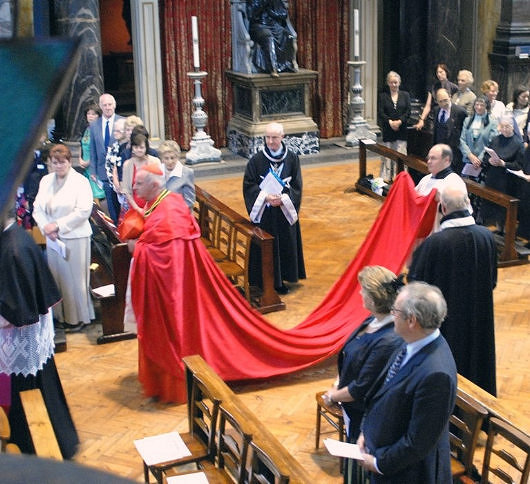
His Eminence Keith Patrick O’Brien, Cardinal Archbishop of St Andrews & Edinburgh, at the Brompton Oratory for the Feast of St. John the Baptist this year.
(From the NLM)
First Things, Three Songs
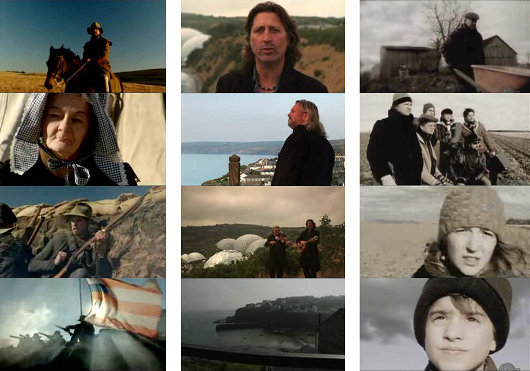
Through an interesting post by Joseph Bottum on the First Things blog, I discover that R. R. Reno posted all three of the songs I elaborated upon in my June 2007 post “We’ve Lost More Than We’ll Ever Know”, though (so far as I can tell) he arrived at the same three without stumbling across my entry on them. I always read First Things in New York (it’s one of my favourites, and simply a must-read), but it’s sadly not available in South Africa (bar actually scraping one’s pennies together for a subscription) so I’ll just have to wade through friends’ archives when I return to the Empire State. (Or does the Society Library have a subscription? And if not, why not?).
While it has a reputation among some Catholics as being a bit too liberal & democratist, I suspect the whiff of Americanism one finds in the pages of First Things is akin to the aroma of tobacco in an old bar: the smell lingers but that doesn’t mean anyone’s actually still smoking. Nonetheless, they often feature top-notch articles and writing that are of interest to Catholics & other traditionalists.
Of tribes and traditions
In tribal Africa, Ghaddafi expounds traditional government; Meanwhile ethnic Romanians vote to be ruled by their German neighbours.
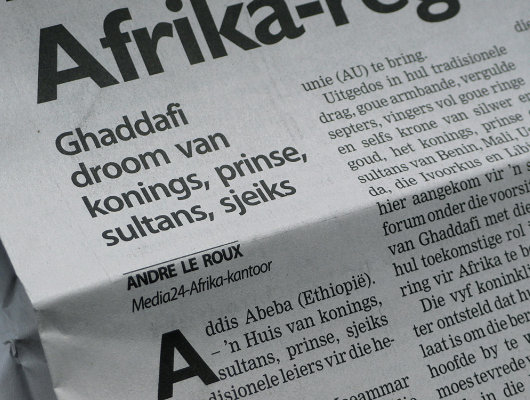
«Ghaddafi dreams of kings, princes, sultans, sheiks»
reports the Afrikaans newspaper Die Burger.
ONE OF THE LESS-REPORTED aspects of the selection of Col. Moammar al-Ghaddafi, the tent-dwelling Libyan leader and notorious eccentric, as Chairman of the African Union was his proposal that an upper house of “kings, princes, sultans, sheiks, and other traditional leaders” be added to the Pan-African Parliament. Col. Ghaddafi has been forthright in his condemnation of democracy as ill-suited to the African continent. “We don’t have any political structures [in Africa], our structures are social,” he explained to the press. Africa is essentially tribal, the argument goes, and as such multi-party democracy always develops along tribal lines, which eventually leads to tribal conflict and warfare. “That is what has led to bloodshed,” the AU chairman posited, citing the recent example of the Kenyan elections.
Europe, of course, solved the matter of tribal difficulties by brutally uprooting long-established peoples from their native lands after the Second World War and transferring them to jurisdictions in which they would ostensibly be part, not only of the majority, but of theoretically “national” states. Cities with centuries of Polish history became Soviet, towns as German as sauerkraut became Polish, and so on and so forth. Sometimes the undesired populations of multi-ethnic places were cruelly murdered, as recent revelations from the police in Bohemia have shown.
Still, remnants of the old cosmopolitan order remain. (more…)
Quebec Stamp
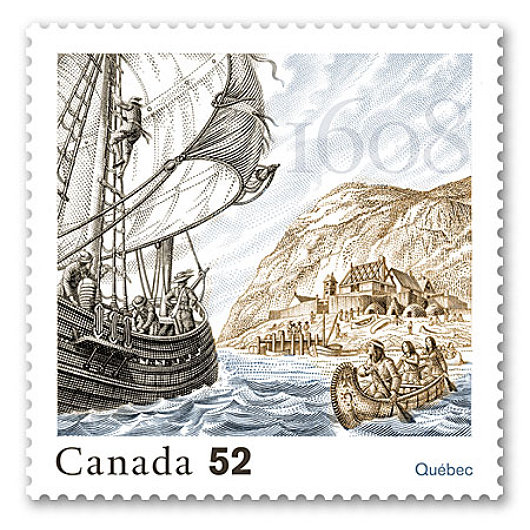
This stamp was designed by Jorge Peral, the artistic director of the Canadian Bank Note Company, for Canada Post to commemorate the four-hundredth anniversary of the foundation of Quebec.
Nature diary
by ‘REDSHANK’
St John’s Day, Midsummer Day, has come and gone, bringing to the nature diarists’ community, as the country folk call us, melancholy thoughts of the inexpugnable passage of time and of the already declining year. In our neighbourhood, St John’s Eve is a time when age-old customs, elsewhere, alas, confined to the mists of antiquity, still flourish even in these prosaic days.
 Young men and maidens, not to speak of some in neither category, forsake their clubbing to dance in the woodland glades, undeterred by ghostly commercial travellers, doomed to play solo whist among the trees for all eternity, who scarcely interrupt their play to hurl traditional insults from another world.
It is different with the watercolourists who, following another ancient custom, come trooping out from the neighbouring town to set up their easels in the woods, industriously sketching everything they see, including the indignant dancers. Many of them are retired schoolteachers recommended “remedial art therapy” by their psychiatrists, distressed gentlefolk and ordinary people lately released into the community.
All take their orders from the big, ginger-haired old fellow who seems to be their leader. From my library window I watched through powerful field glasses as he rallied them amidst the dancers, lashing out with outsize paintbrush or sharp-edged paintbox and generally giving as good as they got.
He encouraged them, too, with anecdotes of eminent painters he seems to have known well: how he and Turner saw off a gang of criminal art dealers in Petworth Park; how he and Edward Lear, attacked by bandits while painting in Albania, put them to flight by endlessly repeating Lear’s limericks.
The village folk regard him with superstitious awe. He lives, so the talk goes in the Blacksmith’s Arms, in a rambling old mansion “way out t’ other side o’ Simpleham Great Park”. He is said to be a “gurt old ‘un for t’ book learnin’.” Some say he is writing a “Book of All Known Knowledge”. Some say he is the king of all nature diarists. All believe he is a powerful enchanter.
When I called at the inn the other day, there was an animated discussion about him, carried on, of course, in the genuine old British Composite Pandialect. Jack, the retired poacher told how, when laying a trail of sultanas to trap pheasants, he had seen the big man sitting in his enchanted garden, where creatures of the wild, deemed to be extinct in other parts of England, came to his call: the speckled linnet, the ringed dotterel, the corncrake and the wolf. Jack swore he had once seen an Andean condor perching on the enchanter’s shoulder and whispering secrets in his ear.
Old Frank the waspkeeper, who has a tendency to live in the past, and contributes a “Wasp at War” feature to the local newspaper, thinks the master watercolourist is a German or even Japanese spy, using watercolours to signal to enemy airmen. All believe he and his watercolourists are creatures of ill omen, and that to speak to them brings misfortune.
Though I am inclined to smile, I am sure there is a profound rural wisdom here, far beyond the grasp of your average know-all urban intellectual.
Search
Instagram: @andcusack
Click here for my Instagram photos.Most Recent Posts
- Brunel’s Unbuilt Capitol February 3, 2026
- Cricket at Fordham January 27, 2026
- Palacio Barolo Revisted January 14, 2026
- Learning to Love Liguria January 14, 2026
- Crux Alba No. 2 January 13, 2026
Most Recent Comments
Book Wishlist
Monthly Archives
Categories