About Andrew Cusack
 Writer, web designer, etc.; born in New York; educated in Argentina, Scotland, and South Africa; now based in London.
 read more
News
Blogs
Reviews & Periodicals
Arts & Design
World
France
Mitteleuropa
Knickerbockers
Argentina
The Levant
Africa
Cape of Good Hope
Netherlands
Scandinavia
Québec
India
Muscovy
Germany
Academica
‘The Tolstoy of Transylvania’
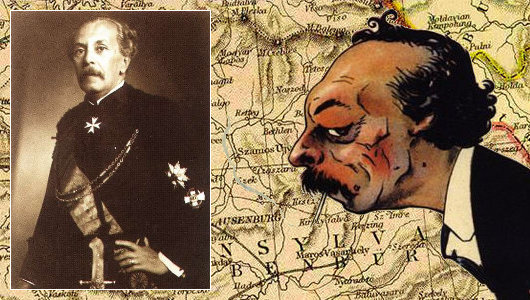
In his column in the Daily Telegraph, former editor Charles Moore praises Miklos Banffy as ‘the Tolstoy of Transylvania’. Ardent Banffyites like myself are always pleased when the Hungarian novelist gets attention in the English-speaking world, which happens all too rarely. I can’t remember how on earth I stumbled upon the works of Banffy, probably through reading the Hungarian Quarterly, a publication that — covering art, literature, history, politics, science, and more — is admirably polymathic in our age in which the specialist niche is worshipped.
To put it simply, Banffy is a must-read. If you love Paddy Leigh Fermor’s telling of his youthful walk from the Hook of Holland to Constantinople (the third and final installation of which we still await), then Miklos Banffy will be right up your alley. Start with his Transylvanian trilogy — They Were Counted, They Were Found Wanting, and They Were Divided.
The story follows two cousins, the earnest Balint Abady and the dissolute László Gyeroffy, Hungarian aristocrats in Transylvania, and the varying paths they take in the final years of European civilization. The novels “are full of love for the way of life destroyed by the First World War,” Charles Moore points out, “but without illusion about its deficiencies.”
Three volumes of nearly one-and-a-half thousand pages put together, they make for deeply, deeply rewarding reading, transporting you to the world that ended with the crack of an assassin’s bullet in Sarajevo, 1914.
After finishing his trilogy, Banffy’s autobiographical The Phoenix Land is worthwhile; some of the real events depicted shadow those in the fictional novels. As previously mentioned, it contains a description of the last Hapsburg coronation (that of Blessed Charles) and numerous amusing tales.
After that, I’m afraid you will have to learn Hungarian, which I have neglected to do, as no more of this author’s oeuvre has yet been translated into English.
When an American aristocrat meets a European Grand Duke
Mother Margaret Georgina Patton, OSB of Regina Laudis Abbey in New England is the daughter of Gen. George S. Patton IV and granddaughter of the famous Gen. George S. Patton III. Mother Patton remembers being introduced to the Grand Duke of Luxembourg when she was but five years of age. At the instruction of her parents, she spent a week practicing her curtsey. When the moment finally came and she was brought before His Royal Highness, she looked him over, and stuck out her hand. The young girl had expected a crown, and, seeing none, thought a regular old handshake would do.
The elder Gen. Patton did have a connection to the Abbey himself. “General George Patton, Sr., liberated France as the commanding general of the Third Army,” explains Mother Delores Hart (the former film actress, and only nun among the members of the Academy of Motion Picture Arts & Sciences). “His was the army that liberated Jouarre, the abbey where Mother Benedict was in hiding.” Mother Benedict Duss founded the Abbey of Regina Laudis after the war, and died at the ripe age of 94.
“This connection continues through the whole Patton family to this day,” Mother Delores continued. George S. Patton V lives close to the Abbey in Connecticut, with his brothers Robert H. Patton in nearby Darien, and Benjamin Wilson Patton in New York, while their sister Helen lives in Saarbrücken, Germany.
General Patton père died in a car accident in Germany, but his son followed in his footsteps by choosing a career in the army. When his daughter Margaret, the future nun, was born, he was fighting in the wilds of Vietnam. Nonetheless, General Patton fils felt compelled to write a letter to his newborn daughter, introducing himself from abroad. He ended it simply “Play it cool” and signed his full name.
It’s no wonder that Margaret joined Regina Laudis, a community of Benedictines in full, traditional habits, as she came from a well-dressed family. General Patton père designed his own uniforms and even the family of the younger general continued the tradition of dressing for dinner, “despite the trend toward informality that was sweeping the nation” as the Patton Saber puts it. The old habits are returning — any bets on when folks will start dressing for dinner again?
Joyce Linton: The Lady with the Voice

Yesterday, in a beautiful sung requiem at St. Agnes, we paid our final respects to our friend Joyce Linton. I had known Joyce for quite some time before I ever actually met her because we tended to sit in the same neighborhood of pews (in the back of the church towards the left) at the 11 o’clock Mass at St Agnes every Sunday. While a schoolteacher by profession, she was also a trained vocal musician, and her voice carried as the congregation belted out our Credos and Glorias. She became known to me as “the Lady with the Voice”, and every so often I would see her making her way towards the church just before 11:00 and, without knowing her name, I would say to myself “That’s the Lady with the Voice”.
Eventually, I got to know Joyce well, and joined the regular tea-drinking crowd of which she was a devoted and prominent member. Vim. Moxie. Determination. Those are the words that come to mind when I think about Joyce, a spirited lady if ever there was one. But she was, also, a woman with a certain style. Think of 1950s New York, swanky, bright, and modern, but still traditional, and never out of date. That was Joyce.
Now, if there was one thing that undoubtedly went along with Joyce’s vim, moxie, and determination, it was that she had an opinion. She enjoyed a vibrant discussion and the interaction of ideas, but she made certain that even if you didn’t happen to share her opinion, you would at least be familiar with it. As it happens, Joyce and I were lucky enough to agree with one another on many things, but by no means all things. More than once did I attempt to refute her position on this, that, or another thing. After the back-and-forth had exhausted itself, she would say, “Well, I don’t think it’s quite as simple as that”, I would shrug my shoulders and say “Perhaps”, and we would sip our tea and rejoin the larger conversation.
She was a woman who was grateful for the graces in her life. She was grateful for the blessings of her family, though it was not without hardships. She was grateful for the magnificent inheritance of centuries of art and culture she was born on the receiving end of. She was a patriot if ever there was one — a proud American, but one with a devoted filial love of Europe, and especially of Italy.
I think the first time Joyce visited Italy was when she did her voice studies in Florence in the 1970s, and she never stopped going back. She had a devotion to Padre Pio and paid her respects to the great saint by pilgrimming to San Giovanni Rotondo. Towards the later years of her life she had a special love and appreciation for summer days spent at Gardone on the shores of Lake Garda, enjoying the intellectual stimulation of the annual summer symposium organized by the Roman Forum. The Italian airs invigorated her Celtic blood and she would return to New York in late summer rejuvenated and refreshed.
She always knew lots of things about New York. You can get great freshly baked bread here. They do a good brunch there. If you really want to do X, then you’ve got to Y at Z on Nth Street. I remember one drizzly November Sunday afternoon Joyce showed me “the best way to cut through Saks” as she and I made our way to the annual Choral Evensong & Flag Service for the Patriotic, Historical, and Hereditary Societies at the Church of St. Thomas, Fifth Avenue.
Joyce loved her job as a high school teacher at Manhattan Center on the Harlem River, just a few doors away from Our Lady of Mount Carmel on 115th Street. Any and all bureaucratic encroachments upon the teaching profession were vociferously opposed by her, and she had an enormous pride when her students did well (especially her girls). Latin was another excuse to spend time in Italy, where she studied the language under the famous Fr. Reggie Foster in Rome. She taught English as well, and was adamant that her students learn important lessons from writers like Orwell and Wilde, rather than a rote set of facts or ideas or quotes. She was always on the lookout for a new way of explaining the old truths to the students in her charge. She loved them, but she also loved her colleagues, and more than once had us praying for this one or that one.
When she was first diagnosed with cancer, many of us prepared ourselves mentally for The End. I think Joyce said to herself “Well I’m not having any of that.” She beat it the first time round (remember what I said about vim, moxie, determination?) to the surprise of many, probably her devoted doctor most of all. She went back to work, and her own hair grew back, allowing her to dispense with the peppy wig she had specially styled. Life, it seemed, returned to normal, for one last Halcyon day before the Hour approached. When the time did appear on the horizon, her descent was rapid. I’m glad I had a chance to see her one last time, surrounded as she was by friends in Lenox Hill Hospital.
Joyce would have loved her requiem, the priest in mournful black trimmed by resplendent gold, acolytes and torch-bearers aiding in the sanctuary, the Dies Irae rising from the choir loft, and those who knew and loved her pleading God’s mercy and quick remission of her earthly transgressions. It was beautiful — as the most beautiful things are — because it pointed towards that Heavenly place from whence our only glories come, where we pray “the Lady with the Voice” will enjoy perpetual light and rest eternal.
Requiescat in pace.
Amen.
From Parking Places to People Spaces
Transforming a Suburban Parish into a Traditional Neighborhood

The widespread unsightliness of suburban development in the United States is one of the most significant counts one can hold against the country. The earliest suburbs, or indeed any that are pre-war, came out fairly well by contrast. One of the pleasures of living in Westchester is our system of verdant parkways (from the inter-war period) with arched stone bridges spanning the little creeks and carrying local thoroughfares over the road. The transformation of Long Island, after the Second World War, from countryside to row after row of mass-produced cookie-cutter homes was disastrous. (Levittown is my personal vision of Hell — identical homes completely divorced from any sense of livable social order.) Post-war suburban development combines ugliness, boringness, and an astonishing misuse of available land. Erik Bootsma, however, here presents a model proposal of how to transform the medium-sized property of a modern suburban parish church in Virginia into a small, livable neighborhood. (more…)
Brother Ursus of Blackfriars, Oxford
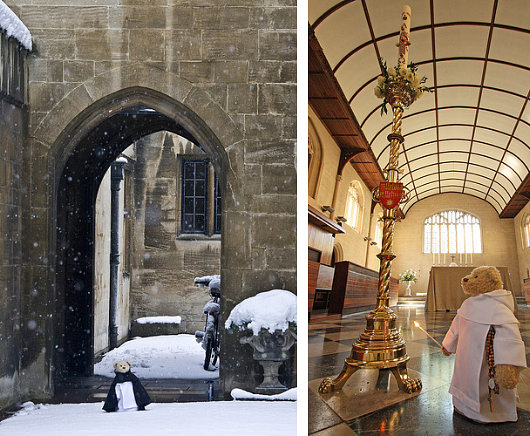
Left, contemplating the winter snow. Right, contemplating how the deuce a bear of his particular stature can light the Easter candle.
La Grande Séduction
This is a perfectly charming film. “La Grande Séduction” comically celebrates the dignity of work and the assault on the human character that inevitably results from reliance upon government welfare for survival. The inhabitants of the small fishing village of Ste-Marie-La-Mauderne have refused to abandon their homes after the collapse of fishing, but lack the resident doctor a potential investor requires in order to build his factory in the town. “La Grande Séduction” (released in Anglophone cinemas as “Seducing Dr. Lewis”) depicts the efforts of prominent townsfolk to unite and persuade the arrogant city-slicker Dr. Lewis to sign up as doctor for their little corner of the world.
Fans of “Local Hero” or “Waking Ned Devine” will find the theme familiar, but with a remote corner of maritime Quebec substituting for the Celtic hinterlands of the British Isles. If anything, the film allows the viewer an opportunity to hear that charming Québécois back-country accent. There are also elements that will grate somewhat the prudish tendencies of Anglos like us, but one must make allowances for the Latin temperament that survives in la Nouvelle-France and the other Romance realms.
Overall, a celebration of place, work, and community, and an interesting exploration of the conflict between artificiality and authenticity.
Race Riots in South Africa’s Birthplace
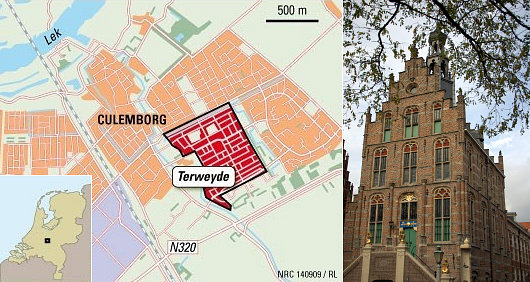
CULEMBORG in the Netherlands is the birthplace of Jan van Riebeeck, the Dutch East India Company bureaucrat who founded Cape Town, and thus in a sense the city is the birthplace of South Africa. That country’s had more than its fair share of racial tensions, but NRC Handelsblad reports that race riots recently erupted in Holland’s Culemborg. The rioting was not between Dutchmen and foreigners but rather between Moroccan and Moluccan youths in the district of Terweijde.
“It’s typical of ‘young male syndrome’ says a riot-expert with 25 years experience,” the article informs us. There’s rather something of Peter Simple in referring to a “riot expert with 25 years experience”. In NRC’s case, they are referring to behavioural scientist Otto Adang, but one could easily imagine Michael Wharton referring to a football hooligan or some other ne’er-do-well as “a riot expert with 25 years experience”.
The End of India Street
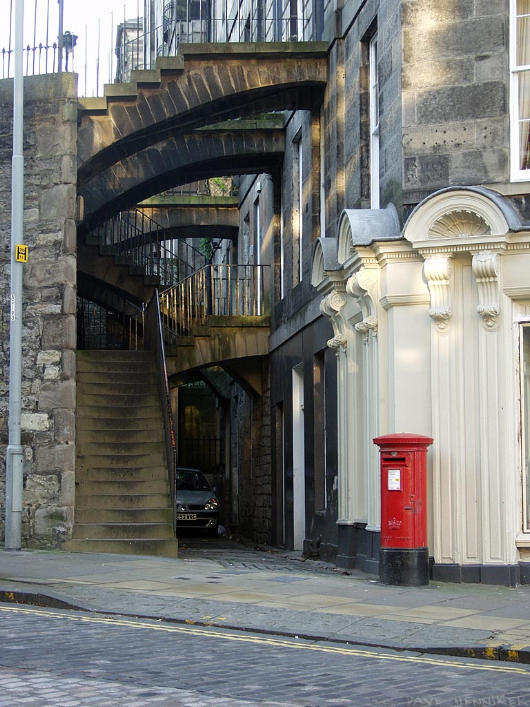
Photograph by Dave Henniker.
Life in the Cape
Some Selections from the Work of Photographer Bernard Bravenboer

Bernard Bravenboer is a Stellenbosch photographer whose website I stumbled across some time ago. In their vivacity and their variety, Meneer Bravenboer’s photographs capture something elemental about life in the Cape. Here are some selections from his work. (more…)
The Roman Forum
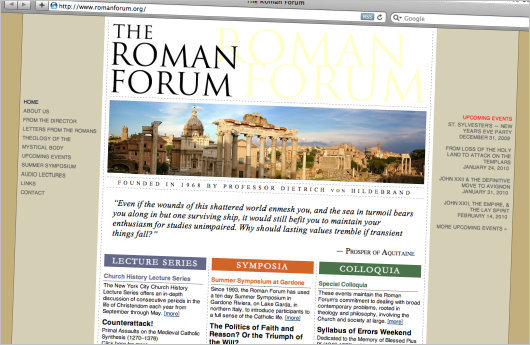
Over at The Hermeneutic of Continuity, Fr. Finigan points out the website of the Roman Forum, which (as it happens) was recently renovated by none other than yours truly. The Roman Forum is an excellent institution which organizes a church history lecture series here in New York, special colloquia such as the Syllabus of Errors weekend I recently attended, and of course its renowned Summer Symposium every year at Gardone on Lake Garda in Italy.
The theme of this year’s symposium is The Politics of Faith and Reason? Or the Triumph of the Will?. The list of illustrious names who will be in attendance this coming summer is indeed impressive: Jamie Bogle, the Chesterton Society’s Dale Ahlquist, Msgr. Barreiro, the Spanish jurist Miguel Ayuso, James Kalb, “Front Porcher” John Médaille, and Fr. Richard Trezza, who often says the old Mass at St. Agnes in New York on Sundays. And my friend Josh Copeland will be singing.
Each day involves three lectures (morning and before dinner), with sung Mass at noon, and musical and theatrical entertainments take place in the evenings after dinner. For years I’ve heard testimony from Gardone-goers about how enlightening, entertaining, and fun these ten-day symposia are, but I’ve not yet been able to attend myself.
The Roman Forum’s events are among the splendid outposts of civilization that preserve the animated spirit of the Faith so aptly captured by Hilaire Belloc’s lines: “Wherever the Catholic sun doth shine / There’s always laughter and good red wine.” I hope some of our readers will take a gander at their site and consider attending some of the numerous events they organize.
Hapsburg Hebraica
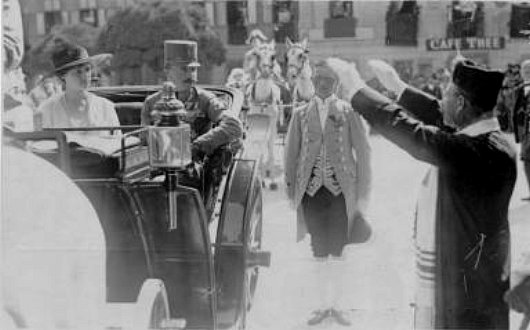
After the passing of the Hapsburg empire, which had been so protective of its Jewish subjects (especially compared to the regimes which succeeded it), numerous prominent Jews were received into the Catholic faith, perhaps having come to a full appreciation of precisely what they had lost. The subject of “Literary Jewish Converts to Christianity in Interwar Hungary” is worthy of further investigation (some graduate student should write a dissertation on just such a matter). I am no longer surprised when, in my researches, I come across yet another fascinating Hungarian Jew — be he a writer, playwright, poet, or patron — and discover, usually buried in some footnote, that he died a good Catholic.
Chartres 2009
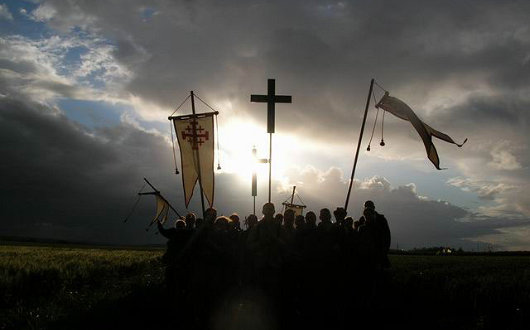
While there are but a few days to go, I can’t let this year depart without finally showing you photos of the 2009 Paris-Chartres pilgrimage which takes place every year on the weekend of Pentecost. (See 2008, 2005, 2004). The theme for the upcoming 28th Pilgrimage from Notre-Dame de Paris to Notre-Dame de Chartres was recently announced by the Association Notre-Dame de Chrétienté which organises the event. The 28th Pilgrimage will take place on the 22nd, 23rd, and 24th of May 2010, with the theme “The Church is Our Mother”. The themes for the individual days will be: 1) Teaching, under the patronage of St. Peter; 2) Sanctifying, under the patronage of St. Jean Vianney, the Curé d’Ars; 3) Governing, under the patronage of St. Pius X.
The following photos, however, are compiled from various sources, and show the pilgrimage which took place this past Pentecost. (more…)
La Bandiera dell’Io Amo L’Italia

In most countries, the voter of sound mind and disposition is hard pressed to find a political party worthy of his vote. One of the charming aspects of Italy is that the inverse is true: there are usually at least half-a-dozen political parties worth voting for, sound in policies and public morals, though the more recent trend has been towards amalgamation. It nonetheless often seems that every Italian of public stature has, at some time or another, founded his own political party.
Readers will no doubt recall the Holy Father’s rather brave baptism of the Egyptian-born Italian journalist Magdi Allam during the Easter Vigil of 2008. Signore Allam has proven his Italicity by following the peninsular trend of founding one’s own political party. Founded as Protagonisti per l’Europa Cristiana (Protagonists for Christian Europe), Allam’s party is now known as Io Amo L’Italia (I Love Italy). The party has had an early success in that its founder was elected to the European Parliament in the most recent elections, and he caucuses with the Christian-democratic Unione di Centro in the continental assembly.
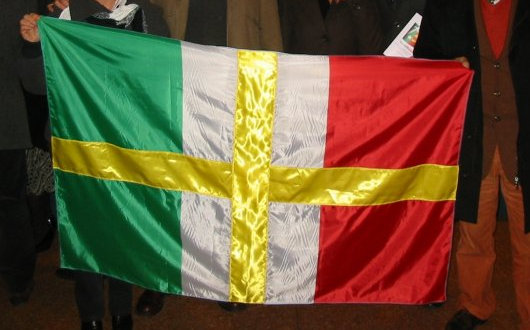
Anyhow, the relevance for us is that Magdi Cristiano Allam’s political party has adopted a “baptized” tricolore of its own: the green-white-red tricolour defaced (as is the proper vexillological term) with a simple golden cross the arms of which reach to the ends of the field. A very simple solution, and not half bad really. One of the party’s Facebook followers suggests having a tricolore with a Constantinian-style cross in the center, which is another not half bad idea.

In the Dublin auction houses
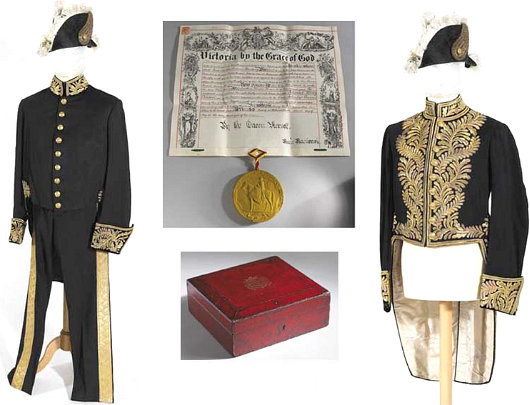
THOUGH THE BORING brains of tawdry metropolitan Londoners are all too quick at relegating Dublin to the provincial periphery of the mind, the Irish capital is a perpetual treasure trove for the old-fashioned and right-minded. A number of items of interests have recently been sold at the auction houses of the fair city, including two ceremonial uniforms (above) of that famous Dubliner, Sir Edward Carson QC. Carson was the lawyer and statesmen who passionately, but without bigotry, opposed the cause of Irish home rule. He was the defending barrister in the Archer-Shee case and led the Marquess of Queensberry’s team in Oscar Wilde’s doomed libel action. Carson and Wilde had been at Trinity together (where — little known fact! — Carson was a keen hurler), and the famous wit quipped of Carson “I trust he will conduct his cross-examination with all the added bitterness of an old friend.”
Having a fine mind for the law and being politically active meant that Carson moved through several layers of British government, holding numerous offices and positions. He was a Privy Counsellor twice over (of both Ireland and the United Kingdom), a Queen’s Counsel, served in the House of Commons as leader of the Irish Unionists, and held portfolios in the British Cabinet. The two ceremonial uniforms auctioned at Whyte’s of Molesworth Street are from his appointment as Solicitor General for England & Wales in 1900. (He had been Solicitor-General for Ireland in 1892, and was later Attorney General for England & Wales, in which position he was succeeded by the F.E. Smith of Chesterton’s famous poem).
The two black wool morning coats feature gold bullion trimming and buttons, and are sold with a pair of trousers with gold filigree stripe matching the lesser uniform, and knee breeches & silk stockings for the greater uniform. The vellum appointment as Solicitor General was also included, in a red leather box with a gilt impression of the royal arms. Whyte’s estimated a sale of €50,000-€70,000, but the lot’s realised price was €42,000. (more…)
The Oratory as It Was Built
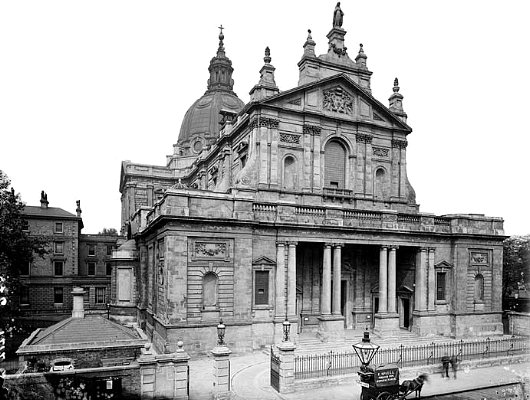
Since we explored Brompton Oratory as it might have been, here is the Oratory as it was built. The façade were finally completed in 1893 to a design by George Sherrin, with the dome following in 1894-95 by Sherrin’s assistant E. A. Rickards. How is the Oratory as depicted above different from the Oratory today? The fence and gates were replaced with a curved design at some date unknown to me, perhaps in response to a road-widening scheme.
Baptizing the Tricolore

THE RECENT RULING of the self-styled “European Court of Human Rights” that the presence of crucifixes in Italian schools is a violation of the rights of a non-practicing Lutheran from Finland has sparked a surge of outrage against European institutions in Italy, and indeed elsewhere. While (as Gerald Warner has reported), the Italian Constitutional Court has shown the proverbial two fingers to the ECHR judgement in a ruling of its own, one junior cabinet minister has a suggestion of his own. Roberto Castelli, Italy’s deputy minister for infrastructure and transportation, suggests the country should reassert its Christian identity by adding a cross or crucifix to the Italian flag.
“I believe,” Mr. Castelli said, “that Europe has the right to recognize its true identity that we are starting to lose completely.” Even the Minister of Foreign Affairs, the Freemason and ex-Socialist Franco Frattini, seemed amenable to the idea. “Nine European countries already have the cross on their flag,” Frattini pointed out. “It is an extremely common proposition.” (more…)
Stefan Beck Online
 Fans, foes, and other followers of that favoured son of Granby, Mr. Stefan M. Beck, can track his hoots, wails, and whinnies at this new locale. The site archives a number of Stefan’s writings as well as containing his food blog, where, most recently, you can investigate the Ulster fry. Past mentions of Beck can be found here, including my favourite mental image of “wearing a bearskin and sacrificing holly-crowned virgins to Wotan”.
The House of Assembly
Die Volksraad

The House of Assembly (always called the Volksraad in Afrikaans, after the legislatures of the Boer republics) was South Africa’s lower chamber, and inherited the Cape House of Assembly’s debating chamber when the Cape Parliament’s home was handed over to the new Parliament of South Africa in 1910. The lower house quite soon decided to build a new addition to the building, and moved its plenary hall to the new wing. (more…)
No. 82, Eaton Square
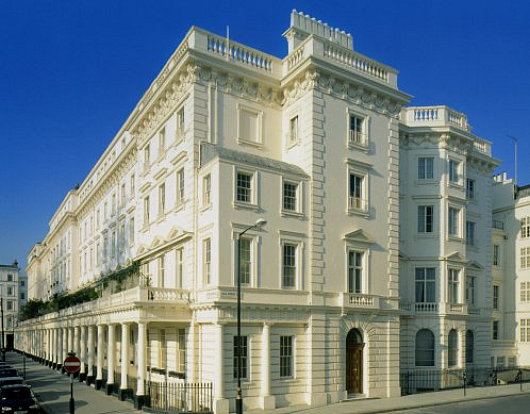
In it’s long history, the address of No. 82 Eaton Square in London has housed a Major-General of the East Indian Cavalry, a Lord Strafford, a Lord Bagot, an Earl of Dalhousie, an Earl of Clare, a Duke of Bedford, and Queen Wilhemina of the Netherlands — thankfully not all at once. It’s probably best know for its half-century as the Irish Club, a much-favoured drinking & smoking spot for the community of Gaels in London. The club was founded in 1947, with a number of pre-existing Irish clubs merging into it. George VI — grateful for the devoted service of the Irish who volunteered for his armed forces during the Second World War — heard that the club was in search of premises and asked the Duke of Westminster, one of the largest landowners in London, if he could help. The Duke provided the leasehold of No. 82 Eaton Square to the Irish Club for a nominal sum. (As it happens, the 4th Duke’s son served as a Unionist MP for Fermanagh & South Tyrone, and later in the Northern Irish Senate). (more…)
Search
Instagram: @andcusack
Click here for my Instagram photos.Most Recent Posts
- Brunel’s Unbuilt Capitol February 3, 2026
- Cricket at Fordham January 27, 2026
- Palacio Barolo Revisted January 14, 2026
- Learning to Love Liguria January 14, 2026
- Crux Alba No. 2 January 13, 2026
Most Recent Comments
Book Wishlist
Monthly Archives
Categories