About Andrew Cusack
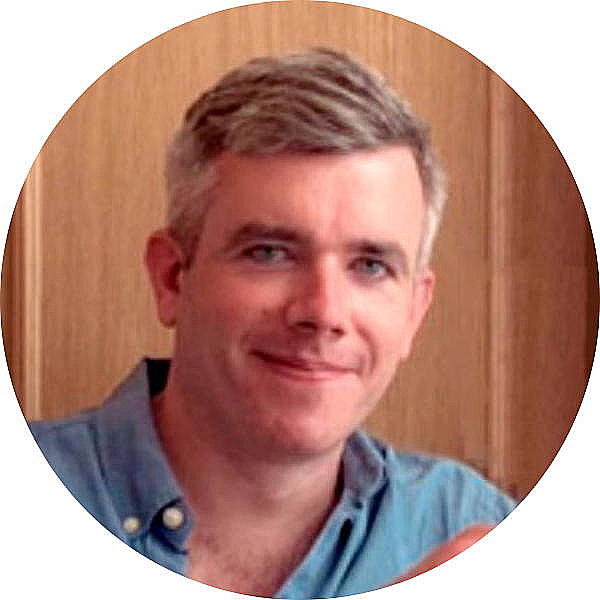 Writer, web designer, etc.; born in New York; educated in Argentina, Scotland, and South Africa; now based in London.
 read more
News
Blogs
Reviews & Periodicals
Arts & Design
World
France
Mitteleuropa
Knickerbockers
Argentina
The Levant
Africa
Cape of Good Hope
Netherlands
Scandinavia
Québec
India
Muscovy
Germany
Academica
Moedertaalsprekers in Suid-Afrika
Vanuit die blog van die “vryskut visuelejoernalis” Charles Apple, ons kry hierdie grafiek van sprekers van die twaalf offisiele tale van Suid-Afrika. Dit is die werk van die grafiese kunstenaar Rudi Louw van Naspers. Dié grafiek het in Die Burger verskyn. (O, Die Burger! Ek mis jou!). Afrikaans is nie eerste in nommers nie — Zoeloe is bo-op, Xhosa is volgende — maar die taal is eerste in ons harte. (Awww…) (more…)
NRC Handelsblad Goes ‘Compact’
Another broadsheet bites the dust
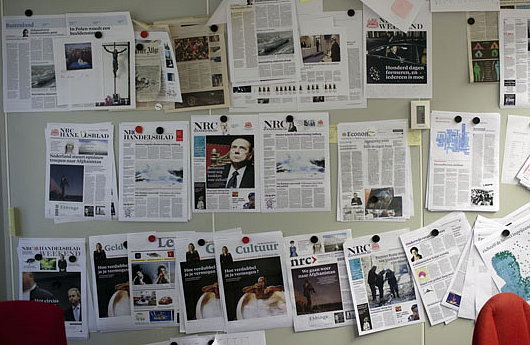
ONE OF THE most prominent newspapers in the Netherlands, NRC Handelsblad, switched from broadsheet to tabloid size this week. The newspaper claims it is returning to the ancestral format of its predeccesors, the Algemeen Handelsblad, the Amsterdam newspaper founded in 1828, as well as the Rotterdam Courant, founded in 1844. Those two papers merged in 1970 to form NRC Handelsblad, which is the seventh in circulation among the national newspapers of the Netherlands.
The evening newspaper has gained experience in tabloid-size printing since 2006 when it launched its morning compact edition, nrc.next, aimed at young, highly educated readers. Nrc.next has a Monday-Friday circulation of over 300,000, while NRC hovers around 240,000 on weekdays and 270,000 on Saturdays.
Interview with the Last July 20 Plotter
Der Speigel speaks with 88-year-old Ewald von Kleist
Ewald von Kleist is the last surviving member of the circle of Wehrmacht officers who participated in the July 20, 1944 plot to kill Hitler and overthrow the Nazi state. Der Spiegel has translated its interview with him into English, and all four pages feature interesting insights from this brave old man.
And if you read German (I don’t), you might be interested in this article on China & Carl Schmitt.
Canada’s Temporary Commons
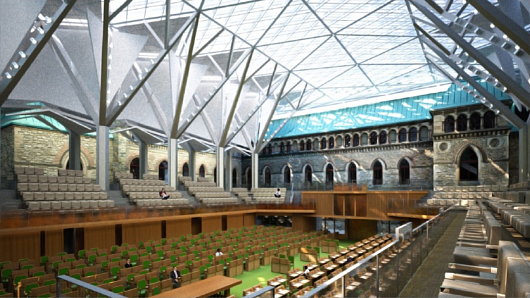
Canada boasts one of the most imposing parliamentary complexes in the world, presiding from a lordly bluff in the federal capital of Ottawa. While I think the city could do with an overall Hausmannisation, the government of the Confederation is undertaking significant efforts to renovate the buildings on Parliament Hill.
While the House of Commons chamber is renovated, the dominion’s lower house will meet in a new temporary chamber (above) constructed in the inner court of the West Block, one of a pair of high Victorian Gothic structures that flank the main parliament building. The restoration will take five to seven years, after which the temporary chamber will be converted into parliamentary committee rooms.
The Commons in the Lords
IT WAS THE NIGHT of 10 May 1941. For nine solid months the Luftwaffe had thrown everything it had at the people of London, as Hitler hoped to bomb the English into despair and surrender. By early May, the Nazis realised the campaign had failed, and resources had to be directed elsewhere. The Blitz had to end, but on its final night, it hit one of its most precious targets. Twelve German bombs hit the Palace of Westminster that night, with an incendiary striking a direct hit at the House of Commons. The locus of Britain’s parliamentary democracy was consumed by flame and completely destroyed. (more…)
The New Zealand Half-Crown
In the 1930s, New Zealand devalued its pound in relation to sterling and a whole new series of coinage and bank notes were introduced under the authority of the Reserve Bank of New Zealand. The government commissioned the accomplished English numismatic artist George Kruger Gray to design the dominion’s new coinage, which included this very handsome half-crown. It’s a splendid convergence between Maori and European design, two cooperating strains of New Zealand’s national culture. The country’s shield of arms is topped by a Tudor crown and flanked by indigenous motifs. (more…)
John Rao on PBS

The other day I stumbled upon this blog post from the Chairman of the LMS which included a segment from Religion & Ethics Newsweekly, the hebdomodal programme shown on PBS in the States. The R&E spoke with Dr. John Rao, associate professor of history at St. John’s University in New York and director of the Roman Forum, about the annual Paris-Chartres pilgrimage which unites tradition-minded Catholics from across the globe every Pentecost. You can watch the segment or read the transcript here on the PBS website. It’s also available on gloria.tv here.
I’ve already commended any New York readers of andrewcusack.com to attend the series of historical lectures in Greenwich Village organised by the Roman Forum. It’s time already to consider the annual summer symposium in Gardone on Lake Garda in Italy. This isn’t a boring academic conference where stuffy professors will present papers, this is a symposium in the truest sense. The root of the Greek word means literally “to drink together”, and that more closely reflects the Gardone spirit: a jovial meeting of minds where matters high and low can be discussed in a convivial attitude surrounded by the beauty of the Italian lakes.
Everyone I know who’s attended the Gardone symposium has come back with rave reviews, and many add it to their annual calendar. I’m really, really hoping to make it there this year for the first time, and I hope others will give it a go as well. From June 30th through July 11th, 2011. Click here for more info.
A Pell Sighting
…and sundry other occurences
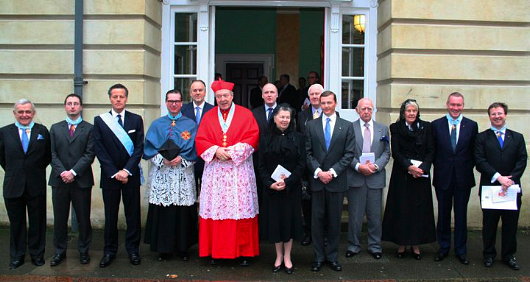
Outside of Rome, you don’t run into cardinals all that often, but last Saturday I caught sight of one of the most popular clerics in the Catholic Church: Australia’s Cardinal Pell. The occasion was the Cardinal’s reception into the Sacred Military Constantinian Order of St George, which took place in the Little Oratory. His Royal Highness the Duke of Noto presided over the investiture, and if you squint your eyes enough you can make out a profile shot of Young Cusack in the background of the photo of the Duke (below). In addition to the Cardinal Archbishop of Sydney’s being made a Bailiff Grand Cross of Justice, six others were invested as members of the Constantinian Order, including His Excellency Don Antonio da Silva Coelho, the Ambassador of the Order of Malta to the Republic of Peru. For more info, see the Order’s notice on the event. (more…)
Mamarazza
The photographs of “Manni” Sayn-Wittgenstein-Sayn
IT’S A CRACKING photo; the sort of thing guaranteed to irk the puritanical and bring a smile to the good-humoured. The thirteen-year-old Yvonne Sayn-Wittgenstein-Sayn takes a swig from a bottle while her brother Alexander, just twelve, sits with a half-smoked cigarette. Taken aboard the yacht of Bartholomé March off Majorca in 1955, the photographer was Marianne “Manni” Sayn-Wittgenstein-Sayn — the mother of Yvonne and Alexander — who’s known by her photographic soubriquet of “Mamarazza”. (more…)
The South Kensington Museum
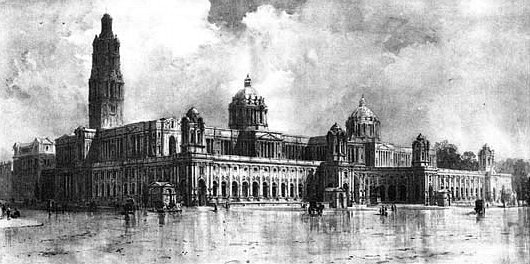
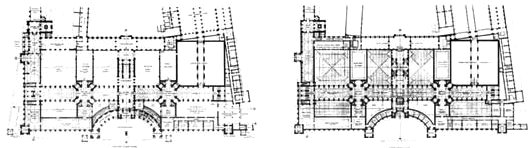
ANOTHER unbuilt project: this time a plan for completing the South Kensington Museum (or the Victoria & Albert as it’s now called) in the part of London which has become known as ‘Albertopolis’. The museum grew incrementally from its first foundation as the Museum of Manufactures after Prince Albert’s Great Exhibition of 1851. 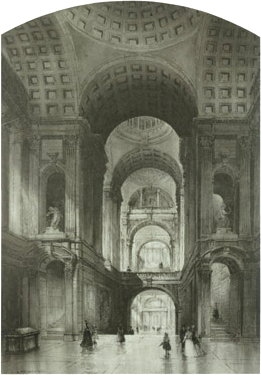 The first design for the museum at its current site was by Gottfried Semper, but the plan was rejected as being too expensive. And so over the years the facilities grew incrementally and according to to haphazard plans. In the 1890s, eight architects were invited to submit proposals for a grand scheme completing the site under a unified architectural plan.
The judges cited this plan, by John Belcher, as the most original of the eight submissions. It’s a splendid composition in high Edwardian neo-baroque. The duality of the main domes is a particular confident touch, and harks back to Greenwich. Belcher’s baroque conception was not just an external factor: his interiors featured vast, sweeping spaces that would have been impressively monumental and reflecting the power and influence of the British Empire at its presumed cultural zenith.
“Although unsuccesful in the competition,” writes Iain Boyd Whyte of Edinburgh University, “this project attracted considerable praise in the professional journals for the plasticity of the main street facade and for its grand, Michelangelesque domes.” While the judges appreciated Belcher’s design, they worried about the cost of its execution, and awarded first prize to Aston Webb instead. His scheme was inaugurated in 1899 by the Queen-Empress, who renamed the institution ‘the Victoria & Albert Museum’ simultaneously.
I wonder if Belcher’s design would have gone better with the neighbouring Brompton Oratory, or if the Oratory benefits from having the V&A in a differing, brick-based style.
Old Master Paintings at Sotheby’s
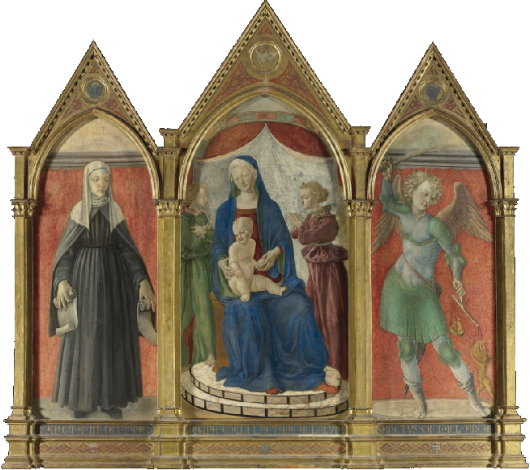
A Florentine Artist, The Madonna & Child Enthroned Flanked by Saints Bridget & Michael
1450; Tempera on panel, 72 in. x 85 in.
QUITE A FEW interesting pieces up for auction today as part of Old Master Week at Sotheby’s in New York. The above altarpiece has been attributed to various artists. For much of its life was called the Poggibonsi Triptych, but scholars now believe it to be the work of the Master of Pratovecchio. This attribution was supported by no less an authority than Roberto Longhi, who (as the catalogue notes point out) “considered him an artist of note who contributed to the Florentine transition from the early fifteenth-century serenity and intimacy of Fra Angelico and Filippo Lippi to the more dynamic forms found later in the century.”
The altarpiece, commissioned from a certain Giovanni di Francesco in 1439, was acquired by the J. Paul Getty Museum in California, which is now auctioning to raise funds for future acquisitions. (more…)
Dempsey Heiner (1927–2008)
THIS MONTH IT’S already three years since the death of dear Dempsey Heiner, who went to his eternal reward on 16 January 2008. Demspey was a real gem of a man: a scholar and a gentleman, capable of relaying brilliant insights easily and who, at least once, exhibited his skill in the art of the gentlest intellectual rebuke of a presumptuous young intellectual fellow-Catholic (i.e.: yours truly), backed up with a remembered citation of François Mauriac.
Dennis Clinton Graham Heiner was born in New York in 1927 to Robert Graham Heiner and Frances Eliot Cassidy, friends and fellow-travellers of Margaret Sanger, the notorious racial eugenicist & founder of Planned Parenthood. Dempsey’s parents enrolled him at St. Bernard’s, where he was in the same year as George Plimpton, the founder of the Paris Review and twentieth-century embodiment of the gilded amateur. Plimpton (who died in 2003) described Dempsey as “the brightest boy in the class, a genius” and remarked that since leaving school he remained something of an enigma. (more…)
Christopher Rådlund
My first encounter with the art of Christopher Rådlund was through the website of a friend. Bill Coyle is a poet and translator whose knowledge of the Swedish language gives him an insight into the rich and ingenious Scandinavian world. His January 2010 New Criterion article on the Swedish “retrogarde” was a fascinating insight into what is arguably one of the most fruitful multi-disciplinary artistic movements in Europe today, left almost completely unreported upon in the English-speaking world. Bill’s website displays one of Rådlund’s painting.
Christopher Rådlund was born in Gothenburg, Sweden in 1970 and now lives and works in the Norwegian capital of Oslo. In muffled tones, his paintings exhibit a melancholic coldness, like a modern baring-down of Caspar David Friedrich. Here is a small selection of his haunting but beautiful work. (more…)
The City of Unexpected Charm
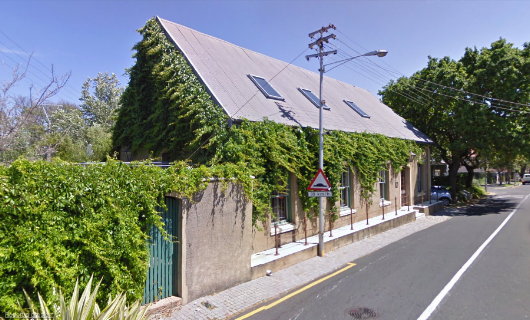
One of the things I like about Cape Town is its continual ability to surprise by throwing up surprisingly handsome buildings in unexpected places. To be honest, there is a great deal of mediocre architecture in the city, though I’d argue Cape Town’s mediocre architecture is better and more humane than, say, New York’s or London’s. But if you keep your eyes open to the world around you as you potter about the Cape, you can stumble across some happy little structures. This little building in Rondebosch is one such example. It sits on Rouwkoop Road, the street which takes its name from the old house that is no more. The N.G. Kerk Rondebosch is just down St Andrews Road one way, and St. Michael’s Catholic Church is just down Rouwkoop Road the other way. (more…)
Hail, Queen Europe!
The very name of Europe is feminine: Europa, the Phoenician princess of Greek lore, abducted by Zeus. From Strange Maps, we find this cartographic representation of Europe as a queen: Spain the crown, Germany the hearty bosom, Italy the graceful arm, and Sicily the Orb of Europe. The map was produced by Sebastian Munster in Basel in 1570 and was recently up for sale from Barry Lawrence Ruderman Antique Maps.
“During the late sixteenth century,” the map gallery writes, “a few map makers created these now highly prized map images, wherein countries and continents were given human or animal forms. Among the earliest examples is this map of Europa by Munster, which appeared in Munster’s Cosmography.”
The Drakensberg in Buenos Aires
An Argentine-South African Naval Encounter
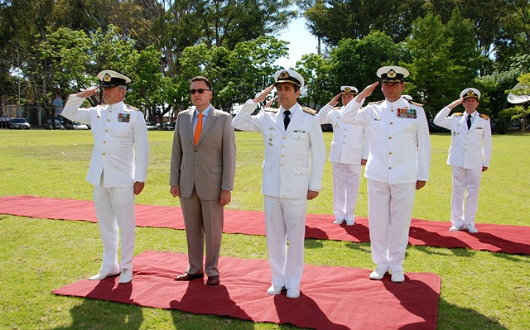
The South African Ship Drakensberg sailed into Buenos Aires last month as part of the sea phase of ATLASUR VIII, a naval exercise involving ships from Argentina, Uruguay, Brazil, and South Africa. Mr Tony Leon, former Leader of the Opposition and currently South African Ambassador to Argentina, was picked up by the ship-borne Oryx helicopter and landed on Drakensberg to observe the sail into Buenos Aires’s harbour. Mr Leon served in the SAN aboard President Pretorius in 1976. (more…)
The Khan Market
“One of the happier moments in what has begun to feel like a long life (for I have now lived through three dekaenneateric cycles), was in the Khan Market at New Delhi,” writes the columnist David Warren.
This was some time ago. There was a bookstore in that market (perhaps there still?) and I am happy as a simile in a bookstore. It was before the Indian economy had turned, in merry cartwheels of Vedic Thatcherism — before the Khan Market had become one of the world’s most expensive retail locations. In those days it was merely well-appointed, and (for India) almost provocatively clean.
It was something about the condition of the light, and the cool air (a late winter afternoon); the understated display of all goods; the polite modesty of both salesmen and customers; the gorgeousness of Delhi ladies in their saris. I felt for a moment that I was in Utopia, and that this was its corner market.
Health Nut vs. Hearty Eating

Via Mulier Fortis, this comparison reaches us. The woman on the left, 51 years old, is a television “health guru” who advocates a holistic approach to nutrition and diet, a pescetarian diet high in organic fruits and vegetables, detox diets, colonic irrigation, and supplements, and other things too frightening to mention. The woman on the right, 50 years old, is a television cook who’s a strong advocate for meat, butter, and desserts.
You do the math!
South Africa in the New Year’s Honours
One CMG and three MBEs show links between Britain and South Africa
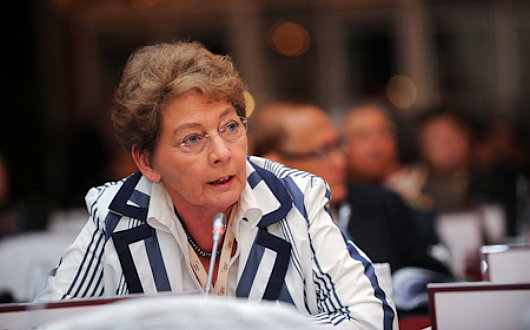
Despite breaking its constitutional links with the Crown over fifty years ago (c.f. here), South Africa continues to enjoy close social, economic, and cultural ties with Great Britain, a fact borne out in the recent New Year’s Honours list. Of the numerous individuals awarded for their public service, four from this year’s list show the relationship between these two countries. Most prominent is Fleur Olive Lourens de Villiers (above), who has been named a Companion of the Most Distinguished Order of St. Michael and St. George. Ms. de Villiers, a graduate of Pretoria & Harvard, is Chairman of the Board of Trustees of the London-based International Institute for Strategic Studies. From 1960 onwards, she has been a theatre critic, economics correspondent, leader writer, columnist, political correspondent, newspaper editor, and travelling correspondent around the world, in addition to working with the De Beers Group and Anglo-American. She was one of the four contributors to the Institute of Economic Affairs’ 1986 study Apartheid: Capitalism or Socialism? which examined the role of the state and its race policy in the South African economy. (more…)
Diary
HOW MANY COUNTRIES have you been to? As for myself, not many, perhaps a dozen, although I’ll concede that that dozen is spread over four continents. I know people who have been to two or three times as many countries as I have, particularly if they’ve travelled through the Continent, where you can notch up several in a single day. My travel plans tend to be those of saturation rather than spread: I visit places and start relationships with them and then keep coming back.
And how do you decide that you’ve “been” to a country? There are various methods of determination. (more…)
Search
Instagram: @andcusack
Click here for my Instagram photos.Most Recent Posts
- Brunel’s Unbuilt Capitol February 3, 2026
- Cricket at Fordham January 27, 2026
- Palacio Barolo Revisted January 14, 2026
- Learning to Love Liguria January 14, 2026
- Crux Alba No. 2 January 13, 2026
Most Recent Comments
Book Wishlist
Monthly Archives
Categories