About Andrew Cusack
 Writer, web designer, etc.; born in New York; educated in Argentina, Scotland, and South Africa; now based in London.
 read more
News
Blogs
Reviews & Periodicals
Arts & Design
World
France
Mitteleuropa
Knickerbockers
Argentina
The Levant
Africa
Cape of Good Hope
Netherlands
Scandinavia
Québec
India
Muscovy
Germany
Academica
Dublin Diary
WE START OUT at the usual Italian place, PH’s stammtisch despite his complaints that they’re stingy and never bring you a limoncello at the end of a meal, as is custom elsewhere. The usual verbal briefings are exchanged, updating each other on the scheme of things and the general banter. It’s warm enough to sit outside, which allows us the luxury of a cigarette with our coffee as we cast aspersions on passing strangers. This quickly moves on to casting aspersions on mutual acquaintances (we will not call them friends!) and extrapolating therefrom more general condemnations of the heresiarchs and heretics of our day (chiefly: liberals, Modernist clergy, fops, les Brideshead affectés, users of inappropriate typefaces, and all people who take life too seriously).
After the postprandial coffee, we head on to Doyle’s but, just as we arrive, Brian gets in touch directing us elsewhere. We meet up with him and his three friends on the street but PH and I do not take a shine to Brian’s temporary entourage and secede from the party. Where to? Lincoln’s Inn, end of Nassau Street. (more…)
Dino Takes on Nic & Rem
Dino Marcantonio is on his usual top form when responding to an interview with the “Dutch architect and uber-gobbledegook-meister” Rem Koolhas by Nicolai Ouroussoff, the architecture praiser for the New York Times. Many modernists now find themselves in the role of perverse preservationists, trying to save ugly modernist buildings that are already falling apart because of their inherent conceptual flaws and rejection of inherited architectural wisdom. But while the Mods want to save the crumbling monstrosities, they attack the natural human instinct to preserve what is beautiful (i.e. traditional and vernacular architecture) and to destroy or get rid of what is ugly (their own work, the “ambitious” carbuncles of the past century).
Koolhaas and Ouroussoff pretend to confuse the true spirit of preservation with hoarding. A hoarder makes no value judgments about what should be kept. It all stays, and the result is his home is a dump. If we keep everything, we wind up preserving nothing–and that, my friends, is what Koolhaas is really all about. His endgame is the embalming of our architectural identity. He is suffering from an acute case of cronophobia, the irrational fear that old things might still be alive to us today.
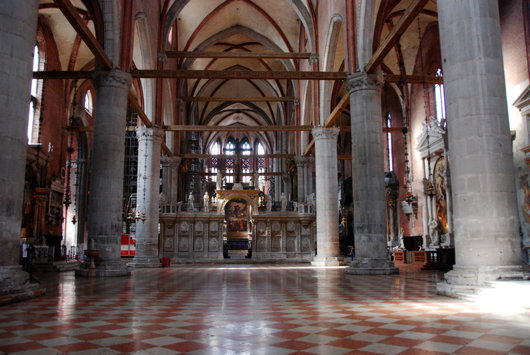
Dino, however, is not having it:
Consider another approach taken by the Venetians toward the beautiful church Santa Maria Gloriosa dei Frari. Completed in the early 14th century, it has been lovingly embellished by generations and generations, all meaningfully, and without any angst about what is authentic and what is not. It has also suffered through suppression, looting, and radical restoration. I Frari has been through it all. It is almost 700 years old, yet because it has been properly cared for, it still looks fresh as a garden daisy. And it is mobbed by visitors year-round who yearn to follow its example, not only in the preservation and handing down of churches, but also our cities, our homes, our culture.
Cross-Border Raids into Finance
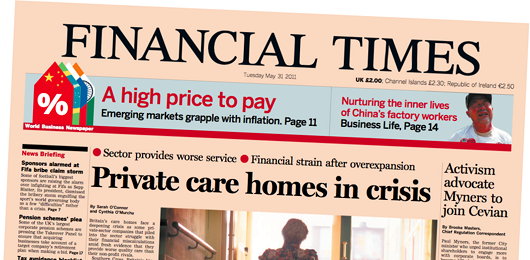
The St James’s offices of Aim-quoted Cluff Gold in London resemble an explorer’s den: an antique globe, exotic objets d’art on the walls and a bust of Jan Smuts, the South African statesman, greeting visitors in the corridor.
It is the work of Algy Cluff, the buccaneering 71-year-old chairman of the west African gold producer. Just returned from shooting guinea-fowl in the Kalahari Desert, Mr Cluff’s air of patrician derring-do could have been sketched by the pen of Evelyn Waugh.
Having worked in Africa long before it became a fashionable investment destination Mr Cluff is modest about the key to success in frontier markets: “Good manners.”
It used to be the certifiable Cusack position that the realms of finance & business were dead dull and to be avoided at all costs. I do read the Financial Times fairly often — especially for its praise-worthy and restrained weekend edition — but I’ve always steered well clear of the Companies & Markets section that appears in the paper’s Monday-through-Friday editions. A week or so ago, inspired by some bizarre exotic curiousity, I wandered over the borders into the territory of Companies & Markets for the first time, and was fascinated by the intricacy of what I found, as well as how interesting it all was.
Also, when younger I thought only boring people went into finance, but after graduating from university and seeing everyone toddle along their various paths, I find that about half the fun and interesting people I know have ended up doing somethingerother financial — another assault on Cusack’s anti-finance defences. I am aided in my exploration of this intricate world by a nifty little book I’ve stolen from a friend’s collection: How to Read the Financial Pages by Michael Brett; basically finance for layfolk such as yours truly. And of course I am still enjoying Philip O’Sullivan’s Market Musings.
Admittedly, much of this is sparked by the initial public offering of Glencore. There’s something splendidly boyish and fun about commodities (especially gold, as the above-mentioned Mr Cluff surely knows) and Glencore’s massive corner of the global commodities market is truly beyond the dreams of avarice. There is, apparently, gold in them thar hills.
Nobility and Dignity at the Café Valois
Farewell, O good old days! Farewell, O affable visage of the proprietor and smiling and respectful reception of the waiters! Farewell, O solemn entries of the Café Valois’ dignified customs, which people were curious to see. Such was the case with the Knight Commander Odoard de La Fere’s arrival.
At exactly noon, the canon of the Palais-Royal heralded his arrival. He would appear on the threshold and pause for a moment to sweep the salon with an affable and self-assured gaze as someone eager to practice a longtime custom. His right hand pressing firmly on the white and blue porcelain handle of his cane, he threw his old faded brown cape over his shoulder with a swing of his left hand. No one ever snickered at this, since not even the most elegant mantle with golden fleur-de-lys embroidery was ever thrown back with a more distinguished movement.
In 1789 the former steward of the Prince of Conti ran the Café Valois; it was rather devoid of political colour and local flavor at that time.
Among the frequenters of the place, standing out by his noble manners, stately demeanor and wooden leg, was the Chevalier de Lautrec. He was from the second line of that family, an old brigadier of the king’s army, a Knight of Malta, of Saint Louis, of Saint Maurice and of Saint Lazare.
The Chevalier de Lautrec was a middle-aged man who lived a modest, though very dignified life on his small pension. Though he rarely appeared in society, he could be seen most often at the Palais Royal and the Café Valois. He was a very cultured mind and an assiduous reader of all the newspapers.
Deprived of his pension overnight, it was never known what the Chevalier de Lautrec lived on at a time when it was so difficult to live, and so easy to die. But here we have something that sheds at least a dim light on this mystery.
One morning after finishing a very modest breakfast in the Café Valois, as was his custom, the Chevalier de Lautrec rose from his table, chatted with all naturalness with the proprietress, who stood behind a counter, bid good-day to the master of the café with a slight gesture of the eyes, and walked out majestically saying nothing about the bill. (more…)
Turning the Book on its side
Books are a central obsession of mine. I’ve a reasonably large and ever-increasing library of my own and wherever I’ve called home there have been larger collections available to tap into: the Society Library in Manhattan, the Gericke-biblioteek in Stellenbosch, and the mostly excellent public libraries dotted around lower Westchester. When you see the wide range and styles of the book — it’s size, proportion, paper, appearance — it’s depressing to see how monotonous contemporary book publishing is today. I have a thousand different ideas on book publishing and the wide gaps in the market that are completely ignored today, but here’s one inventive idea I didn’t have.
According to Le Figaro, Editions Point Deux (a subsidiary of the La Martinière group, the third-largest publishers in France) has begun offering what it calls « le plus portables des livres » . These little books are printed on their side to be read like a flipbook rather than in the more conventional format. The idea, apparently, comes out of Holland and has proved successful in Spain, but I haven’t come across it at all in the English-speaking world.
The first question is: what’s the point? At 4.75 in. x 3.15 in., they’re a handy size, but is anything actually gained by turning the text on its side? I imagine it’d be helpful for commuters, but I think it’d be difficult to judge the concept without actually having one in hand and using it, so I think I’ll refrain from handing down a verdict just yet. Very boring of me, I know, but I’ll admit I’m intrigued by the idea.
Licorne Perdue
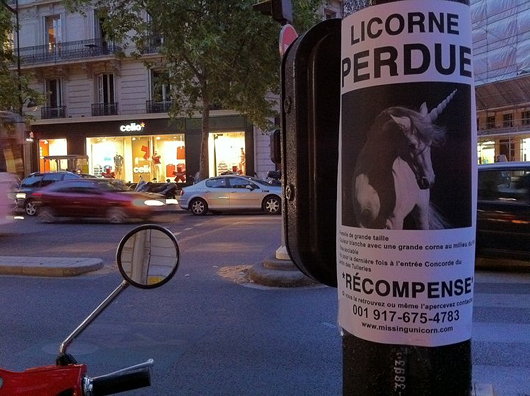
“Vu hier soir à Odéon” writes Nicholas S-M, posting this photo on Facebook.
Of course, my mind immediately wanders to Le Secret de La Licorne, the 3D film version of which (directed by Mr. Spielberg) will be released before the end of the year. I am sure I will hate it, but in that way you can hate things while still liking them.
Civilised Barbarism, Barbaric Civilisation
“Despite my inclinations to the contrary, I have racial sensitivities. I am Latin. I regard the civilised barbarian in the North with an inherited sense of mistrust. Today [the United States] has become a colossal society, and has adopted the goal of imposing its industry, its commerce, and its imperialism. Each citizen of the Union is a kind of stockholder… [upholding] an ideal of material perfection above moral perfection, and equating civilisation with the triumph of industry and commerce. We, by contrast, descendants of the Latins and educated by the Greeks, regard that person as most civilised who is most morally perfect. … I am proud to say I am bored with railroads and factory chimneys.” – Belisario Montero
ONE OF THE best aspects of Catholicism is the affirmation (for lack of a better word) of absolutely everything that is good throughout the world. All the peoples of the earth, each with their particular genius, eventually descend from the same parents. This gives one, I hope, a certain sympathy towards every nation and every people, and an anticipation that each one will eventually grow into the full flower of a Christian order appropriate to their particular characteristics and personality. Christianity is not oppressive and conformist in its universalism but instead all-embracing.
There is much to be admired in the sentiments expressed by Belisario Montero, an Argentine diplomat, in the comments cited above. To put them in context, they were made after the final collapse of the Spanish Empire following the Spanish-American War of 1898. Argentina, as you already know, is a place that excites me. In her is found so much of the idea of Europe, varyingly perfected and perverted, accidentally demolished in an attempt to save it and then put back together again not precisely as it was before. Marx “travelled” to Buenos Aires, but so did Maurras (and perhaps the Frenchman was more influential). For a time, photographs of Mussolini cut from the illustrated magazines were plastered onto the walls of aspirational working-class porteños trying to keep up with the latest European fad, and the military elite and social aristocracy combined to oppose the vulgar and destructive forces of liberal democracy and unbridled capitalism. Almost every coup in the nation’s history was received with a sigh of relief, especially (and ironically) the coups getting rid of whomever the previous welcome coup put in charge. Argentina has a long history of terrible success and beautiful failure. Perón himself is the very embodiment of this.
Of course, unlike Don Belisario, I am not a Latin. (more…)
An Update
Please don’t think I’ve been neglecting you! There has been a lot going on of late, some of which I will report on later, but I can tell you that I have been rendered temporarily homeless, my phone has been stolen, and my computer is (what’s new?) on the fritz. The damned fan is broken and so you’re lucky to get an hour out of it. Of course, before its latest round of hiccups, I took on a little charitable web design project for a certain non-profit London institution currently in its hour of need, so working on that has priority over compiling blog posts in the little time the aged laptop affords me. (If anyone wants to buy me a new MacBook – get in touch!).
Still, there is the office computer, a miserable Dell running miserable Windows on which I am forced to use miserable Internet Explorer (system administrators – that ominous tribe – forbid the downloading of more useful browsers like Safari, Firefox, etc.).
My computer woes have inhibited all my creative efforts! It’s funny (and worrying) how one’s thinking and operation can be so tied to a machine. The flip side of it is that you’re getting more word entries than image entries (even though my writing flows much more fluidly when typing on my Mac). So many damned images on my machine, most waiting for their ticket to come up so I will write what I hope will be an attractive, handsome, and informative article about whatever the subject matter is. You know I am a very visual person, but I am also a word person strangely.
If you’re lucky, perhaps we might tempt Alexander to make another appearance, though he’s currently in Paris trying to undermine French republicanism in an exceptionally asymmetric and perhaps not entirely logical fashion.
UPDATE: Just to clarify: please don’t think I’m homeless in the sense of sleeping rough on the streets. It’s merely that my flatmate fled the country and the landlord sold the place, so I’m currently staying with friends.
The Meeting Place
A Bigoted, Drunken Rant
by the Hon. Alexander Shaw
WANDERING AROUND St. Pancras International railway station today, I came across Paul Day’s ‘The Meeting Place.’ The much acclaimed, £1m, nine-meter-high statue of a couple embracing is, at a glance, a nice image for a railway station — a theme of reunion and all that. But looking up at the gargantuan PDA, I started to realise that this was actually an audacious assault on sovereignty and a shameless celebration of European supremacy over Britain. (more…)
Bo Bartlett
THERE IS SOMETHING vigorously American about the art of Bo Bartlett. The modern realist was born in Columbus, Georgia, and studied in Italy under the Arthur Ross Award laureate Ben Long (one of the “greatest draughtsman of the twentieth century” according to Philippe de Montebello) before moving on to the Pennsylvania Academy of Fine Arts. After completing a filmmaking degree at New York University, Bartlett embarked upon a five-year process creating a film covering the life and works of Andrew Wyeth, in collaboration with the artist’s wife Betsy. The artist’s work certainly shows the influence of Wyeth, as well as other American artists like Thomas Eakins, Edward Hopper, and Winslow Homer.
Hopper’s works, I’ve always found, have a particular quality of still abandonment, as if the scenes he depicts are living but just abandoned five minutes ago. Bo Bartlett’s paintings have a similar feel: they often exude a slight air of uncertainty and disquiet. There’s the looming threat of anarchy in The End of the 20th Century, also insinuated in So Far, as well as the reversal of the grounded American flag implied in Cradle. Other paintings, like Calling and Deer are peans to the animal kingdom. Still more are disturbingly quiet odes to the American coast — Bartlett divides his time between Puget Sound on the Pacific and Maine on the Atlantic. Whether beautiful portents of doom or eery celebrations of American life, the viewer suspects that there are stories not being told, and that the artist’s paintings conceal as much as they reveal. (more…)
The Mornings of the World
THERE IS A CERTAIN bizarre and unreasonable attraction about the existentialists — as if amidst all the ridiculous and fatuous statements they made, there was here and there a phrase in which, while utterly inexplicable, one can nonetheless find some deep resonance. This is especially true of Camus, who (for me) is instantly the most convincing of that lot, and – perhaps because of that – the one most naturally separable from them.
Camus, I read somewhere, had a particular phrase or concept or perhaps even idée fixe that constantly resurfaced in several of his works: the morning of the world, or les matins du monde (as Camus rendered it in plural). (more…)
Prayer to St. Joseph for Priests
Where would we be without priests? Terrible to even consider. Ever since the Year for Priests held in 2009-2010, I have tried to remember priests in my intentions much more frequently than before, especially those brilliant priests who’ve had an influence in my life in Scotland, South Africa, New York, and elsewhere.
Fr Mark over at Vultus Christi posted this prayer to Saint Joseph for priests a few weeks back, and it seems worth reblogging.
O glorious Saint Joseph,
who, on the word of the angel
speaking to you in the night,
put fear aside to take your Virgin Bride into your home,
show yourself today the advocate and protector of priests.
Protector of the Infant Christ,
defend them against every attack of the enemy,
preserve them from the dangers that surround them
on every side.
Remember Herod’s threats against the Child,
the anguish of the flight into Egypt by night,
and the hardships of your exile.
Stand by the accused;
stretch out your hand to those who have fallen;
comfort the fearful;
forsake not the weak;
and visit the lonely.
Let all priests know that in you
God has given them a model
of faith in the night, obedience in adversity,
chastity in tenderness, and hope in uncertainty.
You are the terror of demons
and the healer of those wounded in spiritual combat.
Come to the defence of every priest in need;
overcome evil with good.
Where there are curses, put blessings,
where harm has been done, do good.
Let there be joy for the priests of the Church,
and peace for all under your gracious protection.
Amen.
Cocktail, Anyone?
A journey into the drinks cabinet
The multifaceted realm of blogging has been penetrated by a friend and occasional drinking partner of mine. Known only as the Sybarite, he brings us a few thoughts on the inhabitants of the drinks cabinet. I thought I’d share his thoughts with you, as well as adding a dash of mine own into the mix. (more…)
Arms of the Irish Universities
 University of Dublin
Universitas Dublinensis; Ollscoil Átha Cliath
Dublin University was founded with the idea of creating a collegiate university along the Oxford and Cambridge model. The University of Dublin, however, failed to develop along those lines, and so its sole foundation was the College of the Holy and Undivided Trinity of Queen Elizabeth near Dublin, more commonly known as Trinity College. Strictly speaking, TCD and the university are distinct entities in law, Trinity being the only college of the university.
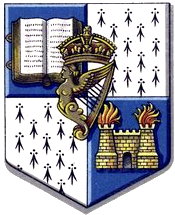
The university’s arms, granted in the nineteenth century, are blazoned Quarterly azure and ermine. First quarter a book open proper, bound gules, clasped or, and in fourth quarter a castle of two towers argent, flamant proper. Overall in the centre point the harp of Ireland ensigned with the royal crown. The castle with fired towers is a reference to the arms of the city of Dublin. While it is the university, not Trinity College, that awards degrees, the university arms were not used on degree certificates until 1963, when President John F. Kennedy was granted an honorary doctorate of law in St. Patrick’s Hall at Dublin Castle. (more…)
Branding the Rowing Nation
National Governing Bodies in Rowing and their Logos

THE OTHER DAY I was flipping through some publication and came across a photograph of two people standing in front of a boathouse. Emblazoned upon the building was the above logo, along with the words ‘British Rowing’. As a former member of SARA (the Scottish Amateur Rowing Association), I found this quite intriguing as I’d never heard of any such organisation. 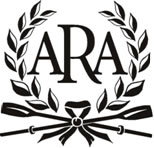 Like many sports, rowing is organised on a country-wide level (i.e. England, Scotland, Wales), not on a union level (the United Kingdom). Ever wary of centralisation, I was relieved, albeit a bit confused, to discover that the group now branding itself as ‘British Rowing’ is actually the Amateur Rowing Association, the ruling body for the sport in England, not Britain. The ARA was founded in 1882, but lamentably decided to end its ban on non-amateurs in 1998. They kept the ARA name regardless until now. Having the word ‘Amateur’ in their name was obviously a bit inaccurate, but if accuracy was the aim, why have they decided to style themselves ‘British Rowing’ when they only speak for England? What’s wrong with ‘English Rowing’? Very odd, if you ask me. (more…)
A Little More Graaff-Reinet
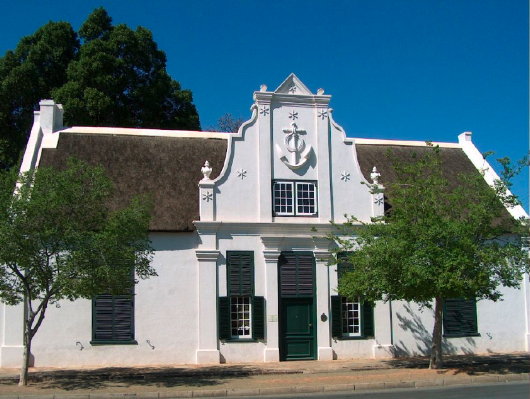
Here’s just a handful more photos of Graaff-Reinet from the blog of Angelika Wohlrab, a South African tour guide, author, and photographer. Above is another Cape Dutch gem, the Urquhart House with its splendid plasterwork design in the gable. (more…)
Market Musings
If forced to describe him, I would say my friend Philip O’Sullivan is the canny man at the back of the smoking section, cigar in hand, a wry, knowing smile on his face, and a slight glint of gold in his eye.
Philip has condescended to share a thought or two on matters financial at his new blog, Market Musings. Think of it as our own private Lex Column (only, er, not private).
I’ve already ventured a comment on Philip’s mention of George Osborne’s most unwelcome petroleum industry tax hike. George Kerevan (Vote George for Edinburgh East!) offers his own thoughts on this and other aspects of the recent UK budget in his Scotsman column.
Graaff-Reinet
The Gem of the Karoo
IF YOU HEAD OUT from Cape Town making for the Valley of Desolation, you take the main road to Johannesburg, breaking ranks at the town of Beaufort-West in the Great Karoo, where you head eastwards on the R61. That road eventually joins up with the N9 (famous for its “Uniondale Ghost”) and, before you reach the Valley, takes you to the pleasant little town of Graaff-Reinet. The town was founded in 1786, making it the fourth-oldest in South Africa, after Cape Town — the “mother city” — Stellenbosch, and Swellendam. Graaff-Reinet was named in deference to the Dutch governor of the day, Cornelis Jacob van de Graeff, and his wife whose maiden name was Reynet, but the burghers earned an early reputation for rebelliousness, proclaiming their own independent republic in 1795, with further uprisings in 1799 and 1801. While now situated in the Xhosa-dominated Eastern Cape, Graaff-Reinet is predominantly Afrikaans.
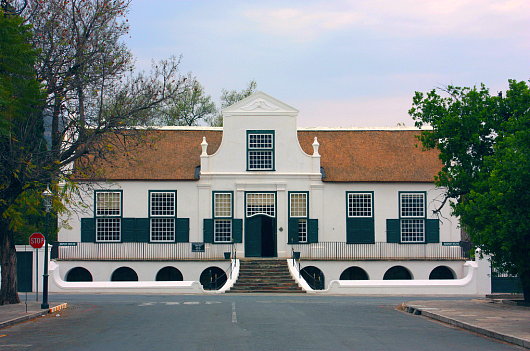
The town, which rests on a bend in the Sunday’s River, has a host of architectural delights, of which my favourite is the Reinet House (below). It was built in 1812 as a parsonage for the Dutch Reformed minister, and was later part of the teacher training college until it fell vacant and was restored as a museum after the Second World War, being opened in 1956 by the Rt. Hon. E.G. Jansen, the Governor-General of the day.
The Modern Baroque: Brasini in Parioli
The Church of the Immaculate Heart of Mary
GOOD ARCHITECTURE requires a combination of willpower, taste, and resources. This nexus used to occur quite often; instances from the Renaissance and the long nineteenth century come most easily to mind. A late twilight of this combination is found in the magnum opus of the Italian architect Armando Brasini: the Church of the Immaculate Heart of Mary in Rome’s swish Parioli neighbourhood.
The 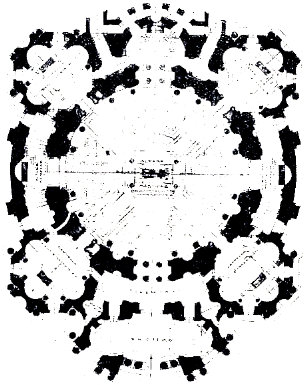 church, a modern expression of the Baroque, has somewhat curious and disjointed origins. Every age has left its imprint on Rome in one way or another: the Rome of the Republic, the Rome of the Empire, the Rome of the Popes, the Rome of the Liberals, the Rome of the Fascists, the Rome of the Italian Republic. In the 1900s, it was realised that the Church had not made a significant contribution to the great architecture of Rome for some time. Worse: the more significant structures of the past century were mostly built by the government of the Sardinian kingdom that conquered Rome and gave itself the fanciful, if geographically correct, name of ‘Italy’. A new church was needed, on a monumental scale, to be the age’s contribution to the great churches of Rome. Originally, the church was to be dedicated to St. James the Greater, but as preparations increased for the International Marian Year of 1924, it was decided the cult of the Immaculate Heart of Mary would take precedence instead. (more…)
The Namibian Way of Reconciliation
Accepting differences, not erasing them, is the path to civic harmony
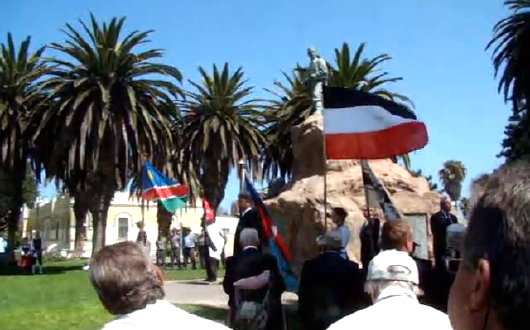
DISCORDIA GERANT ALII, tu felix Namibia reconciliant! Peace and reconciliation are amongst the noblest of earthly aims, but the deluded establishment that rules most of what used to be called the Western world often seem convinced that peace among peoples can only be achieved by erasing the differences between them. Yet it is precisely those differences — the unique characteristics of tribe, clan, and platoon that separate us from some and unite us with others — that make us who we are: human beings, created by God in time and place and circumstance. Without them, we are rootless citizens of nowhere, easily abused and manipulated by the powerful. (How flimsy is even the thickest oak when its roots have been severed). It is the acknowledgement of differences, rather than the erasing of them, that leads to true respect and understanding between and among peoples. While the racial grievance industry thrives in America and Europe, an entirely different attitude exists in happy Namibia. (more…)
Search
Instagram: @andcusack
Click here for my Instagram photos.Most Recent Posts
- Brunel’s Unbuilt Capitol February 3, 2026
- Cricket at Fordham January 27, 2026
- Palacio Barolo Revisted January 14, 2026
- Learning to Love Liguria January 14, 2026
- Crux Alba No. 2 January 13, 2026
Most Recent Comments
Book Wishlist
Monthly Archives
Categories