About Andrew Cusack
 Writer, web designer, etc.; born in New York; educated in Argentina, Scotland, and South Africa; now based in London.
 read more
News
Blogs
Reviews & Periodicals
Arts & Design
World
France
Mitteleuropa
Knickerbockers
Argentina
The Levant
Africa
Cape of Good Hope
Netherlands
Scandinavia
Québec
India
Muscovy
Germany
Academica
Fit for a Duke in Covent Garden
Russell House, No. 43, King Street
This apartment occupies the piano nobile of a 1716 house designed by Thomas Archer for the Earl of Orford, then First Lord of the Admiralty. He obtained the lease for the site from his uncle, the Duke of Bedford, on condition he tear down the house located there and build a new one. Batty Langley, the eighteenth-century garden designer and prolific commentator hated it, and devoted over 200 words of his Grub Street Journal (26 September 1734) to slagging it off. The Grade II*-listed building looks onto Covent Garden Piazza and has seen a number of uses over the years. (more…)
The Lady in Red
Or: Where to sit in church on Sunday
IT IS A LOGICAL TRUISM that good habits are good. But good habits — well and fine as they are — can also produce ancillary habits that, while not ‘bad’, might perhaps also be worth denying the dignified title of ‘good’; they are ammoral rather than immoral. Hearing mass on Sunday is a good habit — indeed it is an obligatory good habit binding upon all the Faithful. Some people express their habit of Sunday mass at varying locations — an attitude which I find surprising, which itself is surprising given until very recently I varied my Sunday mass locale myself.
In New York, it was easy: there was only one real place to hear Mass and that was the Church of St Agnes on 43rd Street. Of course, some dangerous rapscallions dissented from this point de vue and attend the Church of Our Saviour on Park Avenue. I remember one Sunday on Lexington Avenue seeing the group of lads who serve the 11 o’clock mass at St Agnes come down the avenue while the like gang who did the same at the Church of Our Saviour were coming up it on the same side and it was like seeing the Sharks and the Jets meet in “West Side Story”.
In London, I used to go here and there; mostly dividing my Sundays between the Oratory and the Cathedral but every now and then sneaking in Holy Redeemer in Chelsea. But for a year or so, I have been an Oratory regular, and now look strangely upon those who, when the insouciant inquiry at a dinner party or over drinks or such is made “Where do you go to Mass?”, reply “Oh, you know, sometimes here, sometimes there, sometimes I even go to the local parish.” (I never believe the last assertation; I, for one, have only been to my local parish twice: once this past St Patrick’s Day to pray, in vain, for an Irish victory at Twickenham, and lastly on one of those lesser-remembered Holy Days of Obligation.)
But the ancillary (ammoral) habit to the (moral) habit of hearing mass on a Sunday is the custom of sitting in the same place. If one is new to a particular church, one can sit here and there for quite some time, but eventually you find a bit of the church and you realise one Sunday “Ah! This is just right!” and from that day forth you have “your” seat. The chaps who do the collection obviously must have their proper places. The one-legged lady in the wheelchair who shouts at people has her usual spot. A certain sturdy Knight of Malta enjoys sitting in more or less the same location every Sunday, and one friend of mine inexplicably likes sitting in the middle of the row towards the middle of the first section of seats beneath the dome. Inexplicable to me because I cannot abide having to climb over people to get to and fro at mass.
Anyhow, needless to say, I have my preferred seat at the Oratory on a Sunday. It is not even a neighbourhood of seats, or a small vicinity, it is a specific seat and I am loathe not to have it. This is because it is at the confluence of the various important factors. It is not so close to the front that you are mistaken for the religious fanatic, the overly pious, or Princess Michael of Kent. Yet it is not so far to the back that you have to walk a mile to receive Our Lord in the Most Holy Sacrament of the Altar come communion time. (And have you ever sat towards the back at the Oratory? Barely anyone says the responses! The Fathers should set up a specific mission towards the last twenty-odd pews at the 11:00 on a Sunday — I suspect they are unbaptised the lot of them).
Furthermore, there is a duality to the mode of seating at the Oratory: the first two sections, comprising about the first third of the church, are actual seats, whereas the last section is composed of hard, uncomfortable wooden pews. (Perhaps they don’t say the responses because they’re embittered by discomfort?). Also, I dislike being in between the pulpit and the sanctuary, thus necessitating that you have your back turned to the priest when time comes for him to preach. And I prefer to nip up to communion rather swiftly, so I can return and get all my prayers in and not spend half the time standing in a queue awkwardly awaiting the reception of the Eucharist. This, therefore, necessitates that I be directly on the aisle.
“My” seat — I will not reveal its specific location within the Oratory Church of the Immaculate Heart of Mary, Brompton, for the obvious reason of inviting competitors — “My” seat is thus located in precisely the perfect location. Needless to say, I’m used to the others who have found that “their” seat is adjacent or nearby (though I’m glad that one chap who objects to dogs being at mass has given up and gone elsewhere). I feel we all implictly know and understand each other without actually intercommunicating, in that way that researchers who frequent the same stacks in university libraries feel a certain affinity.
About a month ago, we received a new regular to our midst: a white-haired lady in what might be described as late middle age, hebdomidally clothed in a red overcoat. She began to take the seat next to mine. Very well. Pas de problème, etc. Then one Sunday, a slow-moving Italian family attending the previous mass were lingering in “our” row and both she and I assumed positions ready to take possession of our regular seats. Imagine my surprise, then, when the Lady in Red, in full knowledge of my presence, took my seat! Friends were in from the country that week and said they watched the entire scene in detached amusement from the other side of the church. Needless to say, I was reduced to taking the next seat over, usually the Lady in Red’s seat.
What did this fresh assault upon my dignity betoken? I knew not. But I was determined that, in the immortal words of an American president, this aggression would not stand. The next Sunday I made sure to arrive extra early and secure my seat succesfully but untriumphantly. (Triumphalism is a tiresome bore in others and a poor reflection upon one’s self). The Sunday following that she appeared in pole position to usurp my place yet again, but then she didn’t: she let me have it. This, of course, was really a back-handed triumphalism. Haha! See! I shall be the better Christian and let you have the seat to which you have been accustomed since time immemorial! Look ye mighty upon my works and despair!
“Very well!,” I thought, “two can play at this game!” I was determined the Sunday following to arrive early and to deferentially allow her to have the place to which I had grown to know and love so well. But, friends, the best-laid schemes of mice and men gang aft agley. This past Sunday I arrived a mere minute or two before mass was to start, and thus I was forced to sit in the north transept instead. What’s worse, the Lady in Red wasn’t even sitting in my seat: she had ceded it to a mantilla’d Filipino lady.
This raises a fresh quandary. If this past Sunday was “my” week to defer to her, but I failed, and she deferred to someone else, does that then mean that I must defer next week, and the rotation begins anew? Or do we stick to the previous rotation of her week / my week? I know not, but I must be off now, as my French flatmates are wailing, and I suspect there may be a mouse for me to kill. Abientot!
London’s Fallen Water
A cursory investigation into the metropolis’s drinking water yields results that veer towards the somewhat disturbing
by ALEXANDER SHAW in London
UNDERSTANDING  enables self-preservation, but occasionally leads us out of Eden too. Thus, I’m not encouraging you to understand how London’s water is recycled, I’m merely tempting you to.
Education is like lighting a fire, not filling a bucket. One realisation leads to another:
Q: What happens when the ice cubes melt in a brimming Tumbler of Scotch?
A: Nothing – so the disappearance of the polar icecap won’t raise sea levels. So I can drive an eight-litre Bentley after all.
Q: What happens when two cars each travelling at 30mph collide head on head?
A: The Bentley’s CD player skips a track and someone spends the afternoon picking a Nissan Micra out of the radiator.
Point by point, basic wisdom allows us to unpick the paranoid egalitarian ideas subversively presented by the Marxist GCSE Physics curriculum.
However, I am horrified that, even with my impeccable logic, it has taken me three years to realise that London’s recycled potable water supply harbours a rather dirty secret. It was the lime scale in the kettle which gave it away. We all know that, as with many cities, London recycles its water. But why, after the process of evaporation and recondensation, does limescale remain in the supply? The answer, to my unutterable horror, is that it is not recycled by evaporation.
I’ve given up trying to get straight answers from Thames Water about exactly what goes on. Like the pro-choice lobby and socialist economists, they gloss over all manner of sins with a vast lexicon of euphemisms.
For ‘carbonaceous waste,’ read: diarrhoearic faeces comprised of doner kebabs and salted French fries, crammed past cankerous lips by nail-bitten greasy fingers of obese female students in bus stops at 3am. For ‘nitrogenous waste,’ read: cheap lager, churned through proletarian digestive systems whose uncircumcised owners moan with relief as the steel urinal tangs of ammonia – gobs of chewing gum and Mayfair fag butts collecting at the foot of the drain. After a brief sifting and filtering, these ‘wastes’ then gush out of London showerheads. The final confluence of the city’s vomit is on my own pale, patrician flesh.
It might not disturb me so much if the water were sent back to the same house, or even the same postcode. At least in Chelsea, we would be drinking the urbane fruits of some anorexic supermodel’s colonic. But no, the city’s water is pooled in something called the ‘Thames Water Ring Main,’ which sounds ghastly, and is so huge that it reaches down to somewhere called ‘zone four.’
I have read an account of the process used to purify our sewage on Thames Water’s website. First they filter it ‘through a rake’ (right, OK), and then ‘most of the solids are removed by settlement.’ After that, they skim off the cleaner bit of what, by then, is basically an un-shaken-up shit smoothie and pump it through a gravel pit of bacteria. Then they send it back to my house.
The internet consensus seems to be that, on average, our tap water has gone round this system approximately seven times and, for those who still have diehard faith in the system, people start to feel nauseous when they drink 11th generation water. So yes, it does get muckier each time.
“Well, if we don’t get ill it must be alright,” a friend of mine concluded, taking a defiant swig of the tap water she’d just ordered in a café. It seems this may also be the underlying philosophy of Thames Water. I find it an unsettlingly laissez faire approach.
The U.S Geological Survey discovered that the dozens of trace chemicals – often derived from medication – which slip through modern filtration processes amount to ‘only a thimble full in an Olympic pool.’
Only!?! If that thimble were of blood, a shark would smell it. If it were Polonium 210, it would be enough to wipe out the entire city. And, heavens above, any folk who take homeopathy seriously will consider that sort of dilution the medical equivalent to downing a pint of dysentery or bathing in the cesspit of a Kinshasa prison.
Furthermore, the ‘fresh’ water that is brought in to our supply from the Thames contains the only-slightly-treated sewage of the settlements upstream. I’m going to guess that 95% of the female populations of Reading, Cowley, Slough and Swindon perform some type of medical injunction upon their reproductive system every Saturday (or Sunday morning, God forbid). And, of course, what goes in must come out.
A Drinking Water Inspectorate report submitted to Defra in 2007 proclaims that our UK filtration techniques ‘can result in removal rates of more than 90% for a wide variety of pharmaceuticals.’ Oh, good! Only less than 10% gets back in! Further down the report, we read: ‘Very limited data were available for the concentrations of pharmaceuticals or illegal drugs in UK drinking waters, but data from the rest of Europe and the USA have shown that concentrations in finished drinking water at treatment works are generally =100 ng.l-1’ (which sounds like another euphemism to me). The report continues to say that the filtration processes are ‘not specifically designed to remove pharmaceuticals and several compounds have been reported in finished drinking water.’
The report is available in summary here. I was retching and gagging by the third paragraph.
It comes as little surprise to me that our perverse society seems more preoccupied with the treatment of the ‘sludge’ which is siphoned out, than the ‘water’ which is pumped back in to our taps. The Thames Water reports abound with the ‘European Sludge Directive,’ the worthy ‘good chemical status,’ and not forgetting, of course, the all-important ‘Safe Sludge Matrix.’ I have already expounded upon the true meaning of ‘carbonaceous’ and ‘nitrogenous,’ so I will spare you my reflections on ‘sludge.’
In order for my water to be clean, it must be broken down to a molecular level, de-ionised, re-ionised, blessed by a bishop, and prayed over by a virgin.
However, I have identified two brands of bottled water which almost meet the standards which we must now demanded from natural sources: Tasmanian Rain ($11 a bottle), is captured from the ‘purest skies on earth,’ and doesn’t touch the ground before it gets to the bottle. Only problem is: what if a bunch of Aussies on stag-night fly a smoky old Cessna over the rain catchment facility? Perhaps better is 10 Thousand BC ($14 a bottle) – or the hippy’s dilemma, as I call it – because it’s extracted from a glacier and derives its purity from having been frozen since before the fall of man.
Or, of course, you could just give up drinking water, as I did years ago.
Return of La Rittelmeyer
One of our favourite fellow cigarette-smokers has finally returned to the web following what we hope will be the last of her episodic periods of absence therefrom. Miss Rittelmeyer has fled to Australia, that southerly kingdom of sunshine and good feeling, and from there she even includes in one of her pieces a kind remark about your humble and obedient servant. [Though I would pedantically clarify that, while I do drink port, as a Catholic (not an Anglican) I am not “high church”, I do not dress like a dandy (this is being written in RL khakis and an Ireland rugby top), and while I have an appreciation for monarchy I would not really call myself a monarchist; but then I tend to disdain all -isms.]
In her post Welcome she gives a brief overview of recent events and motivations, though I am confused by her concern over bad coffee in Australia, as the most celebrated coffee-merchants in London are Antipodean. I would have put Australian television in the ‘Pro’ column, as I am the most committed propagandist for the cause of Australian television in the British Isles. “Home & Away” is a favourite in our riparian London flat, “Sea Patrol” is a ridiculous enjoyment, “Packed to the Rafters” worth watching, and “Round the Twist” and “Spellbinder” are childhood favourites, alongside other random productions like “The Wayne Manifesto” and “Sky Trackers”. (I won’t admit to having seen “H2O: Just Add Water”). If Helen is allowed her in-depth knowledge of Maldivian heavy metal, I am allowed my Australian television.
Anyhow, pop over and have a read. As one American inhabitant of the Queen’s realms to another, I wish her the best of luck under the Southern Cross.
An Otto Wagner Embassy
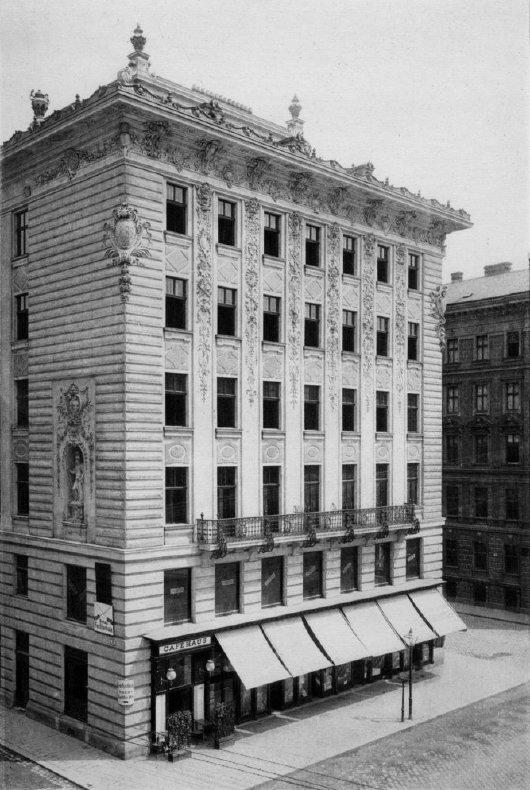
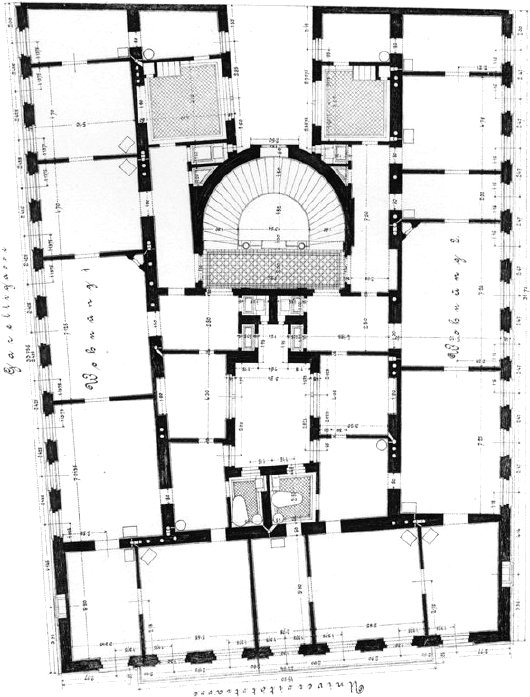
The unbuilt Imperial Russian Embassy in Vienna
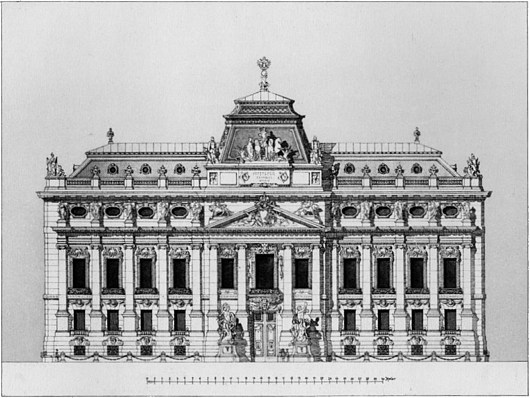
Otto Wagner was an exceptionally talented architect, though not, I think, the genius that many people would credit him with being. In the most emblematic work for which he is known, the Kirche am Steinhof in Vienna, there is too much angularity and not enough flow, curvature. For a free-standing structure it feels a bit stultified and uptight despite the brilliance of the individual elements of the design. I much prefer his Post Office Savings Bank and Stadtbahn stations.
Stumbling through the archives the other day, I came across this unexecuted Otto Wagner design for an Imperial Russian Embassy in Vienna: one now-vanished emperor’s embassy to another. From earlier in his career, it’s not as distinctively Ottowagnerian, but I admire the composition of the façade. The bulbous curved projections into the courtyard, however, are unfortunate, and too large for the space. (more…)
Arab Newspapers
Having recently made my first venture into the Middle East, I thought I’d provide a brief overview of the pan-Arab newspapers that are read by exiles, businessmen, and intellectuals in Arabia and the diaspora.
The Impetuosity of Youth
From the Flickr feed of South Africa’s Etienne du Plessis:
These pictures were taken 2 October 1964: I was the pilot [writes Quentin Mouton]. The pictures are original and not ‘touched up’. The ‘Pongos’ (Army types) were on a route march from Langebaan by the sea to Saldanha. The previous night in the pub one of them had said: “Julle dink julle kan laag vlieg maar julle sal my nooit laat lê nie!” (You think you can fly low, but you will never make me hit the deck). Hullo!!!
I went to look for them on the beach in the morning and was alone for the one picture. I was pulling up to avoid them. In the afternoon I had a formation with me and you can see the other a/c behind me. (piloted by van Zyl, Kempen, and Perold).
A friend by the name of Leon Schnetler (one of the pongos) took the pics. The guy that said “Jy sal my nie laat lê nie!” said afterwards that he was saying to himself as I approached: “Ek sal nie lê nie, ek sal nie lê nie” (I wont go down, I wont go down) and when I had passed he found himself flat on the ground.
Memories from the past.

African Independence

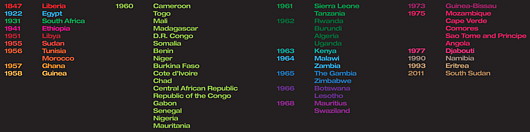
The nifty ‘Tumblr’ site Afrographique, which Africa-related facts and statistics in a visually appealing and accessible way, created a handy chart of all the countries of Africa and the years they became independent. The chart correctly gives Zimbabwe’s date of independence as 1965, even though it had a brief return to colonial status for a few months in 1979-1980. Yet it lists Ethiopia’s “independence” year as 1941, despite the fact that Ethiopia has arguably been independent forever.
The Empire of Ethiopia was founded in 1137 with the ascent of the Zagwe dynasty (responsible for the country’s world-famous rock-hewn churches), and while it was occupied by the Kingdom of Italy (whose monarch usurped the title ‘Emperor of Abyssinia’) from 1936 to 1941 with a continued insurgency and a lack of abdication by the legitimate emperor, Haile Selassie, there’s a strong case that Ethiopia retained her independence throughout but merely suffered a temporary foreign occupation.
Despite this arguable discrepancy it’s not nearly so bad as Africa Report, which published a chart claiming that South Africa gained its independence in 1994. Pray tell, what colonial power ran South Africa before 1994? South Africa was unified and gained dominion status in 1910, and Afrographique goes for the much safer independence date of 1931 when the Statute of Westminster was adopted asserting the sovereignty of the dominions of the British Empire. Some Afrikaners claim South Africa did not become independent until the Republic was declared in 1961, but this is neither legally nor constitutionally the case as the country as an internationally recognised sovereign independent nation merely changed its form of government from a monarchy to a republic.
Afrographique has a number of other interesting posts, including African Nobel Prize winners (nine of them South African, across medicine, peace, and literature) and the ten richest Africans (fellow Matie Johann Rupert is #4).
Marlow’s St Paul’s Capriccio
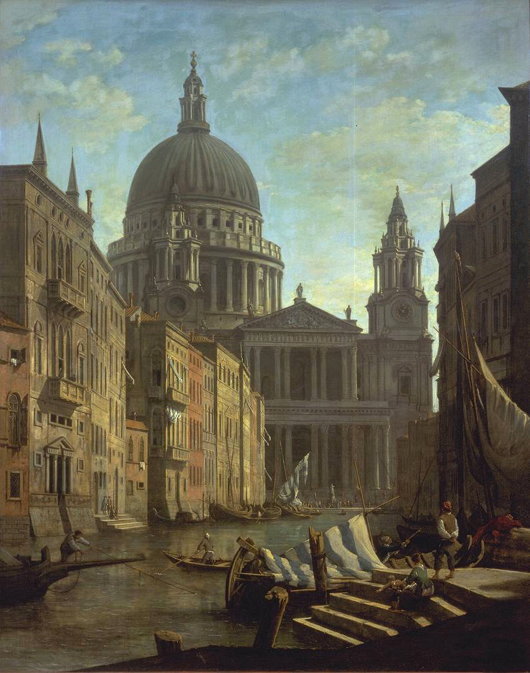
c. 1795; oil on canvas, 60 x 41 in.; London, Tate Gallery
The view of St Paul’s Cathedral as if it had been completed according to the original plans of Wren and with Hawksmoor’s baptistry (which I posted yesterday) reminded me of this capriccio by William Marlow. And then this in turn recalled my 2005 post If London Were Like Venice.
The Perfect Place for Coffee
I’m not sure when I became the sort of person who lounges around drinking coffee. I was never much of a fan of coffee, and remain deeply suspicious of it (hence, for example, refusing to become a daily coffee drinker — very dangerous!). I suppose it was on pilgrimage to Rome in my fourth year of university when I was introduced to the blessed simplicity of cappuccino e cornetto for breakfast; a total riposte to the traditional Scottish morning meals of my habit up ’til then.
After Rome, my daily habit became to rise around 9 o’clock, complete one’s morning toilette, head out around 10 to pick up Le Figaro and maybe The Scotsman if I was in the mood, and then a sugar doughring from Fisher & Donaldson, after which I would sit in Taste, the minuscule place on North St at the top of Murray Park which serves the best coffee in the Royal Burgh, for about an hour or so reading and staring out the window episodically while nursing a cappuccino. This was an exceptionally enjoyable routine, brought to an abrupt end by the cruel realities of the forward movement of time and finishing one’s degree.
Whether rightly or not, I’ve no idea, the concept of dwelling over coffee seems more a habit north of the Alps than south. The quick coffee seems more Italian, and more than once I stopped into Taste with Stefano or others for an unponderous espresso when an afternoon pick-me-up was deemed amenable.
But for the most part, I prefer to rest with a bit of coffee, and read something interesting. Last summer I found myself with a lot of free time in London and spent the greater portion of it in a curious little café-bar not open to the general public reading long historical articles off of JSTOR on such fascinating subjects as the origins of Argentine militarism or the unexpected nineteenth-century German Catholic revival as well as translations of the indispensable Pierre Manent printed in Modern Age.
There was barely ever anyone there in high summer except the two barstaff, myself, and a haggard journalist in late middle age sitting at the bar nursing his first pint of the day. I still go there from time to time, and recently enjoyed sitting there reading Perry Anderson’s trilogy of insightful, deep, and informative articles on India from the London Review of Books (‘Gandhi Centre Stage’, LRB 5 July 2012; ‘Why Partition?’, LRB 19 July 2012; ‘After Nehru’ LRB 2 August 2012).
There is a Pret near my flat where the staff are very nice, but I remember one Saturday morning when I actually stirred from my slumber and fancied catching up with the weekend Irish Independent. I happened to sit next to an awkward Indian computer engineer on a blind date with a Polish girl lacking in self-esteem. I found I could barely get any reading done with them nextdoor and instead relayed the essence of their conversation to a pretty girl sitting in bed in Oxford reading Glamour, who relayed back her own thoughts. The pros and cons of your average Pret come to mind and encourage me to explore what the perfect place for coffee would be like.
First, a coffee place should be mildly popular. There ought to be enough people milling around that it feels lived-in but not so many that you can rarely find a place to sit. The staff must be highly competent in their coffee making, and preferably either young, pretty, Italian, and female or else French chaps with a slightly haughty demeanour until the third or fourth time they see you. We will also accept vaguely hippie/alt-ish characters mostly from the Continent or occasionally the Antipodes. And Inez. (Inez, you can work at any coffee place approaching perfection).
Counter space! This cannot be emphasised enough: there ought to be counter space. I dislike when places have large, tall, bulky displays of the variety of pastries and such on offer and then have a tiny little open space to give your order and pay, etc. Broad counter spaces relay a certain openness and give the impression that the staff behind the bar are accessible. By all means display your delectamenta but you should aim for balance and harmony in your serving area.
There ought to be counter seating as well. Lots of coffee places put this at the window, which is acceptable, but as I like to sit in a large comfy chair and stare out the window, this is impeded by window counter seating, and thus I am mostly against it. And windows: we must have windows, preferably big giant ones with a single plane of glass looking out on a somewhat busy street, or even better a small public square.
Seating is one of the most important aspects. Hard or soft? High tables or low? In a word: both. There ought to be more café-style seats and round tables for when there’s three or four of you gathering, but also soft big comfy chairs for when that feels more appropriate. Different coffee-imbibing situations require different kinds of seating, and the perfect place for coffee should offer both.
I’ve yet to find the perfect place for coffee in London. I was quite fond of the Caffè Nero on Warwick Way in Pimlico with its huge glass panels that open up on summer days, but now that I no longer live in Pimlico it has ceased to be useful or easy to get to. As chains go, I tend to err on the side of Pret, perhaps merely out of habit. Whatever you do, just don’t go to Starbucks. Have some dignity and self-regard.
And if you do find the perfect place for coffee, do let the rest of us know.
Carl Laubin’s Architectural Fantasies
While the subjects of his works are varied, Carl Laubin has become best known for his architectural paintings. Born in New York in 1947, he veered into architectural painting when he was taken on by the London office of Richard Dixon — now part of Dixon Jones, the firm responsible for, among other projects, the Royal Opera House and the redesign of Exhibition Road. With an eye for detail, he has completed capriccios displaying the total built corpus of Hawksmoor, Cockerell, and, most recently, Vanbrugh, while the National Trust also commissioned him to paint a capriccio of all the houses currently within their care.
More of his work can be viewed at the website of Plus One Gallery, and a book of his paintings has been published by Philip Wilson. (more…)
The UN at Quebec
IN 1943, THE BRITISH, Canadian, and American governments descended upon the city of Quebec, capital of la vieille province, for an intergovernmental conference to plan the invasion of France — surely one of the greatest military tasks ever undertaken in the modern era. The site proved auspicious due to a peculiar combination of factors: Quebec City enjoys a certain European cachet but with both the geographic safety of North America and the more spacious accommodation usual to that continent. The three governments held a second conference there in 1944, and in 1945 the International Labour Organisation met in the city, followed a few months later by the Food & Agriculture Organisation of the nascent United Nations.
With this track record of indisputable experience, the ville de Québec, lead by its mayor Lucien Borne, put in a bid to be the permanent seat of the United Nations Organisation. (more…)
Ireland needs an undeniably world-class university
NOT A SINGLE Irish university made it into the top 100 of the Times Higher Education World University Rankings this year, but reviving an old proposal might give Ireland more global clout in the academic sphere. While all rankings systems are on some level arbitrary, the THE takes into account the views of over 17,000 academics across the planet and gives us an insight into how institutions — and by extension their host countries — are perceived not only in academia but also in the perhaps more lucrative field of research and development.
Being pushed out of the top 100 doesn’t necessarily indicate that higher education in Ireland is in any crisis; it could merely reflect the comparative rise of other institutions in countries which are beginning to appreciate the value of academic research and institutional prestige. But a country shouldn’t rest on its laurels, and it’s worth asking: Is Ireland missing an opportunity to have a university of unquestionable world-class status?
Reflecting on the 2012 THE rankings, political commentator Richard Waghorne suggested via Twitter that it is high time that University College Dublin, Trinity, and Dublin City University were amalgamated into the University of Dublin. This is an idea with a long heritage which, even if it is to be rejected, needs to be considered seriously. (more…)
A Mantelpiece
ONE MUST ALWAYS have a mantelpiece. That, at any rate, is my considered opinion. It is a focal point where one can place random objects of vague significance upon it as a salutary reminder of the varied importance of the numerous sectors of one’s life and the gentle interplay therebetween. In my admittedly brief (yet increasingly less brief) existence, I have had several mantelpieces. Indeed, I was even for a year at university in possession of a listed mantelpiece though, sadly, it was abused by the presence of an interloping non-functioning electric heater. But my current riparian London residence is augmented by a number of mantelpieces, one of which fortuitously sits in my own bedroom. While I generally prefer to leave things unexplained, here is a little guide to my mantel as it now stands.
Behind the entire tableaux hangs a French map of Africa I picked up during the summer I lived in Oxford. The recent independence of South Sudan renders it inaccurate, in addition to two or three vexillological changes in its corner display of flags. From left to right, we have the pennon of the Order of Malta in Scotland; the piece of the Berlin Wall my kindergarten teacher brought back from Germany for me; a Rackham postcard from Don Riccardo illustrating depicting a scene from Baron Foqué’s Undine (“Soon she was lost to sight in the Danube”), to which Don Riccardo has added the cryptic line “The fate, it seems, of all Cusack’s loves”.
Next is the glass flask with leather covering I picked up at an antiques place in Millbrook when wandering around hunt country with the Gills; a postcard of Bonnie Prince Charlie sent by the Cap’t as a thank-you note for hosting lunch at Rocca with our favourite ancient veteran of King’s African Rifles; the order of service from the University of St Andrews Alumni Club London carol service; a small bottle of Unicum brought back from Hungary by E.W.; a Marian prayer card from Tom & Alice; a little unpretentious triptych some relative bought; my Order of Malta Lourdes pilgrimage medal; an Infant of Prague retrieved from my grandparents’ house; a St Benedict medal (perhaps obtained at Downside).
The bottle of Boplaas Port was kindly (and perhaps unintentionally) left by one of the previous South African residents of our flat. It was finished off by our Continental correspondent Alexander Shaw and I late one night when he had just alighted the Eurostar and not yet had time to drop his bags off at his grandmother’s place a few minutes up the river on Chiswick Mall. Cornelius Bear is dressed in the red gown of a St Andrews undergraduate. Behind him is a Quebec automobile numberplate and a prayer card from St Philip’s Day 2012 at the Oratory. My Magister Artium diploma is rolled up in its tube next to an empty box of Dunhills purchased in Milan — “Il fumo invecchia la pelle” it warns. Surmounting all is a palm from Palm Sunday at the Oratory.
London to Istanbul
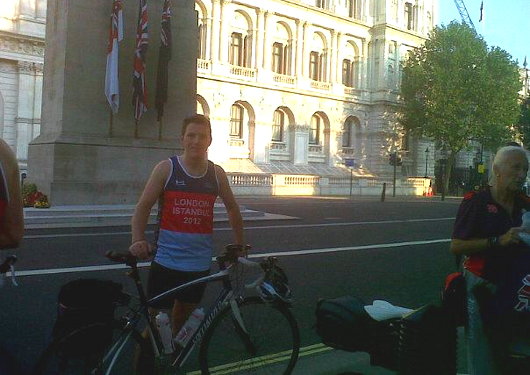
As we speak, Kit S-W is en route from London to Istanbul via bicycle, raising money for Help for Heroes. He and his team of fellow Exonians departed from the Cenotaph (photo above) at the ungodly hour of 7:00am Thursday morning. We were meant to be there to provide moral support, but some Lebanese friends were in town the night before and with the ensuing joviality I couldn’t extract myself from bed until just past 11:00am.
Oh well. Of the twelve siblings at least one sister was there. If you want to put a bit of dosh in the cap of this worthwhile cause, nip over to Kit’s JustGiving page, where you’ll see he’s currently 70% towards his target of £1,350.
Little Ben
 WALKING THROUGH Victoria recently, I was horrified to see the recent renovations and street improvements have led to the disappearance of ‘Little Ben’, the small Victorian clocktower that sat in a traffic island halfway between Westminster Cathedral and Victoria Station. Little Ben is a convenient meeting place in a district that is rather uninspiring and surprisingly lacking in conveniences.
Why, for example, is there no decent pub in Victoria? If you need a meal, Grumbles of Pimlico is walking distance, and they treat you well at Il Posto. But a decent pub atmosphere is not to be had, unless you fancy The Pub Formerly Known as the Cardinal (now styling itself as ‘The Windsor Castle’).
Happily, a simple Google search reveals that Little Ben’s absence is merely temporary: indeed, Little Ben is taking a rest-cure. The goodly folk at Wessex Archaeology have informed us as such.
The clock owes its creation to Gillet & Johnston of Croydon, who built Little Ben in 1892 and erected it in the middle of Victoria Street. It fell victim to a road-widening scheme and was removed in 1964 but, after sitting in storage unappreciated for some years, it was finally renovated and restored to its original location in 1981.
Transport for London is currently working on a significant upgrade to Victoria Underground Station, including a rearranged traffic alignment on surface level, in addition to new entrances and exits and a great big whopping ticket hall sous la terre. When all is finished and done and in tip-top shape, Little Ben will be returned to his traditional location, and some semblance of order will return to this sector of the most unglamorous Victoria Street.
Politigården
The Police Headquarters, Copenhagen
One of the pleasures of the recent hit Danish television series Forbrydelsen (released in the UK as ‘The Killing’) is the occasional view it provides of Copenhagen’s police headquarters.
Politigården (lit. police-yard) is in a restrained Scandinavian modern classicism and was designed by Hack Kampmann.
It was constructed from 1918 to 1922 but Knapmann died in 1920, and his role as chief architect was assumed by his son Hans Jørgen Kampmann (whose brother Christian was also an architect).
The interior hints towards a variety of styles from Renaissance to Baroque and Art Deco, while the building rises around a large central circular courtyard roughly the same diameter as the Pantheon in Rome.
Some architectural historians consider Politigården the last neoclassical public building in northern Europe (so far, that is). (more…)
Overwhelming the Farber Building
A bland glass-plated giant will piggy-back onto a sound example of the Modern Movement in Cape Town
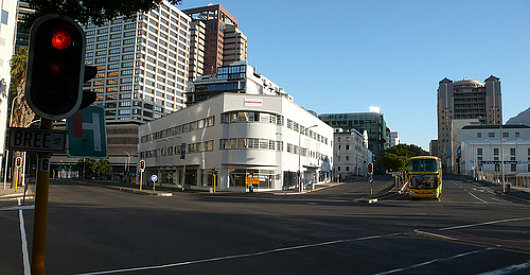
The Farber Building, one of the few extant examples of the Modern movement in architecture in Cape Town, is to be overwhelmed by an eighteen-storey plate-glass skyscraper. The developers had sought to have the 1935 building designed by Roberts & Small demolished, but the city fathers wisely refused permission. The price of its salvation, however, is that the boring skyscraper will piggy-back onto this actually rather inoffensive Modern structure. (more…)
The Iconography of Party
Taking into account the important aesthetical nature of politics, it might be worthwhile taking a sweep round the political parties to see what their emblems, logos, and symbols look like. (more…)
Search
Instagram: @andcusack
Click here for my Instagram photos.Most Recent Posts
- Brunel’s Unbuilt Capitol February 3, 2026
- Cricket at Fordham January 27, 2026
- Palacio Barolo Revisted January 14, 2026
- Learning to Love Liguria January 14, 2026
- Crux Alba No. 2 January 13, 2026
Most Recent Comments
Book Wishlist
Monthly Archives
Categories