About Andrew Cusack
 Writer, web designer, etc.; born in New York; educated in Argentina, Scotland, and South Africa; now based in London.
 read more
News
Blogs
Reviews & Periodicals
Arts & Design
World
France
Mitteleuropa
Knickerbockers
Argentina
The Levant
Africa
Cape of Good Hope
Netherlands
Scandinavia
Québec
India
Muscovy
Germany
Academica
A Maori in Buenos Aires
The Argentine stopover of Te Pēhi Kupe
So  far as I can tell, the first Maori to visit Argentina (or the United Provinces of the River Plate as it was then called) was the young nobleman Te Pehi Kupe in October 1824. (The name is spelt varyingly as Te Pēhi Kupe, Tupai Cupa, Te Pai Kupa, and Tippahée Cupa). Te Pehi was born on the North Island, probably around 1795, and was a senior-line descendant of Toarangatira (founder of the Ngati Toa tribe) as well as an uncle to the more famous Ngati Toa chief, Te Rauparaha.
Most of New Zealand was a bit of a mess at the time, as various Maori tribes fought each other for land to grow potatoes on. Te Pehi Kupe, being a chief and military leader, was desirous to go to Europe in order to obtain weapons for his tribe. When the British ship Urania went past the southern tip of the North Island, Te Pehi forced himself aboard despite the violent resistance of the ship’s officers and crew. When asked what he desired by the Urania‘s captain, Richard Reynolds, Te Pehi replied in broken English, “Go Europe, see King George”.
Captain Reynolds did not think this a good idea and, knowing the Maori to be good swimmers, tried to have him thrown overboard, but the native nobleman’s physical strength prevented this. (And a good thing, too, as Te Pehi managed to save the Captain from drowning later on in the journey.)
The Urania made its return to England with Te Pehi Kupe aboard, calling at Lima and then sailing around the Southern Cone, where they called in at Buenos Aires. George Thomas Love provides us with an account of the Maori’s arrival in A Five Years’ Residence in Buenos Ayres (published in 1827):
In the month of October, 1824, the visit of a New-Zealand chief to Buenos Ayres, by name Tippahée Cupa, attracted much curiosity; he arrived in the British ship Urania, Captain Reynolds. Tippahée came alongside this ship in Cook’s Straits, with a war canoe filled with his people, and, in spite of the remonstrances and even force used by Captain R. refused to quit the vessel, expressing his determination to proceed to England. He bade his followers an affectionate adieu, enjoining obedience to his successor during his absence. The Urania sailed for London with her passenger the 8th December, 1824.
Tippahée, when he first arrived in Buenos Ayres, was clothed in an old red coat, formerly belonging to a London postman. The English paid him many attentions, inviting him to dine at their houses, and new clothing him. His behaviour at table was easy and unembarrassed; and, when requested, he would perform the dances and war songs of New Zealand. He understood a little of the English language, and spoke a few words of it; his intelligent manners, and circumspect conduct, rendered him an universal favourite.
On the map he could trace the ship’s course from New Zealand to Lima and Buenos Ayres. He knew an Englishman immediately; the Spaniards he did not much admire, fancying they viewed him with contempt, and was glad to get among Englishmen. His age is about forty; he possesses amazing strength; his tattooed face and appearance always attracted a crowd after him in Buenos Ayres.
On board ship he was found very useful, doing all sorts of work, but he positively declined to go aloft. The fate of Captain Thompson, and the crew of the British ship Boyd, ought to bespeak caution in using coercion with these savage chieftains of New Zealand.
In Cruise’s book of New Zealand, Tippahee was shewn a picture of a chief of his country, with which he was greatly delighted. The object of his journey to England is to solicit arms and ammunition, to place him upon a par with a rival chief, who possesses those requisites.
In England, Te Pehi was indeed presented to King George IV. He also learned to ride, visited factories, was given many gifts, and survived the measles before leaving England aboard the Thames on 6 October 1825. In Te Pehi’s absence abroad, peace had been agreed between the Ngati Toa and their Ngati Apa rivals. Ngati Toa eyes soon turned to the South Island, and during the military campaign there Te Pehi Kupe was killed, his body cooked and eaten, and his bones turned into fish hooks.
Still, at least he enjoyed Buenos Aires before he died.
The Dome of the Custom House, Dublin
THE MOST RECENT series of the ITV detective drama “Foyle’s War”, though set in London, was filmed entirely in Dublin. (Ah, those Bord Scannán incentives!). I’ve noticed a phenomenon in which something set in England but filmed in Ireland suffers from English stereotype overcompensation. What this entails is unnecessarily sticking noticeably English ‘things’ (double-decker bus, red pillarbox) into the frame when, if filmed in England, the directors might otherwise be satisfied without these subconscious emblems reassuring the viewer that they are not in fact in the country the programme was actually filmed in.
So two characters meeting on a street of Georgian houses will have a red post box shoved into some arbitrary place on the street to remind us we’re in jolly old England. Despite this, any devotées of the Georgian style will recognise the Irishness of the houses because of the subtle yet noticeable difference between the Georgian styles of, say, London, Edinburgh, Bath, and Dublin.

Anyhow, not to reveal too much of the plot of this latest series, but Chief Superintendent Christopher Foyle is recruited into a post-war British intelligence gathering organisation. The exterior shots of the building used as this group’s headquarters is the Custom House on River Liffey in Dublin, only the show’s producers have digitally removed the building’s prominent dome, presumably in order to make it less distinctive and identifiable. (more…)
Into the Qadisha Valley
THE HOLY VALLEY cuts down like a gash in the earth, with the cathedral city of Bcharré on the clifftop, almost hanging off of it. One almost wonders if you started building at the other end of the town, it might force St Seba’s Cathedral off over into the deep beyond. There is something almost Lord of the Rings about the setting, a Levantine Minas Tirith, if only Tolkein had been a Maronite.
The Qadisha Valley (Ouadi Qadisha, وادي قاديشا, literally the “Holy Valley”) takes its name from the Aramaic word for saintly and for over a millennium its natural caves have provided shelter for hermits seeking solitude as well as others seeking refuge and safety. Evidence of human habitation dates back to the Paleolithic era, and the Qannubin Monastery here is said to have been founded by the Emperor Theodosius the Great in the fourth century. While this is the holiest ground of the Maronite Catholics, hermits living in these caves and in these monasteries have been Melchite, Nestorian, Armenian, Syrian Orthodox, and Ethiopian. When the Monastery of St Maron was sacked by Antiochene Monophysites, many monks fled to the Qadisha Valley, strengthening the presence of this Eastern church which has always remained in communion with Rome. For over five hundred years, the Maronite patriarch made Deir Qannubin his seat. (Since 1830 the Patriarchate has been based at Bkerké above the pleasant Mediterranean city of Jounieh). (more…)
Lebanon Diary
Early evening sun illuminates the pendentives and architraves of the Maronite church. Discoloured prints of numerous saints — of East and West — crowd one of the few side altars. The Arabic numerals indicate the date of its dedication: 1971 — before the war.
Without internet in a remote village in northern Lebanon, elevation 500 ft, we are cut off from the outside world. Word reaches us of a military coup in Egypt. (I hate missing a coup!) The reactions are a mixture of relief and caution, and a little wonderment at how things must have moved very quickly. Curiosity is sparked as to what else is going on in the world outside Sourat.
Dappled sunlight. Unfamiliar saints. A lizard scurries past, its long processional tail trailing behind it.
D.G. of the Financial Times drops in and brings that commodity we most desire: news from elsewhere. I quiz him on the coup in Egypt, how it played out, how it was orchestrated, and what he thinks of it, but there is little time.
At night, reading Ian Fleming’s From Russia With Love on the terrace with a Gauloise and a bottle of Almaza. Two wolves cry in the distance and I remember hearing the snorting of a wild boar a few nights previous. One chased Emmanuel on his way back from ‘the Palace’ (as we have dubbed the Abouna’s house, where the honoured guests stay) and was shot and killed — the photos of the quarry being displayed on an iPhone handed round.
The night is punctuated by the sound of repeated explosions in the distance. Luckily these are fireworks — a particular Lebanese obsession. It seems symptomatic of the Lebanese mentality that — having spent so long being so close to death — it is necessary to celebrate being alive. One may as well have a good time, and the Lebanese are experienced at having a good time.
In the car on the way to the pharmacy, Mahe our indispensable handyman (and a refugee) talks to Niall about Syria. “Syria. Big war. Boom boom. Muslims fight Assad. Assad fight Muslims. Big war.”
BUILD! BUILD! BUILD! Beirut is abuzz with cranes and construction and wood boarding over the site of new projects. That tower wasn’t there last year, was it? No. And doubtless by next year new spires will scrape the sky over St George’s Bay, where the saint slew the dragon. Is he dormant there beneath the waters still? Something lurks perpetually beneath the Lebanon, occasionally raising its head above the surface in open violence. Just then a Hezbollah building in the southern suburbs is bombed. The list of assassinations in this country’s history is long and depressing, from that of Maarouf Saad which (arguably) sparked the fifteen-year Civil War, and of course the former prime minister Rafik Hariri’s killing in 2005. Even since Hariri’s death, no fewer than twelve Lebanese public figures have been assassinated.
Have you ever been to Rafik Hariri’s tomb? It’s a slightly vulgar thing, still shrouded in its temporary marquee, giving it a somewhat transient feel, as if it might up sticks and away to Sidon or Tripoli at a moment’s notice. We nipped in the other day after a trip to the adjacent mosque he had built, completed in 2007 with its brilliant blue dome. The mosque’s design is traditional but not entirely perfect. The massive crystal chandelier hanging from the vast central dome is impressive but perhaps a bit much. Somehow, we are deprived of ancillary spaces: going through the main entrance one feels a certain lack of procession. No narthex, no nave, you just take off your shoes, step through the open doors, and are there. Why not one of those spacious courtyards which grace so many older mosques? Land in Beirut doesn’t come cheap.
Of course, when it was completed it was noticed that the minarets overshadowed the campanile of the adjacent Maronite cathedral, which meant the Catholic bell-tower had to be rebuilt to be at least the same height as the Sunni minaret, or perhaps an inch taller. Just to be on the safe side.
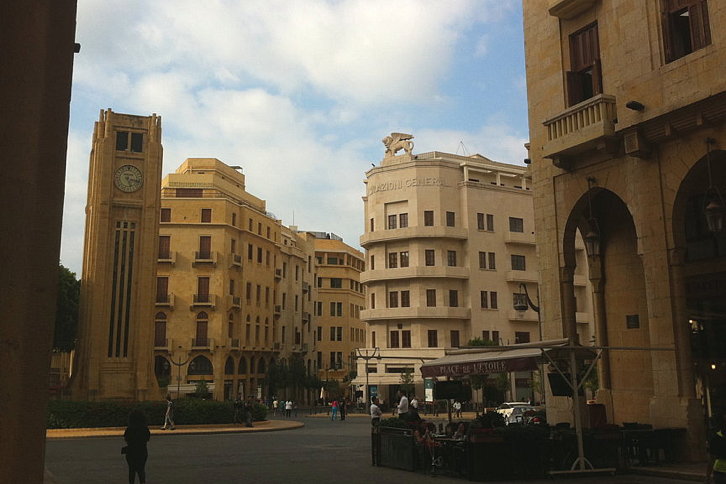
We had arranged to meet G. and the others twenty minutes later at the Grand Café on the Place de l’Étoile, which was a silly idea. A wedding was finishing at St George’s, the Greek cathedral, as we rolled up and we joined in the applause for the happy couple when they exeunted the church. In between, however, we nipped in to Hariri’s tomb, or perhaps shrine is the more appropriate word. It is choc-a-bloc with oversized portrait photographs of the smiling premier in his prime — a mix of political, semi-tribal, and religious devotion. The soldiers guard it nonchalantly and seem glad for some visitors on a Saturday afternoon. One presumes plans are being made for some grand mausoleum to supersed the transient tent with its faint hint of a vagabond yurt. We had to move on to a rather trendy place in Gemmayze, Mo stopping along the way as he ran into friends.
These nuns are magnificent: it is impossible to respect them enough. They do an impossible task taking care of so many physically and mentally handicapped, on very little resources. They take anyone and everyone under their wing — Christian, Muslim, Druze, whatever. Their founder, Abouna Yaacoub (Père Jacques), is up for canonisation and the fruits of his foundation are still flowering. We’ve visited a number of the care homes they run — in Antelias, Dar al Kamar, etc. — and while the conditions are very basic I think the love these nuns have shines through. They have devoted their entire lives to serve these men and women who often, ignored and forgotten, have no one else. They are also completely clued in; you wouldn’t be able to get anything past them. The Mother Superior’s mobile rings, she answers and buzzes off away to put something right.
Arabic is a beautiful language, though at its most beautiful when spoken by women. (But then: isn’t every language?)
“Our relationship to France is completely different. We were never a colony, only a protectorate, a mandate. My grandparents still refer to France as the mother country.” Still, the decline of the French language here is noticeable, as is the concurrent advance of English. The new global tongue dominates billboards and advertisements, not to mention the radio. In some places in the countryside, I’ve seen new streetsigns in Arabic first and English second: no French. (Beirut seems to have escaped this phenomenon).
If Lebanon ever loses the French language, it will lose part of itself. But the Lebanese, who have many admirable qualities, are expert businessmen — merchanting is in their blood — and English is the language of business. Not just business, but culture too: if you’re given a handbill advertising some small art show or exhibition, it’s invariably in English.
An evening party at a family home in Bsous, on the hills overlooking the capital. Everything is simply perfect. R, S, and I sit down amidst the grove of olive trees and immediately a small table with nibbly things is moved to just before us for our convenience. Beer, wine, and merriment flow and while the pool shines glows eerily as the lights of Beirut twinkle before us. Our hosts speak little English but we make do with French. P.A. claims (in that way that he often does) that P.’s father is so brilliant he was Minister of Finance to both Lebanese governments during the Civil War. When was this house built? 1890s? 1910s? It’s hard to tell. It suffered during the war but has been restored well and sensibly. Its location is beyond envy and I only wish we were here during the day to see the view across Beirut to the Mediterranean beyond.
Curiosity Killed the Cat
Or: our love/hate relationship with the Phoenix, Chelsea
It was an unusually warm evening for a night in March, which is to say that it was not horrendously cold and you could tarry a while outside without fear of frostbite. Given the nature of his job, Nicholas is not frequently free to socialise, as he has to be doing certain things in certain places at certain times, which sometimes involves being in Greece or a sudden trip to Anguilla (“I’m not doing any more Caribbean islands — I’m fucking tired of them.”). But when he does manage to free himself from indentured servitude, we often find ourselves at the Phoenix on Smith Street.
All sensible right-minded people love the Phoenix and hate the Phoenix. It is a wonderful place, comfortable and delightful, yet somehow attracts the very worst and most tiresome lot of humanity. “Look at these estate agents,” Nicholas moans in the put-on snobbery which has become one of his traits. “They all live in Fulham I’m sure.” (Which is rich, as I live even beyond Fulham). Kit and H. were dining there with Ivo & la B a week or two earlier (or later) and such was the tiresomeness of the crowd that Kit texted Ivo “What a bunch of overgrown yuppies” (or something along those lines).
It’s delightful during the day, and there was one afternoon not long ago when, sauntering down the King’s Road, I ran into Prof. Pink on his way to John Lewis and managed to waylay him into an enjoyable conversation at the Phoenix over two large glasses of the house white. But during the evening the crowd gets so horrendously up-itself that it almost becomes an attraction in itself. “It’s ten o’clock on a Friday night. Shall we drop in to Smith Street and see how awful everyone is?” The experience ends up infecting one with a reverse snobbery almost as snobbish and pretentious as the pretentious snobbery one is reacting against in the first place.
As I was saying, it was a warm evening and Nicholas managed to find an ideal parking spot within sight just round the corner on Woodfall Street. I think it was a Friday or a Saturday so naturally the place was packed inside and I’m partial to the occasional Dunhill so enjoying an exceptionally refreshing cider outdoors with a cigarette was the obvious way forward. I lit up and Nikolai — very generously, as I’m sure it was my round — went inside to brave the crowds in search of drink. Now the curious thing about the smoking ban is that it has turned previously insular cells of humanity — smokers, that is — into a sort-of fraternité universelle. People who have absolutely nothing in common but for being at the same drinking establishment now, for better or worse, through the medium of tobacco, enjoy a recognisable commonality which can frequently turn conversational.
A little Spanish man with a moustache had a party inside celebrating his birthday — 31st, I think — and he ventured outdoors for a smoke and somehow or other conversation was initiated. A pleasant enough fellow but his chat was unexceptional and was suddenly interrupted by the arrival by cab of two tall-ish and rather fashionable Azeri girls, who may have been friends of friends of his or may have had nothing to do with him at all. Being a chatty Spaniard (and perhaps a bit ambitious) he engaged them in conversation almost as soon as they alighted their cab.
After the innocuous pleasantries of introduction all round he eventually asked the Azeri duette, “So where do you girls live?” “Knightsbridge” they replied. “Ah, cool, I’m in Knightsbridge a lot,” our Spanish friend replied as Nicholas, turning away, launched upon a severe, disapproving rolling of the eyes. “Why?” I interjected, somewhat mischievously pricking the balloon of his pretentiousness. After all: what possible excuse could anyone who neither works nor lives there reasonably have for being in Knightsbridge a lot? He turned towards me and with an irritated smile said “My friend, you are too curious; you ask too many questions.”
The Azeri girls remained unconvinced of him, and the birthday boy, having finished his cigarette (which I think came from my pack), sheepishly returned inside where his presumed friends had doubtless continued the celebration of his birth in his brief absence.
But we still all love the Phoenix.
Some Aspects of the Fall of the Fourth Republic
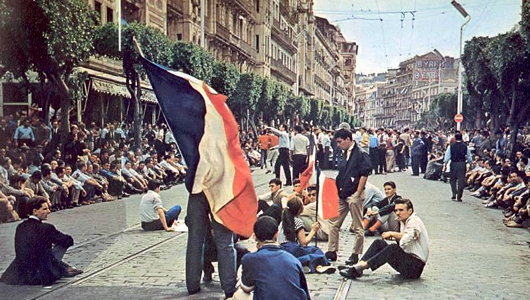
(Only interesting, I’m afraid, to those reasonably acquainted with the situation of France in May 1958)
• The French-Algerian instigators of the military rebellion led by Salan didn’t know what to make of him when he was first appointed to Algeria so they decided, just to be on the safe side, to assassinate him on his first day on the job. Salan survived the bazooka attack on his office but his ADC was killed. The general later became the only socialist freemason to lead a right-wing terror group (the OAS).
• Once the Algiers rebellion commenced and travel between Algeria and metropolitan France was cut, many supporting figures made their way across the Mediterranean by whatever means at hand. Soustelle managed to escape his police guards and get to Algiers via a secretly chartered Swiss plane, but the more romantically inclined Roger Frey — later Minister of the Interior — first tried to get to Algiers on the actor Errol Flynn’s yacht. It didn’t pan out, and instead he was forced to hire the boat of an English ex-naval officer turned smuggler.
• The man in charge of wiretapping French telephones was unsure which side would emerge on top so cautiously refrained from giving the government the full picture of the information his wiretaps revealed.
• When Corsica was seized by the rebels, Moch, the Interior Minister, decided to send in the elite of the police force, the CRS. He was afraid, however, that military transport planes would fly them directly to Algeria, so he was forced to commission Air France planes instead. Upon landing in Corsica, the entire CRS contingent was met by the rebel parachute regiment and immediately defected to the rebellion.
• So widespread was the reluctance to support the government against the military rebels that even the meteorologists send false warnings of storms in the Mediterranean in the hopes of keeping the French Navy from moving against the rebels in Algiers.
• The air force was particularly keen for de Gaulle to take power, and took to flying planes in a Cross of Lorraine formation, as well as sending troop transport planes to Algeria in case they would be needed to invade mainland France.
• Regional military commanders in France varied in their loyalty to the government and sympathy for the rebels. One commander is alleged to have told the regional prefect “M. le Préfet, I am not here to defend your préfecture, but to take it.” Other prefects warned the cabinet that any orders for the police to arrest those suspected of aiding the rebellion might result in the prefects instead being arrested themselves.
• The government had sometimes ordered firemen to unleash their water hoses against rioters in the past. As popular support for the cabinet faded away, the head of the fire brigade felt compelled to inform ministers that his men would not take part in any anti-riot measures but would merely put out any fires that erupted. “And,” he said, referring to the home of France’s National Assembly, “in the Palais Bourbon, they wouldn’t bother.”
• As Philip Williams reports in his article “How the Fourth Republic Died”:
At that night’s cabinet Pleven summed up: “We are the legal government, but what do we govern? The Minister for Algeria cannot enter Algeria. The Minister for the Sahara cannot go to the Sahara. The Minister of Information can only censor the press. The Minister of the Interior has no control over the police. The Minister of Defence is not obeyed by the army.” Said a left-wing Gaullist in the Assembly, “You are not abandoning power — it has abandoned you.”
No. 6, Burlington Gardens
Sir James Pennethorne’s University of London
German university buildings are an (admittedly unusual) obsession of mine, and I’ve often thought that No. 6 Burlington Gardens is London’s closest answer to your typical nineteenth-century Teutonic academy’s Hauptgebäude. And the connection is appropriate enough, as No. 6 was built in 1867-1870 for the University of London in what had once been the back garden of Burlington House (which at the same time became home to the Royal Academy of Arts). Despite the building’s Germanic form, the architect Sir James Pennethorne decorated the structure in Italianate detail, providing the University with a lecture theatre, examination halls, and a head office. Pennethorne died just a year after drafting this design, and his fellow architects described it as his “most complete and most successful design”.
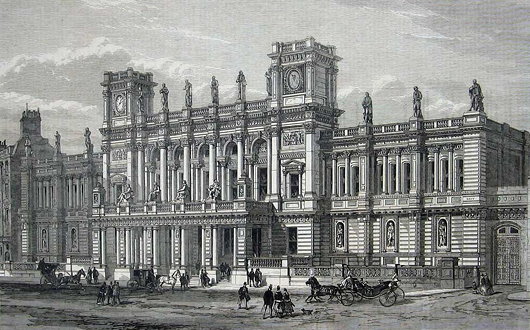
The University of London was founded as a federal entity in 1836 to grant degrees to the students of the secularist, free-thinking University College and its rival, the Anglican royalist King’s College. It now is composed of eighteen colleges, ten institutes, and a number of other ‘central bodies’, with over 135,000 students.
Since its founding, the University had been dependent upon the government’s purse for funding, as well as for housing. Accomodation was provided in Somerset House, then Marlborough House, before evacuating to temporary quarters in Burlington House and elsewhere. It was not until the 1860s that Parliament approved the appropriate grant for a purpose-built home for the University to be erected in the rear garden of Burlington House. (more…)
IHT, RIP
New York Times Kills Off the International Herald-Tribune
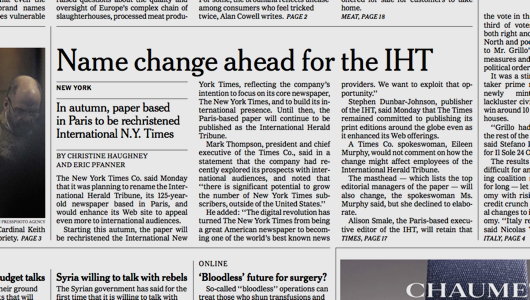
The New York Times Company, owners of the Paris-based International Herald-Tribune, announced recently that they are going to kill off the 126-year-old newspaper. I had predicted back in 2009 that this was precisely what would happen because of the aimless direction the IHT had taken since the New York Times became the sole owners of the title in 2002, after a long period of joint ownership with the Washington Post. The IHT will be merged into the worldwide operations of the Times this autumn and be rebranded as the International New York Times
 Hendrik Hertzberg of the New Yorker bids adieu to the Trib, remembering the first time he left the U.S. in 1960. Crain’s New York Business provides a brief overview of NYTCo’s decision. Margaret Sullivan, the Times’s ‘Public Editor’, reduces any appreciation for the Herald-Tribune as mere emotive romantic nostalgia. Nikki Usher mourns the IHT’s tendency to broaden the Times’s typically American editorial lens. Meanwhile, Ken Layne of The Awl is a bit frank about the decision to drop the Herald-Tribune for The International New York Times: “That’s an incredibly shitty name that makes no sense at all!”
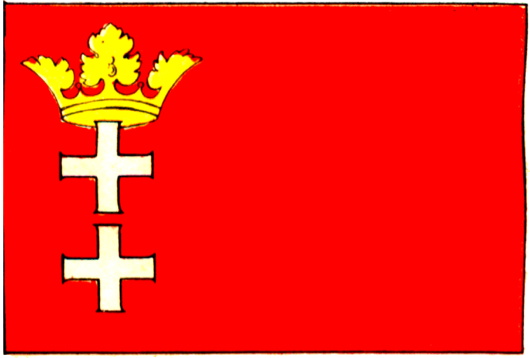
Danzig in Flag & Arms
The first time I met my friend Rafal, I noticed his necktie bedecked with a subtle heraldic pattern. “I gather you’re German,” says young Cusack, summoning his Sherlockian deductive genius. “What makes you say that?” “The coat of arms on your tie: it’s Danzig.” “Actually I am Polish, and it’s Gdańsk!”
Well, so much for my deductive powers, (and Rafal is a secret wannabe-German anyhow) but the arms and flag of the Baltic city — once German, now Polish — combine the usual strong characteristics of any design: simplicity and beauty.
An Original Cusack
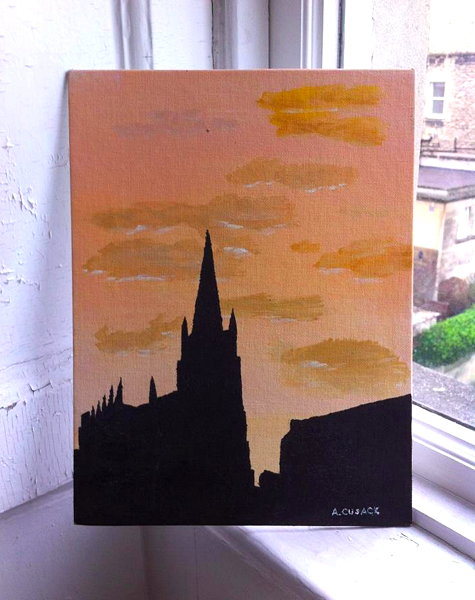
Much to my regret now, I never particularly learned nor pursued artistic skills, but this painting of St Patrick’s Church in Monaghan Town is one of the few fruits of art class from school days we’ve bothered preserving.
I think I was about 15 when this was done; the architecture was from a photo just to have something to stand out against the sunset. Our teacher was very good, but I was a poor student, and inattentive.
An Eclectic Vernacular in Charleston
Two new alleyways designed by George Holt & Andrew Gould
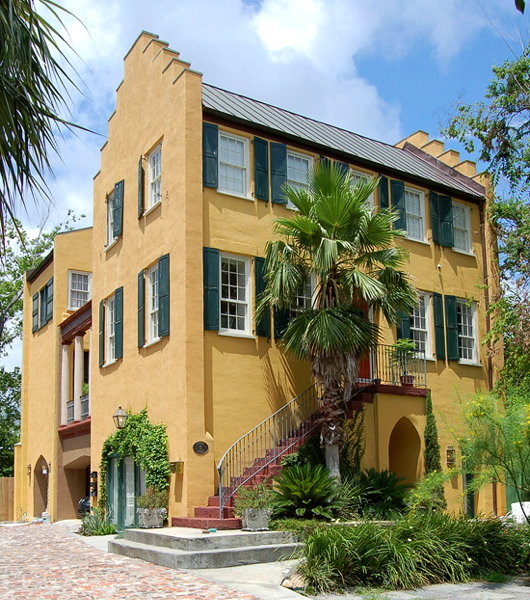
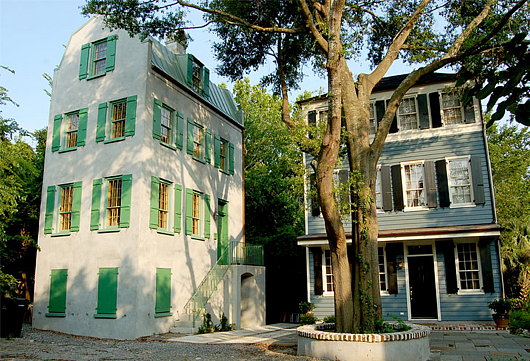
Charleston, the finest city of the American South, boasts two new alleyways designed by the architectural-urbanist partnership of George Holt and Andrew Gould. Holt began buying and restoring old Charleston houses two decades ago, and later expanded his work to building new houses in the traditional style of the town. Recently he’s combined with Andrew Gould, a specialist in the design of Orthodox churches, to craft an “urban infill project” plotting two short alleyways of modern houses built in an eclectic traditional vernacular: Charles Street and Tully Alley. (more…)
The Legacy of 1916
The commemoration of the 1916 rebellion takes place at Arbour Hill prison, where the earthly remains of the executed leaders of the Easter Rising were laid in a pit by the British military authorities. Some of the rebellion’s leaders who did not face the firing squad, most prominently Éamon de Valera and Countess Markievicz, founded Fianna Fáil ten years later in 1926.
Micheál Martin’s address is presented here without comment.
Every state should take time to commemorate and celebrate the people and events of their founding. This commemoration is organised by Fianna Fáil the Republican Party, but we come here as Irish men and women to fulfil our responsibilities to the great generation of 1916.
After 97 years their deeds resonate even more than ever. They saw an Ireland which should not accept limits on its future. They committed everything to the vision of a country with the right to shape its own destiny.
As we quickly approach the centenary of the Rising no one can doubt that the Irish people see the men and women of 1916 as noble and courageous. No one can question their central place in our history. (more…)
The Palace of Holyroodhouse
HOLYROOD IS SUCH a pleasant spot, despite the recent intrusion of an ostentatiously ugly government building designed by a Spanish architect. The other day, while visiting Edinburgh, I heeded the recommendation of the Prettiest Schoolteacher in Clackmannanshire to sample the burger at the Holyrood 9a. It was quite delicious, though not perfect, and was splendidly washed with a pint of Kozel (most un-Caledonian, I concede, but you can get Deuchars in London, you know).
Afterwards, our little party decided to have a little wander down Holyrood Road towards the Palace of Holyroodhouse, the epicentre of the Scottish monarchy.
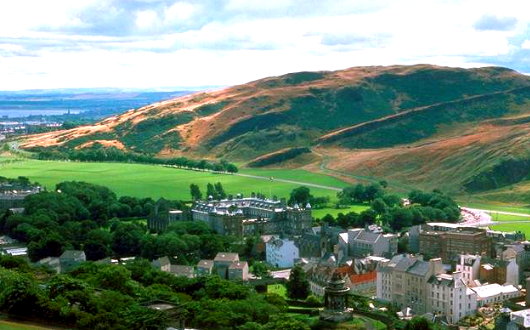
Nestled between Calton Hill and Salisbury Crags, the Palace sits at the end of the Royal Mile that runs between it and Edinburgh Castle. With the Old Town to its west, the expanse of Holyrood Park flows off to the south and east of it. (more…)
The Roman Corner
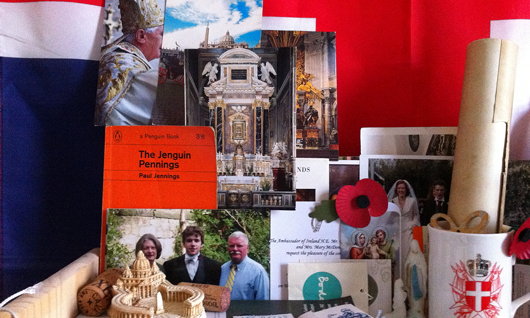
Friends are continually sending me postcards from Rome, such that they have gradually accumulated in a pile in my room. An English friend sent me one, and then an Irish friend saw it while visiting and, doubtless moved by the spirit of one-up-manship, sent one himself, whereupon the first friend sent another, to be followed by the most recent one (which arrived today) of the Chiesa di S. Agostino in the Campo Marzio. A miniature St Peter’s Basilica was recently added to the mix as well.
The Lady Altar
The Oratory Church of the Immaculate Heart of Mary,
Brompton Road, London
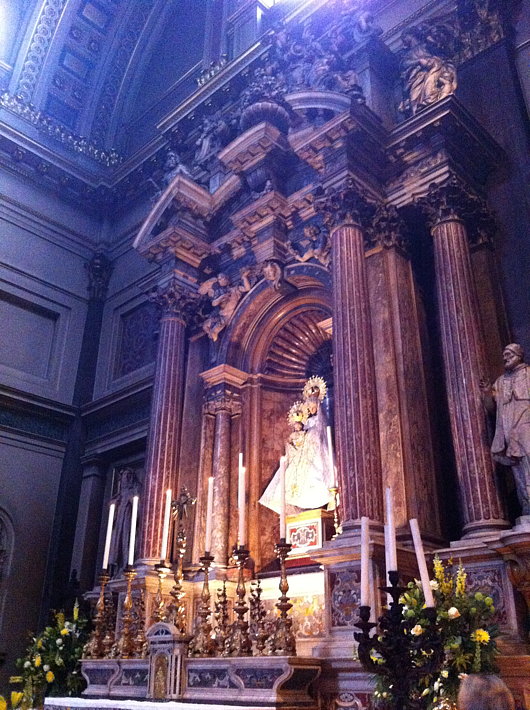
In the south transept of the Brompton Oratory is the altar dedicated to the Blessed Virgin, perhaps the finest altar in the entire church. It is a favourite place for getting in a few prayers and offering a candle or two or three or four. At the end of Solemn Vespers & Benediction on Sunday afternoon (above) it is where the Prayer for England is said and the Marian antiphon sung.
The Lady Altar was designed and built in 1693 by Francesco Corbarelli of Florence and his sons Domenico and Antonio and for nearly two centuries stood in the Chapel of the Rosary in the Church of St Dominic in Brescia. That church was demolished in 1883, and the London Congregation of the Oratory purchased the altar two years beforehand for £1,550.
The statue of Our Lady of Victories holding the Holy Child had previously stood in the old Oratory church in King William Street, and the central space of the reredos was slightly modified to house it. The Old and New Worlds are represented in the flanking statues, which are of St Pius V and St Rose of Lima — both by the Venetian late-baroque sculptor Orazio Marinali. The statues of St Dominic and St Catherine of Siena which now rest in niches facing the altar were previously united to it, and are by the Tyrolean Thomas Ruer.
Vienna Views
My written views of the city you will have to wait for (presuming they ever see the light of day), but here are a few photographic impressions from my jaunt to the Kaiserliche Hauptstadt. (more…)
The Ever Useful Haggis
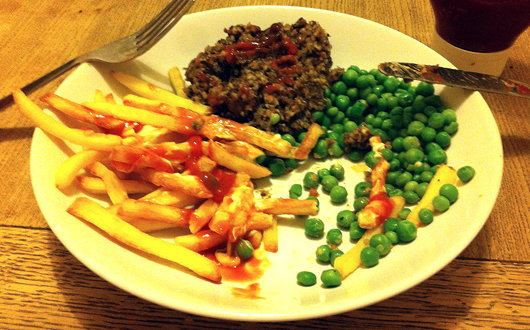
Culinary skills are not prominent among my varied talents, though I was pleased that the guests at the last dinner party I held in my riparian West London abode received the evening rather well. (If the food was only so-so at least the thought behind the choice and mixture of guests was appreciated). In my limited (but slowly expanding) experience, I have found haggis a rather useful addition to the repertoire.
T’other day I cooked a haggis for supper, alongside some chips and peas — an unjustly neglected vegetable I can’t help but feel. (Boring old botanists insist the pea is actually a fruit, but never you mind). Unfortunately I lacked a suitable gravy or sauce, so had to make do with ketchup and mayonnaise (plus a dash of HP).
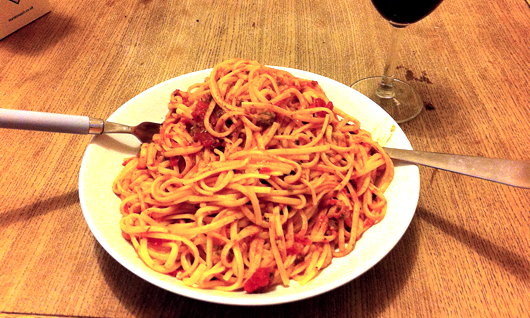
But what to do with the leftover haggis the next day? I tried spreading it on oatcakes but that was far too dry — oatcakes must be reserved for pâté, it seems. So instead I crumbled bits of haggis into a pot of tomato sauce, dobbed it with oregano, some mixed herbs, sea salt, and freshly crushed peppercorns, and enjoyed a surprisingly delicious meal which I’ve decided must be christened linguine alla scozzese.
A Decade of Driehaus
A Carl Laubin capriccio pays tribute to the first decade of Driehaus laureates
THIS YEAR MARKED the tenth anniversary of the Driehaus Prize, the annual award honouring a living architect who has contributed to the field of traditional and classical architecture. To commemorate the first decade of the Prize, the architectural painter Carl Laubin was commissioned to produce a splendid capriccio depicting the works of the first ten Driehaus laureates.
As Witold Rybczynski, a member of the Driehaus panel of jurors, writes:
In the foreground is the Choragic Monument of Lysicrates, a bronze miniature of which is presented to each laureate. It’s fun to try and identify the individual works in this large (5½ by over 8 feet long) painting. But what is more striking is that Laubin has created a convincing urban landscape solely out of landmark buildings.
That, of course, is the advantage of classicism: however it is interpreted, it is a tradition that manages to produce a more or less coherent whole. Even Abdel-Wahed El Wakil’s mosque, standing next to a Seaside beach house by Robert A. M. Stern, doesn’t look too out of place.
The Driehaus Prize was founded in part as a rival to the more publicised Pritzker Prize awarded to modernist architects. But, Mr Rybczynski points out, the fundamental nature of modernist structures is that they thrive only as a visual contrast to buildings constructed in a traditional style.
Can one imagine a similar townscape of Pritzker Prize winners? Well, maybe with the work of some of the early laureates—Pei, Bunshaft, Tange, Siza—but modern buildings need a background of nineteenth and early twentieth century urbanism to shine. A town made up of only signature buildings by our current generation of stars would resemble a carnival or a theme park—Pritzkerland.
I’ve often thought this of the United Nations headquarters in New York, which, when it was first built, must have stood out brilliantly as a bright and fresh harbinger of a better future, but which has been rendered altogether rather boring by the construction of neighbouring buildings of third-rate plate-glass modernist designs.
The UN headquarters on the East River and Lever House on Park Avenue were breakthrough buildings, but the increasing replacement of their traditional stone-clad or brick neighbours by cheap, tawdry modernist structures has exposed how reliant this type of architecture — even when well-conceived and properly executed — is on being surrounded by a contrasting style. (more…)
Search
Instagram: @andcusack
Click here for my Instagram photos.Most Recent Posts
- Brunel’s Unbuilt Capitol February 3, 2026
- Cricket at Fordham January 27, 2026
- Palacio Barolo Revisted January 14, 2026
- Learning to Love Liguria January 14, 2026
- Crux Alba No. 2 January 13, 2026
Most Recent Comments
Book Wishlist
Monthly Archives
Categories