About Andrew Cusack
 Writer, web designer, etc.; born in New York; educated in Argentina, Scotland, and South Africa; now based in London.
 read more
News
Blogs
Reviews & Periodicals
Arts & Design
World
France
Mitteleuropa
Knickerbockers
Argentina
The Levant
Africa
Cape of Good Hope
Netherlands
Scandinavia
Québec
India
Muscovy
Germany
Academica
Stockholm in the Swinging 60s
The Solemn Opening of the Riksdag was the state opening of Sweden’s parliament, seen here in a recording from 1960 during the reign of Gustaf Adolf. Years ago I wrote about Oskar II’s opening of parliament.
Alas, all this was done away with as part of the constitutional innovations of 1974, and the Swedish legislature is now opened with a much simpler ceremony.
via Karl-Gustel
1950s Ireland, the Church, and the Arts
Sitting in Dublin Airport waiting for a flight last week I picked up a copy of the Irish Arts Review which featured a number of interesting pieces (including something by our own Dr John Gilmartin).
Among the articles was an interview with the artist and printmaker Alice Hanratty (born 1939), a member of the Aosdána as well as of its governing council the Toscaireacht.
It was interviewer Brian McAvera’s question to Ms Hanratty about Ireland in the 40s and 50s and her response that proved most interesting.
BMcA: Artists, nevermind historians, often talk about the dark days of the 1940s and 1950s in Ireland: petty, parochial, restrictive, dominated by the Catholic Church, politically conservative and sexually repressed. How did you see this period and was it in any way formative for you as an artist?
AH: I have some experience of the period in question and don’t really recognise the description that you quote.
As far as the arts are concerned you must remember that important Irish poets, dramatists, and novelists, and also painters and sculptors worked at that time. Brian Fallon discusses all that in his An Age of Innocence. As for ‘politically conservative, restrictive, dominated by the Catholic Church’ these I think are quite sweeping statements by people who did not actually live at that time and are re-stating a received perception which is inaccurate.
As for domination by the Catholic Church, to some degree people allowed themselves to be dominated. They were OK with it. It suited them. It provided answers about the imponderables such as death. Nor should it ever be overlooked that the vicious war waged against the Irish people and the practice of their religion by way of the penal laws have had a huge detrimental effect on the national psyche which is not yet dispersed even in the 21st century.
As for political conservatism (don’t start me), that was established by the Free State Government in the 1920s making a deliberate and successful move to stamp out any form of socialism that might develop. Of course the Church was pleased to be of help there, but was not the instigator. President Higgins made reference to this period in one of his 1916 commemoration addresses, so anyone seeking enlightenment in these matters would find it there.
Were the 1940s and 1950s influential for me as an artist? No. I was too young and was not looking outwards for inspiration.
The angel of Görlitz
An anonymous benefactor gives Görlitz half a million euros every year for the benefit of the Old Town.
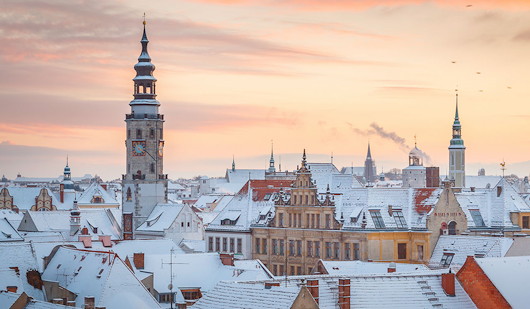
24.02.2015, by MONA JAEGER, GÖRLITZ (Frankfurter Allgemeine Zeitung)
PASTOR, YOU MUST know, are there angels? He jumped up, went to a shelf, grabbed a thin brochure, and opened it. Here, says Minister Hans-Wilhelm Pietz, pointing to a photograph of the Church of the Holy Trinity, the roof was leaking, it was almost raining. And there, at the Lutherkirche, the facade was washed-out.
Four houses of God are maintained by the Lutheran church in Görlitz, between 100 and 700 years old. From the crypt to the tower there is always something to bang, grind, or sand. Sometimes this costs 500 euro, sometimes 5,000. In any case more than the 2,500 congregants contribute to the Sunday collection. “Alone, we would be overwhelmed with the neverending renovations.” But there is indeed him. Or her. An angel, at least, Father Pietz is certain.
He must be a pretty fat angel. He distributes half a million euros in the city every year — €511,500 to be exact. Not an angel as such, but a wealthy entrepreneur or someone with a rich inheritance, the Görlitzers speculate at the bakery counter or at their Stammtisch. Who else would have had so much money left for twenty years that he could simply donate to the city?
For it’s been the same game in Görlitz every year for that long: always in the first quarter, without announcement, half a million euros (formerly a million marks) find their way into the municipal coffers. It has always been a different date. This year it was 18 February. Whether the money will come next year, the donor does not reveal. (more…)
A.D. MMXVI
All in all, a rather amusing year I thought. In 2015 there were a lot of jaunts to the continent, but 2016 — in true Brexit fashion — was the year of the domestic excursion (or ‘staycation’ if you’re a modern person). I also, through great cunning, managed to get to the theatre fairly often and even a jaunt or two to the opera.
Here are a few photos from the twelve months just past us, in no particular order. (more…)
Sir Christoffel Brand
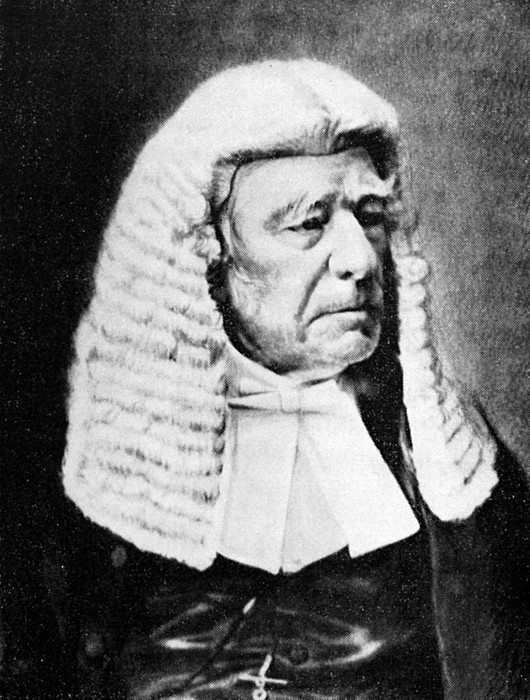
Look at that cragly visage! It belongs to Sir Christoffel Brand, the first Speaker of the House of Assembly in the Cape Parliament.
Brand was born in Cape Town in 1797 and left for the Netherlands in 1815, where he studied at Leiden. In 1820 he was awarded a doctorate in law based on his dissertation Dissertatio politico-juridica de jure coloniarum on the legal relationship between colonies and the metropole, and returned to the Cape. (more…)
The L.A. Times on Papa Pacelli
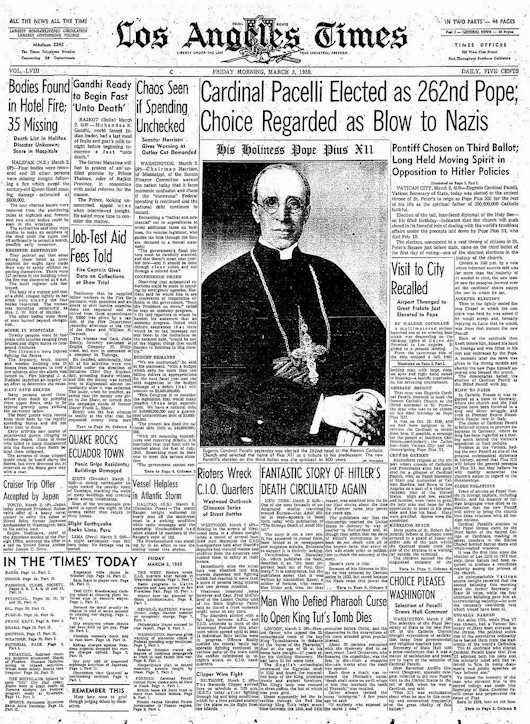
How News of the Election of Pius XII was Received in 1939
The case against Pope Pius XII, accusing him of complicity in the crimes of Nazism, has been so thoroughly debunked — by Jews like Gary Krupp and Rabbi Dalin more than any — that it is no longer even worth refuting.
Still, it’s interesting to read the Los Angeles Times’s coverage of his election as Supreme Pontiff in the difficult year of 1939:
BLOW TO NAZIS
… The choice of Cardinal Pacelli is believed certain to provoke annoyance in Germany, where he long has been regarded as a moving spirit behind the Vatican’s opposition to Nazi policies.
As the news report goes on to note, Cardinal Pacelli was elected in only three ballots — the quickest papal election since that of Leo XIII in 1878.
Christmas on College Green
There are some good (if brief) shots of the Irish House of Lords chamber in this Christmas ad for the Bank of Ireland, 0:35-0:45.
The former Irish Houses of Parliament on College Green in Dublin were the first purpose-built parliament building in the world, and were purchased by the Bank of Ireland after the parliament was abolished by the Act of Union in 1800.
Unfortunately a condition of sale was demolishing the elegant octagonal Commons chamber at the centre of the building, to prevent it being used in the effort to have the Act of Union repealed.
Sir Thomas Cusack (1505-1571) has the distinction of having at times served as the presiding officer of both the upper and lower houses of the Irish Parliament. From 1541-1543 he was as Speaker of the House of Commons, in which role some scholars argue he was a prime mover behind the legislation erecting Ireland as a kingdom.
In the following decade he served as Lord Chancellor of Ireland, presiding in the House of Lords, from 1551 until 1555 when revelations about his involvement in the creative finances of Sir Anthony St Leger’s viceregal regime brought about Sir Thomas’s dismissal and (temporary) imprisonment.
He returned to favour when the Earl of Sussex was appointed viceroy, but never again held high office.
Of course, all that was before this neoclassical building was erected, when Parliament met mostly in Dublin Castle.
Church of the Intercession
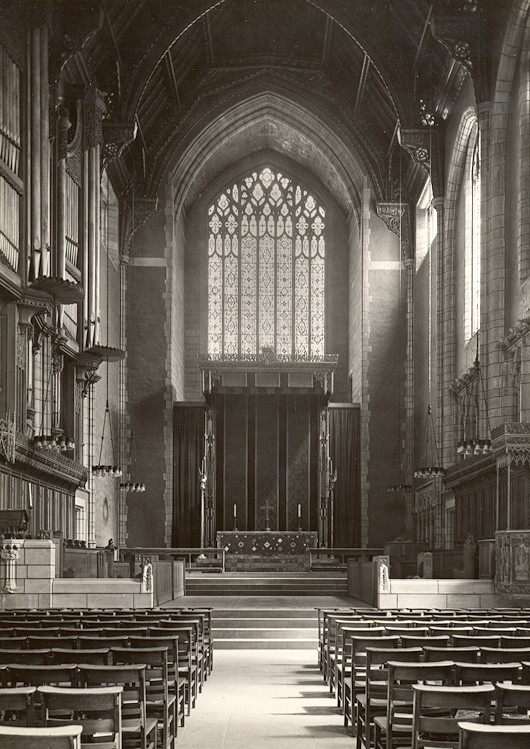
The huge and spacious interior of the Church of the Intercession, New York. One of Bertram Grosvenor Goodhue’s masterpieces; so much so that he decided to be interred in the north transept of the church.
The Ordination of a Priest
Michael Rennier and I first met some years ago as we moved in the same vaguely intellectual circles that congregated in various places between New York and Boston. He was an Anglican clergyman then, having been raised a Pentecostal Christian and endured a long sojourn in the Episcopal Church in which he was called to formal ministry. Michael disguises his intellectual rigour with a light heart and a good sense of humour, and I was deeply pleased to see that rigour guided him, his wife, and family into the Catholic Church in 2011. I believe he had been knocking on the doors of the Archdiocese of Boston asking to be brought in under the Pastoral Provision of John Paul II, but I imagine the last thing that Archdiocese wanted to take on was the cost of a man with a wife and kids to look after as a seminarian, then deacon, then priest.
Things moved along anyhow, and Michael moved his family back to his ancestral homeland in the Middle West – T.S. Eliot country – to find his way in life and see what the future would bring. Thanks be to God, last week, on the feast of the Immaculate Conception, Michael was ordained a priest of the Catholic Church at the Old Cathedral of Saint Louis in Missouri.
In a beautiful reflection, Michael recalls sitting in Yale’s Sterling Memorial Library as a Protestant clergyman-in-training:
I was reading the Apologia; the story of [John Henry Newman’s] conversion to the Catholic Church. I was particularly bothered by one specific bit. I was at the part where Newman makes his point that, fundamentally, there is no difference whatsoever between Arianism and Anglicanism. One is reviled and discredited, the other respectable and vital. But look closer, Newman argued, look underneath. What is there? Rebellion. There, buried beneath the sartorial splendor, the monarchy, the gorgeous liturgy, the incense, the polyphonic chant, and the prestige of Oxford… was a group of Christians steeped in the bitter throes of willfulness. […] Newman got to me that day, blinking in the fluorescent lights of a now disappeared world. My own world, comfortable as it had been, began to slip away as well.
After all, outward appearances are not always what they seem.
Further along, Michael relates attending Mass as a Protestant:
It was fascinating. I was attracted to it. I felt something solid about it, comforting, and yet, I knew for a fact that these people worshiped statues! Okay, with age my critique became a bit more subtle. But in the long run, aren’t all our arguments against the Church just as silly and vain? She outlasts us all. We can kick and scream and throw tantrums; legislate against her, slander her, outlaw her priests and persecute her children: the Church still prevails. She fears nothing. And because of this, she is able to be generous and patient.
The greatest novel of all time (no one argue with me on this) is Brideshead Revisited by Evelyn Waugh. In it, Waugh describes a family who keep their country seat at Brideshead in the ancestral home. The family itself is a mixed lot; A father living abroad in sin, a domineering mother, a son who is a flamboyant dandy, a worldly daughter, and an overly-childlike daughter. Waugh describes the slow decline of Brideshead as the family disintegrates and scatters. This dissipation works itself out universally in the advent of the Great War [sic], which finally swallows up all of England and turns Brideshead into quarters for Army command. In the end, though, we are left with a scene in the house’s private chapel, where the altar lamp is still lit and a lone priest says mass for an old woman. I am a lot like that family. Many of us probably are.
You see, conversion is a gift. Mother Mary holds her Son for us, patiently suffering at the foot of the Cross. We can ignore her, go our own way, rebel … it doesn’t matter. Hanging on the Cross, Christ says to each and every one of us “Behold your Mother.” She is here still. Waiting. We may be elsewhere, doing God knows what, but above the altar the candle still flickers. This is the light by which, in time, we find our way home.
His reflection is worth reading in full.
I hope readers will join me in getting a prayer of thanksgiving in for Fr Michael as well as for his wife and their five children. This is barely even the beginning.
Hamburger Abendblatt
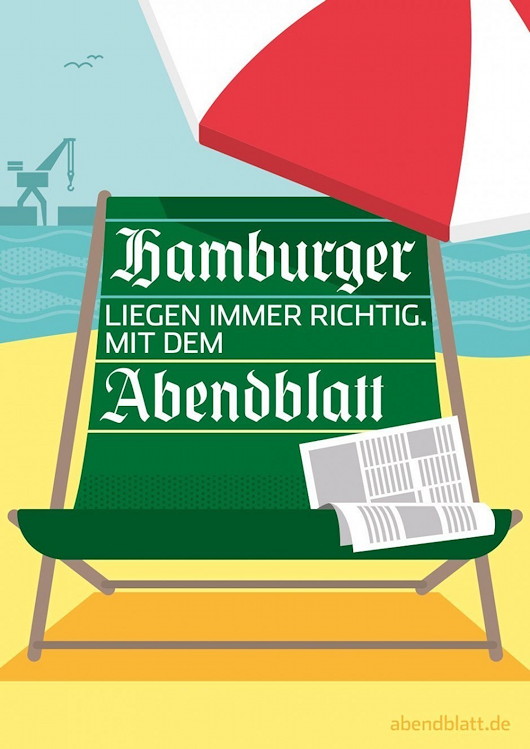
The German advertising agency Oliver Voss created this series of ads for the Hamburger Abendblatt, Hamburg’s daily evening newspaper.
Oliver Voss have done web and print ads for the Abendblatt before but the illustrations in this series of posters strike a jovial pose, feeling perfectly contemporary while still informed by a sense of the 1950s.
The summery beach scene is my favourite.
Marinus Willett
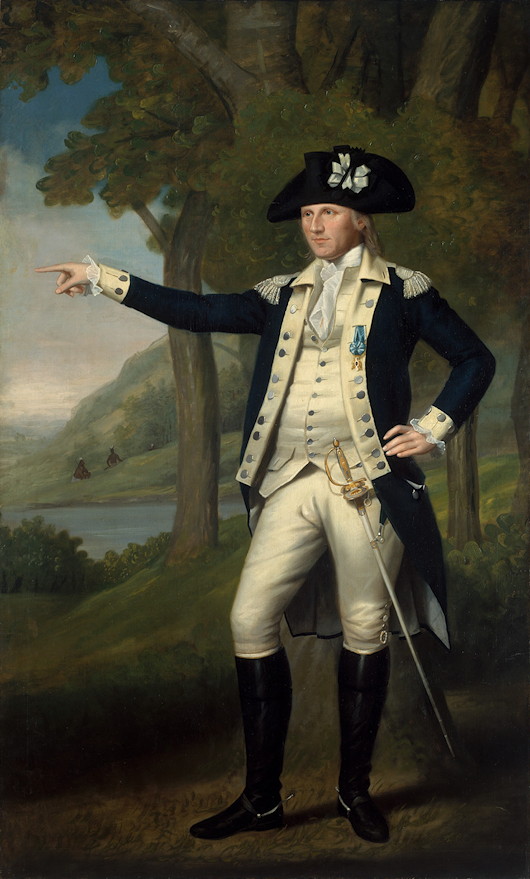
In one of the galleries of the Metropolitan Museum’s American wing, behind the Tuckahoe-marble façade of the old Assay Office (moved here from Wall Street), hangs this portrait of Col. Marinus Willett of the Continental Army’s 5th New York Regiment.
Born in 1740, the second of thirteen children, Willett attended King’s College before being commissioned a lieutenant in a New York provincial regiment during the Seven Years’ War (or French and Indian War as it’s known more locally). (more…)
Mendicant Architecture in Mediaeval Oxford
An interesting video from two American academics on the subject of Mendicant architecture in mediaeval Oxford, with some three-dimensional theoretical reconstructions of the Dominican and Franciscan houses in the city.
Both orders returned to Oxford in the twentieth century. The Capuchins refounded Greyfriars in 1910 and it was recognised as a permanent private hall (PPH) of the University in 1957. Its end as an academic institution was announced sadly on its fiftieth anniversary in 2007, but Greyfriars continues as a Capuchin friary.
Blackfriars under the Dominicans is still going strong, exercising a triple function as a priory of the Order of Preachers, a house of studies for the English province of the Order, and a PPH of the University of Oxford.
Judging Dress
After some absence, The Sybarite has returned and, in A Love Supreme, he weighs in on the very important matter of judicial dress.
I am, it will surprise no-one to know, deeply traditionalist in such matters. I can see the argument for discarding formal court attire in cases involving children, who might be intimidated by wigs and gowns (as a child, I myself would have been as happy as a pig in the proverbial). But I feel strongly that “work clothes”, whether worn by judges, barristers, politicians or clerks in Parliament, are important. They are part of the persona. You are not Alf Bloggs, you are Mr Justice Bloggs and you are performing an important public role. When you put on the clothes, you put on the role. Of course, I am fighting a rearguard action here – I know that the tide of public opinion is against me. If the clerks at the Table in the House of Commons still wear wigs in ten years’ time, I will be (pleasantly) surprised.
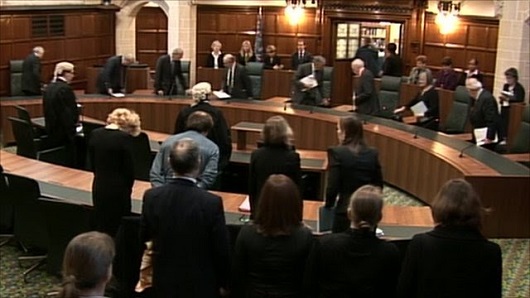
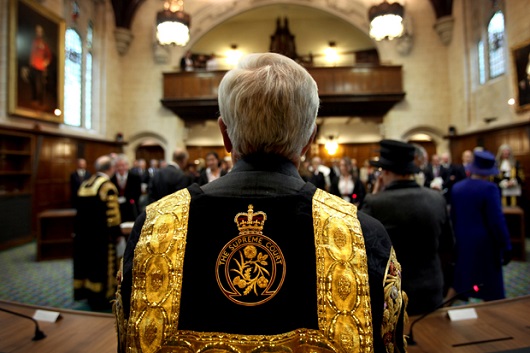
As the Supreme Court was set up in the modish New Labour years, it was inevitable they would dispense with much of the ceremonial. The Justices wear lounge suits to hear cases, though I think in some cases the barristers still wear wigs and gowns. The one concession has been the black-and-gold gowns which the Justices don for special occasions. These are fine so far as they go – and, as observed above, Lady Hale of Richmond likes to accessorise hers with a Tudor bonnet – though they bear on the back the badge of the Supreme Court, which I think looks a bit tacky and smacks of footballers’ names and numbers on the back of their shirts. But they also look a bit odd worn over lounge suits or equivalent. At least successive Lord Chancellors since the role was recast by Blair have retained formal court dress for high and holy days. Mind you, the current occupant, Miss Truss, does look a bit like the principal boy in a pantomime when she wears knee breeches. But fair play to her for continuing to wear the traditional robes, even if the full-bottomed wig seems now to have gone the way of the dodo.
It could be worse. The Supreme Court Justices could wear ghastly zip-up gowns like their American counterparts – you just know they’re made of nylon – over their suits, though I have some time for Justice Ginsberg for adding a lace jabot to tidy up her garb a little. But ceremonial is something that Britain does so well. The Supreme Court could have looked so much better with Justices in gowns and traditional judicial clothing. A wig here and there wouldn’t go amiss.
I couldn’t agree more. Especially on the matter of the badge of the Supreme Court on the back on the gowns, which is simply naff. (See image below.)
But why do the justices of the Supreme Court have (what I think of as) chancellorial gowns anyhow? What is the origin of this style of black-and-gold gown? Did it start with the Lord Chancellor and spread to the Speaker or vice versa? Or have some species of judge always worn chancellorial gowns? The chancellors of universities have likewise adopted it, though its precise form varies from institution to institution, as one might expect in matters of academic dress.
Incidentally, I was speaking with Bob Geldof the other day about Senator W. B. Yeats, about whom Mr Geldof has done a documentary. As we were discussing Yeats’ contribution to the Irish Senate, Mr Geldof mentioned that Yeats had been in discussions with Hugh Kennedy, the Chief Justice of the Irish Free State, about introducing new designs for Irish judicial dress. The results, according to just about everyone, left much to be desired and so the British tradition carried on for the most part. As is so often the case, doing nothing is the least bad option.
Calligraphic Correspondence
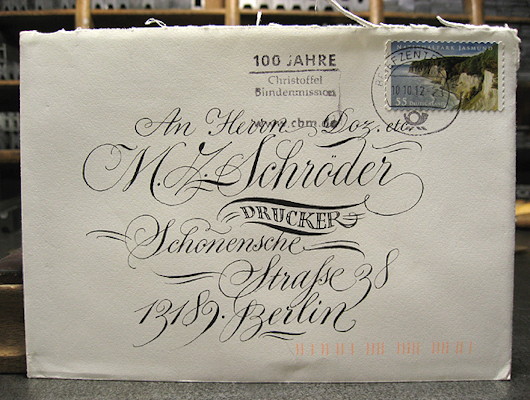
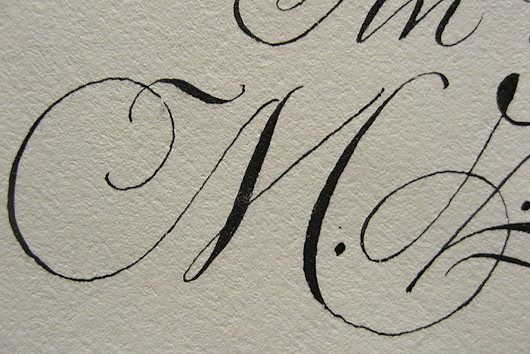
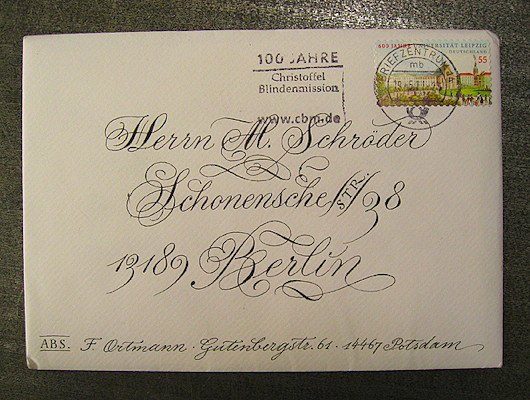
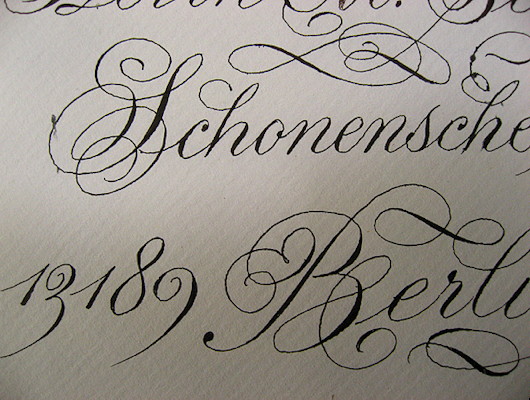
What a pleasure it must be to receive a letter from the designer Frank Ortmann (c.f. here), if the calligraphic correspondence received by printer Martin Z. Schröder is anything to go by. (See here & here.)
The Dutch in Rhodesia
…and why they stayed there.
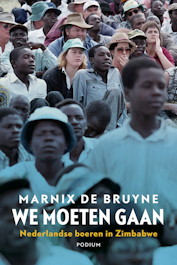 Journalist Marnix de Bruyne has shed new light on the post-war wave of Dutch immigration to Rhodesia with his new book, We moeten gaan. Nederlandse boeren in Zimbabwe (‘We Must Go: Dutch Farmers in Zimbabwe’).
Why did so many people emigrate from the Netherlands in the fifties? Why did hundreds of them choose to settle in what was then called Rhodesia, today’s Zimbabwe? And why did so many of them stay after 1965, when the country was led by a white-minority regime, faced an international boycott and was engulfed in a bloody guerrilla war?
De Bruyne attempted to answer these questions through a recent seminar at Leiden University’s African Studies Centre. The university has rather handily made a recording of the seminar available online.
Daar’s ook ’n interview (in Nederlands) met Mnr de Bruyne in Mare, die koerant van die Universiteit Leiden.
(Dave: hierdie post is vir jy!)
The Death of God the Father
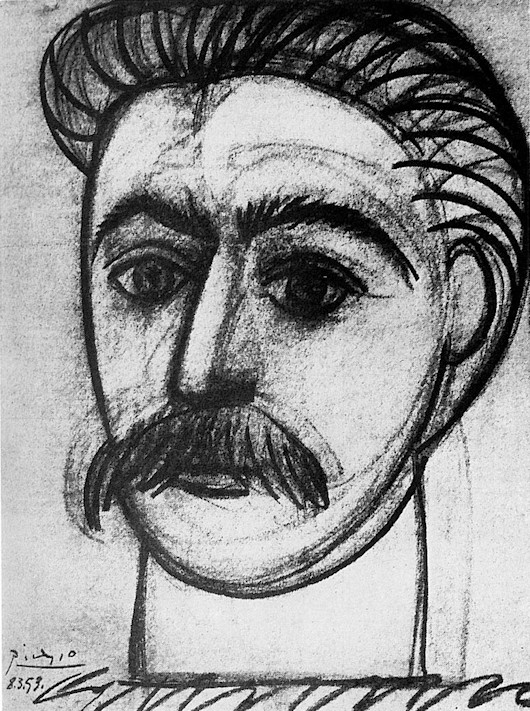
When Stalin’s death was announced on Friday, 7 March 1953, Aragon called in Pierre Daix and rattled off a shopping list of features to honour Stalin in a special issue of Les Lettres françaises. […] Since Picasso had always refused to do a portrait of Stalin from a photograph, Daix sent a telegram to him at Vallauris saying, ‘Do whatever you want,’ and signed it ‘Aragon’.
Picasso’s drawing of Stalin, which depicted him as a curiously open-eyed young man, arrived at the very moment Les Lettres françaises went to press. Daix took the picture to Aragon. He admired it and said that the party would appreciate the gesture. While it was being set into the front page, office boys and typists crowded round the picture. Everyone thought it ‘worthy of Stalin’.
Daix was overjoyed to be the one who had commissioned Picasso’s first portrait of the Soviet leader and rushed it down to the printers. But a few hours later, when the edition had been run off, the mood in the building had completely changed to one of fear. Journalists from L’Humanité, passing by, spotted the drawing and cried out that it was unthinkable that any Communist publication should consider such a representation of ‘le Grand Staline’.
Pierre Daix promptly rang Aragon at his apartment; Elsa Triolet answered. She told him angrily that he was mad to have even thought of asking Picasso for such a drawing.
‘But really, Elsa,’ Daix broke in, ‘Stalin isn’t God the Father!’
‘Yes, he is, Pierre. Nobody’s going to reflect much about what this drawing of Picasso signifies. He hasn’t even deformed Stalin’s face. He’s even respected it. But he has dared to touch it. He has actually dared, Pierre, don’t you understand?’ […]
Antony Beevor & Artemis Cooper (1994, London)
Fête Chiracienne
AS TODAY IS the eighty-fourth birthday of Monsieur Jacques René Chirac, I thought it’d be best to share a few images of the underappreciated fifth president of the Fifth Republic (not to mention sometime Mayor of Paris, Prime Minister of France, and Co-Prince of Andorra) doing the things he does best. (more…)
Wall Street
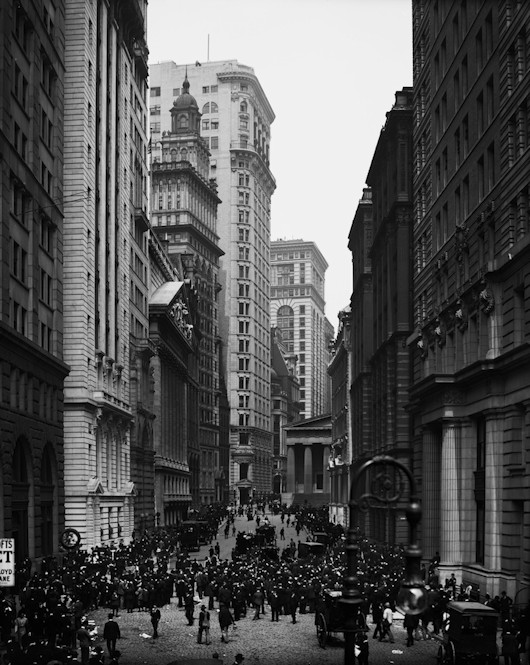
Well, actually it’s Broad Street looking down past the New York Stock Exchange to Federal Hall, which itself is on Wall Street.
Most of Broad Street was originally a canal (hence its width) but in 1676 it was filled in and laid out as a street.
Muratie
The Stellenbosch estate of the artist Georg Paul Canitz
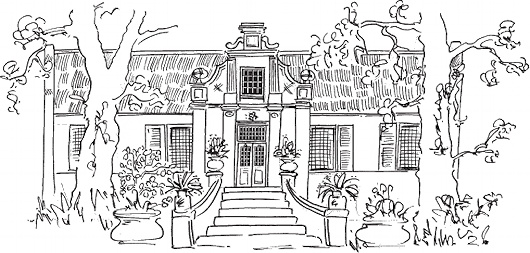
We had supper with Mr. Canitz, the painter, one Sunday night, by the light of candles in a fine Dutch candelabra, and drove back to Stellenbosch in moon light which had transformed the countryside into the most entrancing fairyland imaginable.
Great clumps of trees in unexpected places gave an eeriness to the white ribbon of road which stretched across the valley. The soft evening breeze of magic scents lulled us, and we drowsed to the hum of the car bearing us homeward.
That memory is still vivid to me so I shall turn from our Golden Road, and “…muse awhile, entoil’d in woofed phantasies.”
So the architect Rex Martienssen described a visit to Muratie, the home of the artist Georg Paul Canitz, in 1928. Canitz was a Saxon, born in Leipzig, where his parents had hoped he would pursue a military career. Both his zeal and talent as an artist appeared early on, and so he ended up at the Dresden Academy of Fine Arts. After further studies in Italy, Paris, and the Netherlands, a chest ailment drove him to the interior of Südwestafrika in 1907.
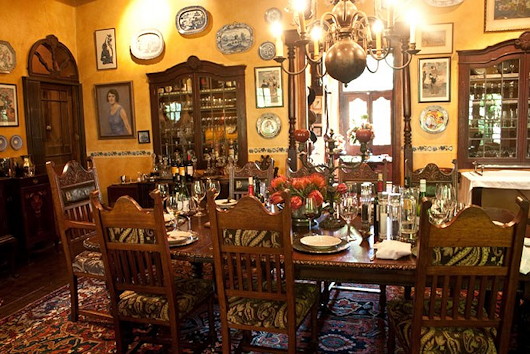
Canitz healed quickly in the dry air but could not find a cure for the striking beauty of the new world around him. His wife and children were summoned from Germany, and three years later he moved to Stellenbosch after falling in love with the “City of Oaks”.
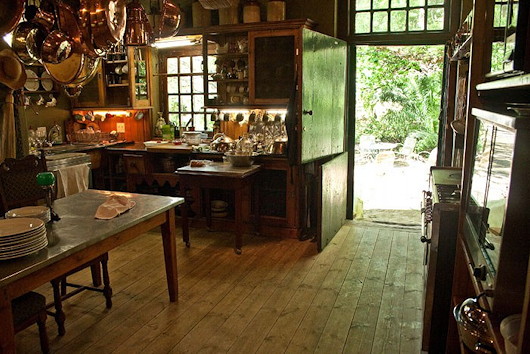
Canitz devoted himself to his passions: riding, painting, and teaching (both at his own art school and at the University). Riding to a party at Knorhoek one day he stumbled upon the little house and farm at Muratie and was quickly enamored of the place. It wasn’t long before he had purchased it and moved his family there.
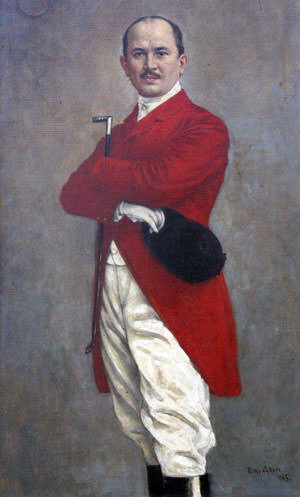
G P Canitz
At Muratie, the painter developed a further art: that of winemaking. In this he was assisted by the legendary Dr Perold — first chair of viticulture at Stellenbosch. Canitz became a pioneer of the pinot noir grapes which have since become a South African staple. Perhaps even more he developed the skills of a kind and generous host, for which he was well reputed throughout South Africa. He would welcome friends and guests — among them Martienssen and his architectural students as cited above — throughout the year. In warmer months they came for the swimming pool and the breezy stoep, while in winter a fire awaited, or perhaps a few rounds of strong drink in the Kneipzimmer.
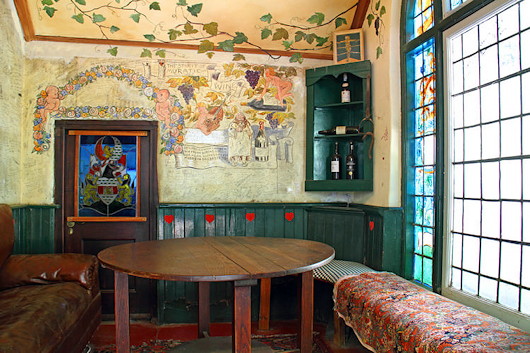
I like to think this was Canitz’s favourite room at Muratie: bedecked with benches, the light streaming in through a stained-glass windows, and the walls covered in naturalistic painting as well as graffitied signatures and sayings in German, Afrikaans, French, and Greek.
The painter died in 1958, leaving Muratie to his daughter, who in 1987 sold it to members of the Melck family who had owned it from 1763 to 1897. (The house was first built in 1685.) I suspect Canitz would have greatly appreciated his handiwork being passed back to those who had looked after the place for many generations before him. The Melcks, unsurprisingly, have a great reverance for the history of the estate. They even go so far as to leave the cobwebs which have accrued go undisturbed and ask visitors to do likewise.
And, even today, the wine still flows!
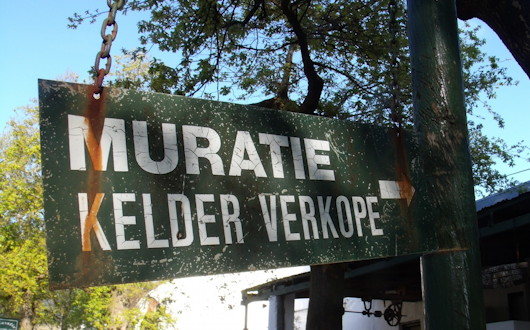
A Handsome Hamsun
Book design is a craft sadly neglected in the English-speaking world. In paperbacks, the French reign supreme, while the Teutons and Scandos design the most elegant hardcover books.
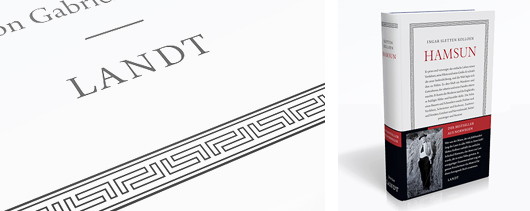
This German edition of Ingar Sletten Kolloen’s biography of Knut Hamsun was designed by Frank Ortmann for Landt Verlag, founded by the conservative popular historian Andreas Krause Landt (aka Andreas Lombard). Landt Verlag is now an imprint of Thomas Hoof’s Manuscriptum publishing firm. Hoof is better known for starting Manufactum, the retail company known for offering high-quality goods made through traditional methods.
I’ve never read any Hamsun myself though he has been strongly recommended by friends with reliable tastes. This Norwegian writer is widely read amongst the Germans but not so amongst the Anglos, and perhaps not surprisingly since he was an uncompromising Anglophobe and had praise for all things German.
Anglophobia was not his worse offence – a Nobel laureate, he ended up giving away the actual medal as a gift to Goebbels – but no less an unquestionable anti-Nazi than Thomas Mann hoped that “the stigma of his politics will one day be separated from his writing, which I regard very highly”.
The designer Frank Ortmann impressed the name of the publisher by incorporating letter-L initials into the rather Hellenic ornamental frame of the book. He’s also managed to banish the dreaded and ubiquitous barcode to a little banderole which also includes a short introductory text, preserving the visual integrity of the book itself.
Search
Instagram: @andcusack
Click here for my Instagram photos.Most Recent Posts
- Brunel’s Unbuilt Capitol February 3, 2026
- Cricket at Fordham January 27, 2026
- Palacio Barolo Revisted January 14, 2026
- Learning to Love Liguria January 14, 2026
- Crux Alba No. 2 January 13, 2026
Most Recent Comments
Book Wishlist
Monthly Archives
Categories