
About Andrew Cusack
 Writer, web designer, etc.; born in New York; educated in Argentina, Scotland, and South Africa; now based in London.
 read more
News
Blogs
Reviews & Periodicals
Arts & Design
World
France
Mitteleuropa
Knickerbockers
Argentina
The Levant
Africa
Cape of Good Hope
Netherlands
Scandinavia
Québec
India
Muscovy
Germany
Academica
The Huguenot Monument, Franschhoek
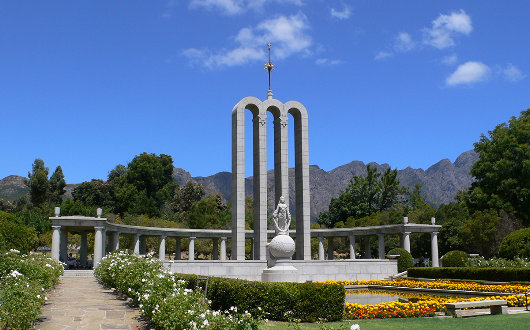
AMONG THE MANY peoples who, through the various vicissitudes of history, have found their home in South Africa are the Huguenots, or French Protestants. These people have always had a certain fascination for me, having being born so close to New Rochelle, the city in the New World founded by Huguenot refugees. The city’s public high school is a rather stately French neo-gothic chateau in the middle of Huguenot Park.
My own alma mater — a smaller private school in New Rochelle — counted Huguenot descendants among its first students and there was at least one remaining in my own school days. Street names such as Flandreau, Faneuil, and Coligni betray the French heritage of the city’s founders, and Trinity Church still has the old communion table brought over from La Rochelle.
Individual Huguenots had settled at the Cape of Good Hope as early as 1671, but it was on the last day of 1687 that the first group of Huguenots to immigrate en masse left their homeland of France for the beautiful colony at the end of Africa. It was the beginning of twenty years of migration that has left a permanent mark on South Africa’s population.
They brought with them the vines and the wine-making skills which have made the Cape winelands renowned throughout the world. What a compliment the old country paid to her descendants when Napoleon I proclaimed vin de constance — Constantia wine — his favourite tipple. Mrs. Jennings in Sense and Sensibility also recommended Constantia wine, “for its healing powers on a disappointed heart”, while poets from Klopstock to Baudelaire have also sung its praises.
Though originally French-speakers, the Huguenots merged into the Dutch-speaking population, especially after the East India Company mandated Dutch as the medium of instruction in schools.
Eventually, to be of Huguenot descent was to automatically be an Afrikaner, and what a range of Afrikaners claim this descent proudly: generals, statesmen, cricketers, writers, and more members of Springboks squad than you could shake a stick at.
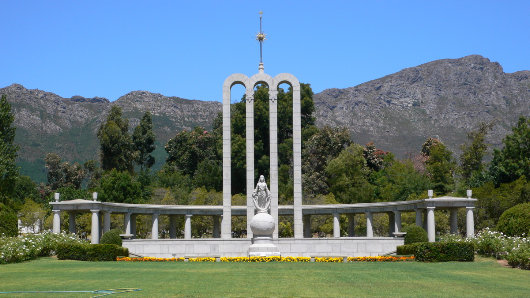
Being grateful unto God for the freedom and prosperity they enjoyed in South Africa, the Huguenot descendants decided to build a memorial to express their thanksgiving. The Huguenot Monument in Franschoek (the town who’s name means literally “French Corner”) was designed by the Dutch-born J. C. Jongens, and was inaugurated in 1948 by Dr. A. J. van der Merwe, the Moderator of the Dutch Reformed Church in South Africa.
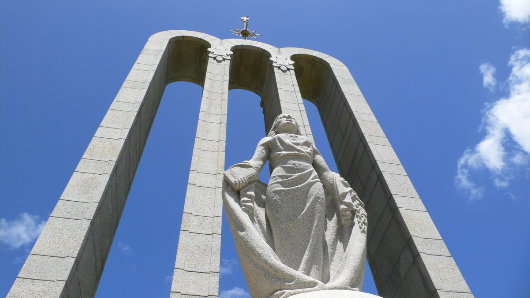
Three tall arches represent the Holy Trinity, above which rises the “sun of righteousness”, topped by the Holy Cross. The central female figure at the base — the replacement for the Virgin Mary that seems to eventually pop up in every Protestant sect who rejects Marian devotion — was sculpted by Coert Steynberg, who designed the Krugerrand, perhaps the most prominent gold currency in the world.
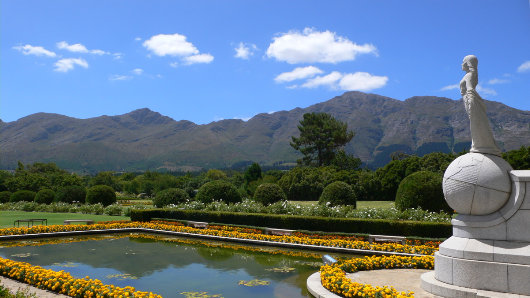
The woman is supposed to represent religious liberty, and holds a bible in one hand and a broken chain in the other. She stands atop a globe which shows the sailing ships of old making their journey from France to the Cape.
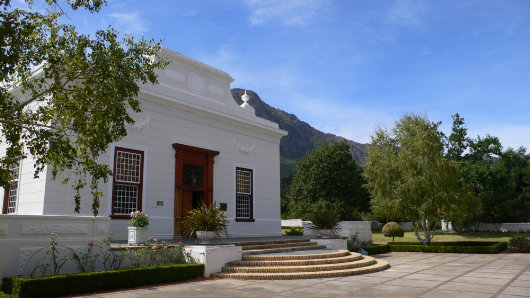
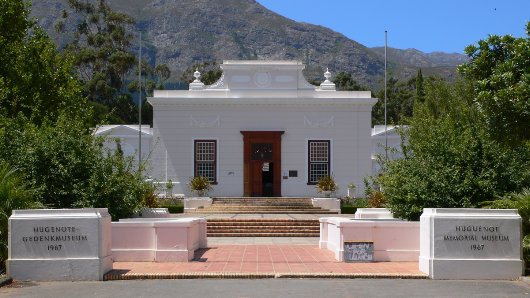
Standing beside the Monument is the Huguenot Memorial Museum which, besides its historical displays for the edification of the public, contains genealogical archives and historic documents & artifacts for the benefit of the researcher. The building is actually a reconstruction of Saasveld, the old Cape Town home of Baron Willem Ferdinand van Reede van Oudtshoorn.
Saasveld was designed by Louis Michel Thibault, the most important architect in the history of the Cape of Good Hope. Thibault was French-born & -trained, but came to South Africa while an officer in the Regiment de Meuron, Swiss mercenaries in the service of the Dutch East India Company. Thibault joined with sculptor Anton Anreith and architect Hermann Schutte to form the sacred triumvirate of the Cape Dutch style — no less a figure than Ruskin himself hailed it as the first truly new and beautiful style of architecture in centuries.
The house stood by what is now Kloof Street in Cape Town, and came into the possession of the Dutch Reformed Church, who decided to demolish it in 1954. Happily, they were eventually persuaded to allow the building to be dismantled instead of demolished, and it was reconstructed next to the Huguenot Monument in 1957.
Search
Instagram: @andcusack
Click here for my Instagram photos.Most Recent Posts
- West Point July 30, 2026
- Brunel’s Unbuilt Capitol February 3, 2026
- Cricket at Fordham January 27, 2026
- Palacio Barolo Revisted January 14, 2026
- Learning to Love Liguria January 14, 2026
Most Recent Comments
Book Wishlist
Monthly Archives
Categories

The sommelier in the Sandton hotel I stayed at recently was the aptly named Franz Bree – a corpulent, genial Huguenot who helped me find my way through some fine Pinot Noir and Pinotage from the Hermanus area.
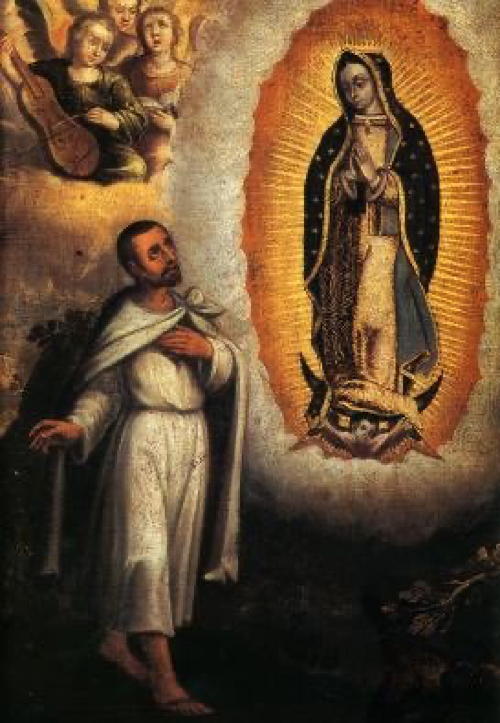
“The central female figure at the base — the replacement for the Virgin Mary that seems to eventually pop up in every Protestant sect who rejects Marian devotion”
Huh? Could you give some examples?
I am a descendant of the French Huguenot. My mother born du Toit is the daughter of Guilaume Du Toit and her mother, Susara Stafford. My mother’s uncle, Michiel Stafford was the builder of this monument. He himself built it physically up to the point where the loops are found. He refused to build any further since he was afraid of heights. If anyone should have documentation on the actual building process, completion and inauguration of this monument, please contact me directly. With appreciation, Jim
When I moved to Amsterdam’s Oud Zuid district near the Olympiaplein and the Noorder-Amstel Canal I was struck by the similarity of the old Van Heutsz Monument (today it has been renamed Monument Indië-Nederland) with the Hugenotemonument at Franschoek. Of course I realise the South African monument is much more splendidly appointed in one of the most beautiful locales on the planet and, in my opinion it is architecturally superior … but riding my bicycle past the old Van Heutsz Monument en route to the centrum, I would close my eyes for a moment and just dream that I was in Franschoek instead.