2009 February
About Andrew Cusack
 Writer, web designer, etc.; born in New York; educated in Argentina, Scotland, and South Africa; now based in London.
 read more
News
Blogs
Reviews & Periodicals
Arts & Design
World
France
Mitteleuropa
Knickerbockers
Argentina
The Levant
Africa
Cape of Good Hope
Netherlands
Scandinavia
Québec
India
Muscovy
Germany
Academica
Wupperthal in die Wes-Kaap
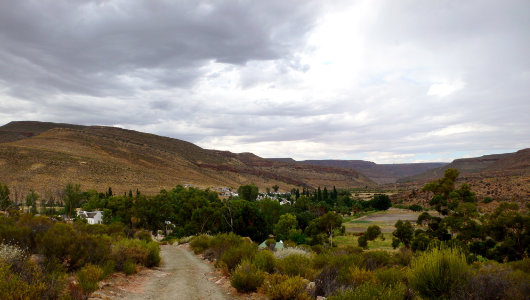
Deep in the Cedarberg, in the northern reaches of the Western Cape, there is a lovely little Moravian mission in a valley called Wupperthal. Unless you have a 4×4, there is just one road in and out of the valley, and even that road can be a bit tricky for conventional vehicles. Barefoot children, smiling and carefree, play in the streets beneath the avenue of eucalyptus that perfectly frames the beautiful church. Genadendal is the most famous of the Moravian missions, but Wupperthal was actually founded by Rhenish missionaries, before briefly becoming Dutch Reformed in the middle of the last century, and then taken over by the Moravians, or Herrnhuters as they are called in Afrikaans, after the Sorbian stronghold of the Unitas Fratrum.
Debating Stauffenberg
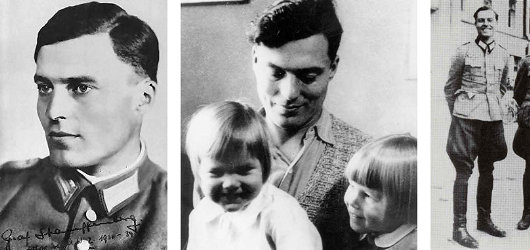
The recent release of the Hollywood film “Valkyrie” has brought the July ’44 plot back into the limelight. Much debate has focussed on the central figure of Count von Stauffenberg, especially the motivation and inspiration for his attempt to overthrow the Nazi regime. Writing in Süddeutsche Zeitung, Richard Evans (Regius Professor of Modern History at Cambridge) asks “Why did Stauffenberg plant the bomb?” Prof. Evans argues that the Count’s contempt for liberalism combined with his (Stefan George-influenced) romantic nostalgia « make him ill-fitted to serve as a model for the conduct and ideas of future generations » .
A week later, the Süddeutsche Zeitung published “Unmasking the July 20 plot“, a response to Evans by Karl Heinz Bohrer, the publisher of Merkur and a visiting professor at Stanford. Bohrer counters Evans on two fronts. « Firstly Evans’s lesson consisted of historical half truths, contradictory theses and slanderous allusions to Stauffenberg’s character; and secondly, such distortions differ very little from the view held by West German intelligentsia regarding the events of July 20th 1944 and the conspirators who were, for the most part, of aristocratic Prussian stock. … For a proper understanding of the how the plot against Hitler of 1944 is seen and judged today, one should bear in mind that today’s horizon has shifted. »
« There is no question that like Ernst Jünger and Gottfried Benn, Stauffenberg’s first spiritual influence, Stefan George, entertained pre-fascist fantasies. And there is also no question that the young Stauffenberg’s reverence for the medieval ‘reich’ was reactionary – in a similar vein to Novalis’s ideas in ‘Die Christenheit oder Europa’. But what does that mean? Neither of them had political ideas that could in any way have served as a model for democratic European societies in the second half of the twentieth century. But to fundamentalise this tautological insight to effectively deny the conspirators any moral or cultural relevance is blinkered and constitutes intellectual bigotry. George, Jünger and Benn’s pre-fascist fantasies contained important modernist symbols which mean they cannot be judged by political moralist criteria, alone. The same goes for Stauffenberg and his friends who – in a different way to the “idealistic” Scholl siblings and their circle – represented a calibre of ethics, character and culture class of which today’s politicians and other bureaucratic elites can only dream. »
In that same week, Bernard-Henri Lévy — the omnipresent French man of letters — waddled into the debate with “Beyond the war hero” in the pages of Le Point. BHL proclaims the release of “Valkyrie” is unquestionably good, for it is inherently good for the world to honour its heroes. « Riveting as it is however, this film poses certain questions that are too complex and too delicate to be resolved solely within the logic of the Hollywood film industry. »
In a moment of pure irony, Lévy attacks the lack of accuracy in the film while making a gross historical error himself. The philosopher asks whether « raising someone to hero status does not always happen, alas, to the detriment of precision, nuance and history itself. The film shows Stauffenberg’s integrity very well. It shows his courage, the nobility of his views, his firmness of spirit. But what does it tell us of his thoughts? What does it teach us about why he enthusiastically joined the Nazi Party in 1933? » In actual fact, while Stauffenberg’s family members were concerned that he was “turning brown” the Count never joined the Nazi Party; not in 1933, not ever.
In a sense, Lévy has answered his own question in that Stauffenberg’s elevation has apparently taken place to the detriment of precision and history in that Lévy is apparently unaware of quite central historical facts of the case.
Previously: Stauffenberg
Russia’s Treasures on the Banks of the Amstel
Seventeenth-century Amsterdam building will, from June, be home to collections from St. Petersburg’s Imperial Hermitage Museum
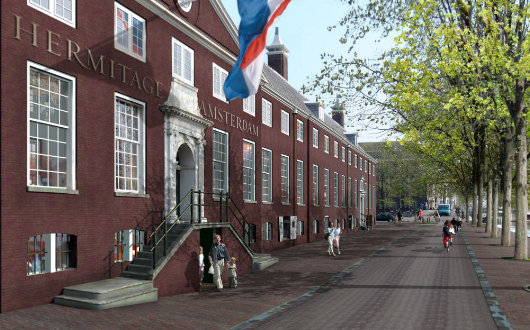
A new 100,000-square-foot space displaying works from the Hermitage Museum in St. Petersburg will open in Amsterdam this June. The Hermitage Amsterdam will be located in the Amstelhof, a former home for the elderly built in 1683 by the Dutch Reformed Church and transformed into a modern exhibition space by Hans van Heeswijk Architects. The opening exhibition, “At the Russian Court” — a “a deeply researched exploration of the opulent material culture, elaborate social hierarchy and richly layered traditions of the Tsarist court at its height in the nineteenth century” — will display 1,800 works from the massive collection in St. Petersburg and continue until the end of January 2010.
New York Firm Tapped for Restoration of Budapest Landmark
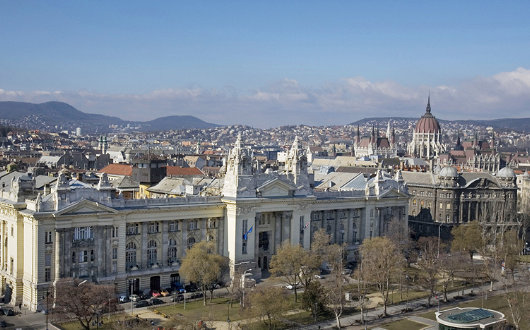
The New York firm of Beyer Blinder Belle, responsible for the restoration of Grand Central Terminal, has been selected to develop “an adaptive reuse and restoration plan” for Exchange Place, a historic building on Budapest’s Freedom Square (Szabadság tér). Exchange Place was built in 1905 for the Budapest Stock and Commodities Exchange, and includes a number of ornamental details in the Hungarian style of the Secession architectural movement. After the Soviet conquest of Hungary, the building became the Lenin Institute before being given over to the state television broadcaster.
First Troop, Philadelphia City Cavalry
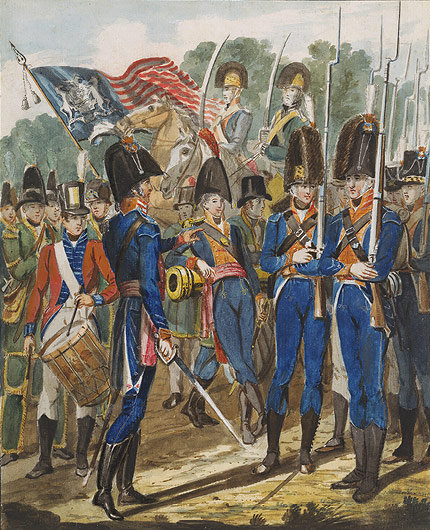
Watercolor, gouache, and graphite on white laid paper, 9 in. x 7 1/4 in.
c. 1811-1813, Rogers Fund
Previously: The Prince of Wales in Philadelphia
RIP
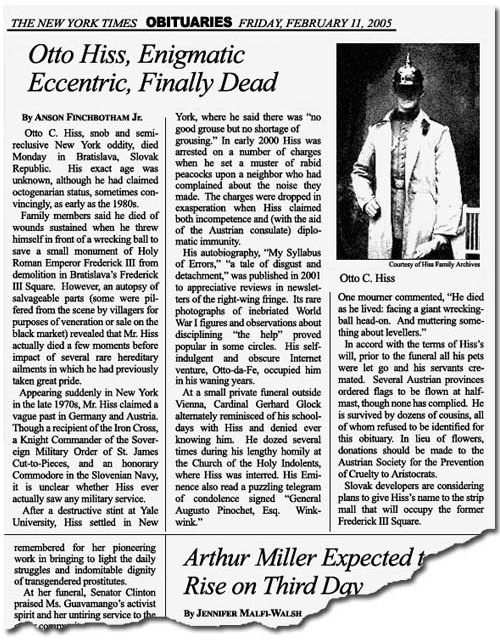
HAS IT BEEN four years already since the death of the late child of scorn, Otto Clemson Hiss? I understand a missa cantata will be offered at altar of the Hiss family chapel in the Church of the Holy Indolents, for the repose of his soul.
Separation Anxiety
Fond of beer in swarthy nooks,
but happiest among his books.
Change happens very quickly these days, and it has always interested me that people born in the same year as me are (more or less) the youngest ones to remember life without the Internet. The younger siblings of friends have no experience, in particular, of being computer literate while not having the Internet. We, on the other hand, recall the tiny Macintosh “Classic” as well as the older machines with the green type on a black background from computer class in school. Computers were for typing things up, or else for games, and computer games were never of much interest in our household. Who could be bothered sitting in front of a monitor when you could have a waterfight with the neighboring kids? (The exception, for me, was SimCity 2000, in which you could be Robert Moses, Albert Speer, and a disastrous hurricane rolled into one.)
Then, of course, came the wonderful World Wide Web. You could send emails, though for the life of me I can’t remember sending any in the first years of our family getting Internet access. When first introduced to yahoo.com, I instantly dismissed it, for I was convinced that nothing of any import could be known by the name of “Yahoo.” Still, we kids couldn’t get enough of the Internet. I was primarily a news & history junkie, seeking to learn of events in far-off lands that I had spent hours discovering in encyclopediae and while pouring over giant maps laid out on the dining-room table or the living-room floor. Every National Geographic that arrived having the red text in the yellow margin that indicated a map was enclosed was received like a gift from the heavens and added to my collection—which included the Canadian provinces, the Soviet Union, Indonesia, the British Isles (when still called so), and of course the precious World Map. Most memorable was when, just a short while after the fall of the Iron Curtain, National Geographic released a map of “The New Europe” with a dozen new countries added and borders changed.
While books were essential during our childhood, the Internet, however, remained a mere sideshow, a curious novelty for occasional use. Then—gradually, sometime, somehow—it became an indispensable part of existence. Essays at school were completed with the help of Internet research, the great quest to decide where to go to college would have been impossible without all those .edu & .ac.uk websites wooing prospective undergraduates, and then the year I started university was marked by the advent of something called Wikipedia.
I found, contrary to the expectations of some, that the Internet did not compete with my love of books, but rather complemented it. One could “google” second-hand bookshops in New York, London, and Edinburgh and then pay them a visit. There, ancient tomes and beautiful editions could be found and, judiciously, purchased. And while reading those tomes, various ideas and inspirations would spring to mind which would cause one to place down the book to the left and turn to the laptop on the right and find out more about any given subject. If Paddy Leigh Fermour mentions a castle in Bohemia or Hungary, you have but to type out the correct spelling, click a button, and reams of up-to-date information about it are at your fingertips. And of course there is purchasing old books online, and thereby expanding one’s library: a particular joy.
But during my university years, spent between home in New York and uni in Scotland, my library was rent in twain. The age of manservants and transatlantic ocean liners having passed, I could not bring my entire collection of books wherever I went, but frequent travel between the two homes of my collection lessened the impact of not having “that” book immediately at hand.
The problem now is that I find myself in South Africa, separated from both my precious library (now consolidated in New York) and the Internet. This part of the world is a strange mix between Palo Alto and Lubumbashi, and the level of Internet connectivity is very poor. Here in Stellenbosch, luxurious vineyards dot the landscape, and lazy cafés sit under the shade of the oak-lined streets, but most Internet service providers charge for use by megabyte downloaded. To those of us accustomed to the easy broadband access of most of the northern hemisphere, it is the galling equivalent of being handed a reed and a wet clay tablet and being asked to send an email in cuneiform (or “stuur ‘n e-pos in spykersrif” as it would be in Afrikaans). I am ostensibly a student here, but even our university—which sent the first African satellite into space—charges its students for the Internet per megabyte used. I looked into getting the Internet installed at home—a flat in an old whitewashed Dutch house in the middle of town—but the widely recommended snowball.co.za is prohibitively expensive for a poverty-stricken young amateur scholar such as yours truly.
Luckily there is a little café just around the corner that only charges R17 for an hour’s wireless Internet, no megabyte limit, peer-to-peer software and mass media downloading prohibited (fair enough). Cheap as chips, but then only during their working hours, and completely ill-suited to my Internet-browsing sentiment. Gone the quick check-of-the-email at the very dawn of day. Gone the ability to google some ancient German dynasty that surfaced amidst a late night’s readings. Needless to say andrewcusack.com—my Internet repository of miscellaneous and somewhat unrelated information—has fallen by the wayside as well. I can purchase an hour’s cheap Internet, but an hour is not what I want. A rushed feeling pervades an hour’s purchased Internet. I want five minutes here, ten minutes there, two minutes elsewhere, and every now and then an hour or two for some knee-deep research.
So should any ambitious techies of Silicon Valley be readers of Taki’s Magazine, set your sights on South Africa. There is a fortune to be made if someone can make good Internet as cheap and accessible as back in the States, but be warned: it might take a good deal more cunning to get things done on African time.
[First published in Taki’s Magazine]
Some Afrikaners
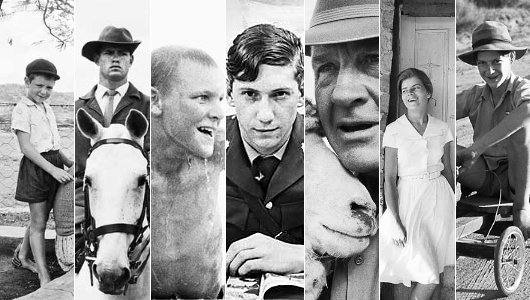
“In my father’s shop,” writes the photographer David Goldblatt, “serving Afrikaners, I found, almost in spite of myself, that I liked many of them and, to my surprise, that I was beginning to enjoy the language. There was a warm straightforwardness and an earthiness in many of these people that was richly and idiomatically expressed in their speech. And, although I have never advanced beyond being able to speak a sort of kombuistaal, I delighted in our conversations. Yet, withal, I was very aware that not only were most of these people Nationalists, strong supporters of the Party and its policies, but that many were racist in their very blood. Although anti-Semitism was now seldom overt, they made no secret of their attitude to blacks, who at best were children in need of guidance and correction, at worst sub-human. I was much troubled by the contradictory feelings of liking, revulsion, and fear that these Afrikaner encounters aroused in me and felt the need somehow to come closer to these lives and to probe their meaning for me. I wanted to do this with the camera.
“I had begun to use the camera long before this in a socially conscious way. And so I began to explore working-class Afrikaner life in our district. I drove out to the kleinhoewes around the town. I would stop and ask people if I might do some portraits of them or spend time with them while they went about whatever they were doing. In this way I became intimate with some of the qualities of everyday Afrikaner life in these places, and with some of its deeply embedded contradictions.
“An old man sits for me. A black child comes and stands next to him, looking at me with curiosity. The man turns and says to the child, ‘Ja, wat maak jy hier, jou swart vuilgoed?‘ (Yes, what are you doing here, you black rubbish?), the insult meant and yet said with affection. How is this possible? I don’t know. But the contradiction was eloquent of much that I found in the relationship between rural and working-class Afrikaners and blacks: an often comfortable, affectionate, even physical intimacy seldom seen in the ‘liberal’ circles in which I moved, and yet, simultaneously, a deep contempt and fear of blacks. …
“Travelling through vast, sparsely populated parts of the country with my camera became a major part of my life at that time. I think that our landscape is an essential ingredient in any attempt at understanding not just the Afrikaner but all of us here. We have shaped the land and the land has shaped us. Often the land was unforgivingly harsh. Yet, the harsher the landscape the stronger the Afrikaners’ sense of belonging seemed to be. Many of the people whom I met in the course of those trips had a rootedness in the land of which I was very envious. Envious in the sense that I couldn’t claim 300 years of ancestry in this country. Yet, increasingly, I felt viscerally bonded to it.”
The Victory Parade, Dublin 1919
UPDATED Peter Henry’s article from Trinity News corrects my errors.
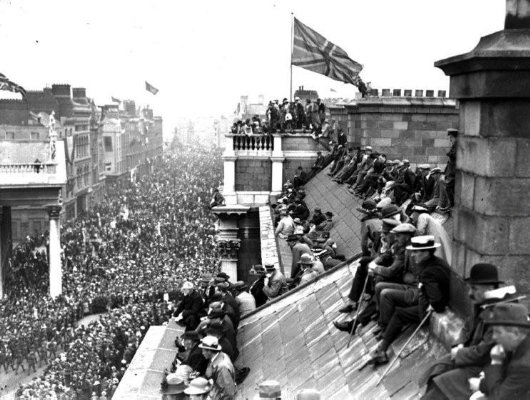
Persuant to our previous photograph of the Union Jack proudly snapping from Dublin’s General Post Office, one of our dear friends & loyal readers, a former editor of Trinity College’s newspaper, sends this photo of the 1919 Victory Parade through the streets of Dublin after the end of the Great War. The red, white, and blue here flies from the top of Trinity College, and the view looks down D’Olier Street (if I recall correctly) towards O’Connell Street in the distance. The classical portico on the left marks the entrance to the Irish House of Lords.
It is worth remembering that a great deal more Irish served in the forces of the Crown than in any republican armed forces or groups. The memory of Ireland’s great sacrifice during the First World War was shamefully neglected from the 1930s until about ten or fifteen years ago. It was a pity that the famous old Irish regiments were disbanded when independence came in 1921, rather than being continued under a native Irish command. Gone the Connaught Rangers and Dublin Fusiliers, and all the great battle honours won by Irishmen from Waterloo to far off India. (Two Irish regiments still exist in the British Army, the Royal Irish and the Irish Guards). Still, in remembrance of the dead of the First World War, one can visit the War Memorial Gardens by the banks of the Liffey, beautifully designed by Lutyens and completed after independence. The cost was split between the Irish and British governments, and, in the post-war downturn, half the workers were Irish veterans of the British Army and half were veterans of the formerly rebel forces.
Ireland remained neutral during the Second World War but declared a state of emergency, which is why the time of the war is often known in Ireland as “the Emergency”. Allied and Axis soldiers who washed up or crash-landed in Ireland found themselves interned in camps, but the Irish soldiers guarding them were only armed with blank ammunition. (Allied internees were often allowed to escape). The law of the day forbade any Irish citizen from joining a foreign military, but many soldiers of the Irish Army, policemen of an Garda Siochana, and many Irish civilians left for Britain to join the Allies in the fight, and were not punished on their return. When the port of Belfast suffered a German bombardment, fire brigades from Dundalk to Dublin were sent north irrespective of the border in order to help quell the flames.
Returning to Trinity, flying the Union Jack in 1919 would not have proved controversial in the slightest (after all, it was still the official flag of the land), but the crowds gathered again on College Green in 1945 to spontaneously celebrate the news of Germany’s surrender. The flag of Ireland with those of all the Allied nations were flown from the flagpole of Trinity, but some tactless student had placed the Union Jack at the top and the Irish Tricolour at the very bottom, below even the Soviet hammer-and-sickle. The crowd noticed this and began to howl, but some more thoughtful Trinity man swiftly took the colours down and raised them again with the Tricolour to the fore. The joyful spirit resumed.
The Groote Kerk
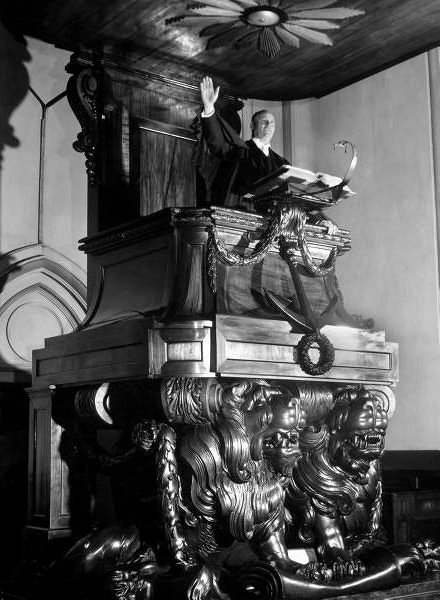
Dr. van der Merwe, moderator of the Dutch Reformed Church, poses in the splendidly carved pulpit of the Groote Kerk in Cape Town.
Search
Instagram: @andcusack
Click here for my Instagram photos.Most Recent Posts
- West Point July 30, 2026
- Brunel’s Unbuilt Capitol February 3, 2026
- Cricket at Fordham January 27, 2026
- Palacio Barolo Revisted January 14, 2026
- Learning to Love Liguria January 14, 2026
Most Recent Comments
Book Wishlist
Monthly Archives
Categories