
About Andrew Cusack
 Writer, web designer, etc.; born in New York; educated in Argentina, Scotland, and South Africa; now based in London.
 read more
News
Blogs
Reviews & Periodicals
Arts & Design
World
France
Mitteleuropa
Knickerbockers
Argentina
The Levant
Africa
Cape of Good Hope
Netherlands
Scandinavia
Québec
India
Muscovy
Germany
Academica
The Pester Lloyd
The Hungarian capital’s German-language newspaper has been “independent, pluralistic, steeped in tradition” since 1854
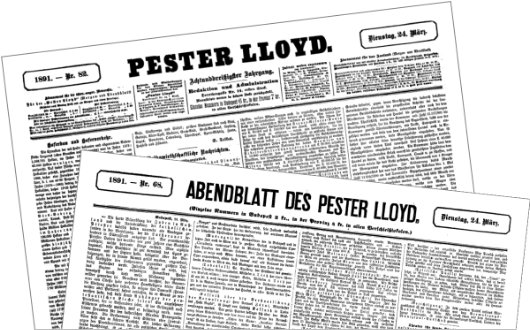
The fall of the Iron Curtain nearly twenty years ago after a half-century of Communist domination in Eastern Europe afforded an opportunity to revive many of the traditions and institutions which — while they had survived monarchy, republicanism, and fascism — were annihilated by the all-consuming Red totalitarianism. One such institution that has risen from the ashes is Hungary’s once-revered German-language newspaper, the Pester Lloyd.
 First appearing in 1854, when Buda and Pest were still two cities flanking the banks of the Danube, the Pester Lloyd was the leading German journal in Hungary. Printed daily with morning and evening editions, the “Pester” in the paper’s name refers to Pest, while “Lloyd” is in imitation of Lloyd’s List (the London shipping & commercial newspaper founded in 1692 by the eponymous properitor of Lloyd’s Coffee Shop and still going strong today). The paper first gained prominence under the editorial leadership of Dr. Miksa (Max) Falk, who had famously tutored the Empress Elisabeth in Hungarian and instilled in the consort a particular love for the Hungarian kingdom.
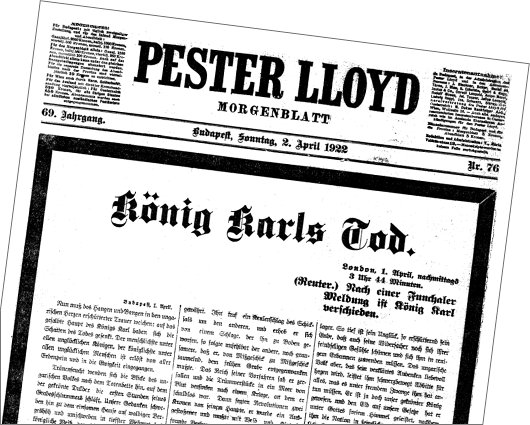
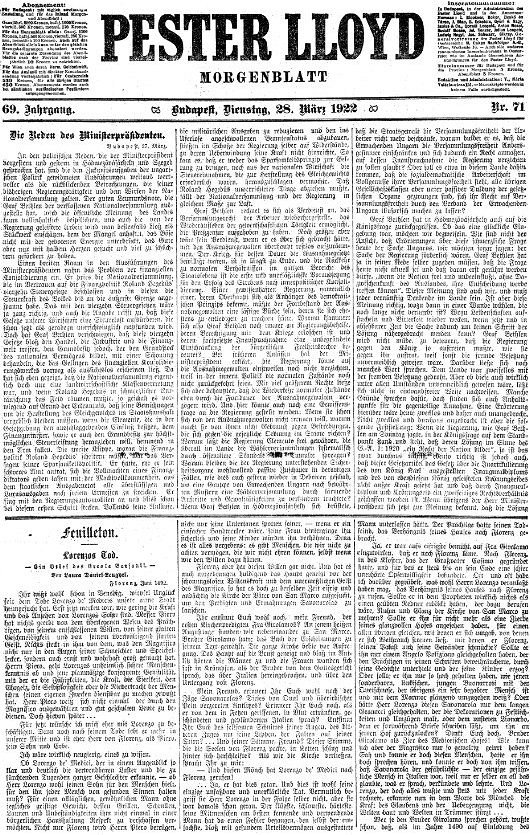
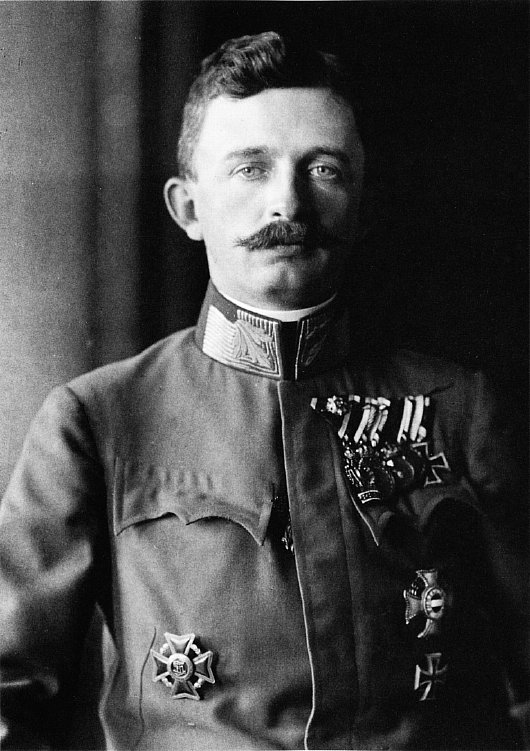
The 2 April 1922 edition of Pester Lloyd announces the death of the Blessed Emperor Charles of Austria who, as King Károly IV, was the last monarch of the Apostolic Kingdom of Hungary (so far).
There were over nine hundred German publications in the Empire, but in Hungary the language was more often spoken by professionals, intellectuals, and aristocracy; this distanced the Lloyd from the more popularly-oriented newspapers published in Hungarian. The newspaper stood out for its popularity among liberals, Jews, and Budapest’s intellectuals. While the experience of two devastating world wars means that liberal monocultural nation-states are the norm in Europe today, Austria-Hungary was an extremely diverse, traditional, multi-ethnic, multi-cultural Christian empire. After President Wilson forced Austria-Hungary’s destruction, the Empire’s liberal intellectual class were deprived of the broad, diverse public sphere in which they had been born, and many found themselves mourning the Danube monarchy once they experienced life after the Hapsburgs.
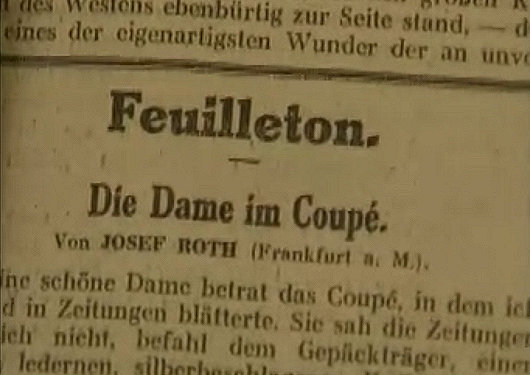 The Pester Lloyd‘s intellectual importance, however, grew during the interwar period, and especially so after the Nazification of newspapers in Germany proper in the 1930s. “From 1933 onwards, it happened that many people came [to Budapest] from German-speaking Europe,” Prof. Antal Mádl, a specialist in German studies, noted. “Poets, writers and journalists who had been laying low in Hitler Germany or were banned from publication … smuggled manuscripts large and small into Budapest, which were then published in the Pester Lloyd.” Among the interwar contributors are Franz Molnar (with whom we are already familiar), Joseph Roth (a Jewish convert to Catholicism), Stefan Zweig, and both Thomas Mann and his brother Heinrich. Mann’s host during his frequent visits to Budapest was the writer and patron Baron Lajos Hatvany, another Jewish convert to Christianity. (Hatvany contributed to the literary journal Nyugat, alongside István Vas, yet another Jewish convert). In Hungary, Thomas Mann also met the writer Sándor Márai (a better feuilletoniste than novelist, in the opinion of your humble & obedient servant) whose works are finally receiving greater renown.
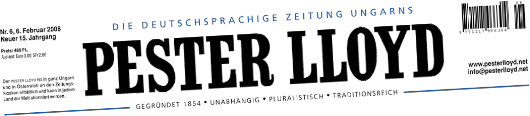
The paper ceased printing in 1945 as the armies of Hitler and Stalin battled over Budapest, but Pester Lloyd was revived as a weekly newspaper in 1994 by the journalist Gotthard B. Schicker. Mr. Schicker was born and raised in East Germany, where he studied at the Humboldt University of Berlin, and in the 1980s he had been involved in getting the Communist authorities to rebuild Karl Friedrich Schinkel’s Konzerthaus on the Gendarmenmarkt in Berlin, which had been burned-out since the war.
“I had a certain tie to the Pester Lloyd,” Mr. Schicker said, “because of my course of cultural studies at Berlin University where it cropped up often enough as a footnote, and as an important footnote for it was clear that this newspaper was very active in forming opinion in the days of the monarchy in Hungary and beyond. Another reason was what I can only describe as a shortage – a shortage of German language literature and journals after the political change in Hungary.”
The deputy chief editor, András Heltai-Hopp, said “When this newspaper was founded in the early 40’s of the 19th century the common language in the city of Pest — at that time there was no Budapest, just Buda and Pest — was German. In both city sections most people spoke German, at the very least those who were able to read a newspaper. The higher levels of society spoke German, the others spoke Hungarian.”

Mr. Schicker has been keen to uphold the intellectual tradition of the Lloyd by having current Hungarian intellectuals, including Nobel laureate Imre Kertész, contribute to the paper. “We are reconnecting, I think, to what the Pester Lloyd has always done,” the editor said. “It has outstanding Hungarian writers when I think of Kostolany, when I think of Molnar, such people who have always written for Pester Lloyd, many others in the past, and that is what we are reconnecting to, what is in fact the crème de la crème once again represented in Pester Lloyd, and we have made a great play of some of them, for example György Konrad, the former President of the Academy of Art in Berlin, whom we are always happy to print and naturally László Földenyi, Esterházy and the rest.” [László Földenyi is an art theorist and literary scholar; Peter Esterházy is an aristocrat & mathematician, but primarily a novelist].
Pester Lloyd is currently the highest-circulation foreign-language newspaper in Hungary, informing its Teutonophone readers on Hungarian politics, economics, and culture, as well as giving news and information about Central Europe in general. It has a normal print run of 15,000, bumped up to 25,000 for special editions. Readers in the city of Budapest — the Pearl of the Danube — also receive the metropolitan supplement, Budapester Rundschau. For Austrian readers back in the old imperial capital of Vienna, a special Wiener Lloyd is printed as a supplement. In worrying times for print media, Pester Lloyd is continuing an old tradition while also increasing its circulation — Hungary may get yet another 150 years out of the paper.
Search
Instagram: @andcusack
Click here for my Instagram photos.Most Recent Posts
- West Point July 30, 2026
- Brunel’s Unbuilt Capitol February 3, 2026
- Cricket at Fordham January 27, 2026
- Palacio Barolo Revisted January 14, 2026
- Learning to Love Liguria January 14, 2026
Most Recent Comments
Book Wishlist
Monthly Archives
Categories


Dear Andrew,
Why do you write Hapsburg instead of Habsburg?
Best regards
If I may speak for Mr Cusack: the form “Hapsburg” is traditional in English, while “Habsburg”, the German language form, is an acceptable variant which, however, has only come into common use quite recently.
Mr Cusack is a traditionalist, ergo …
Note too that he uses “Habsburg” when quoting from the German.
Do they have Page 3 girls?
NBS, you asked for it:
http://www.art-books.com/artbooks/images/items/56-0186.jpg
Dear Mr Cusack
Sorry to trouble you, but I’d be grateful if you will please advise the years during which MIKSA FALK acted as editor of the PESTER LLOYD.
Many thanks for your assistance.
Kind regards
Peter Kemp