Top sitesTop blogs
Friendly BlogsReviewsPeriodicalsChurch
|
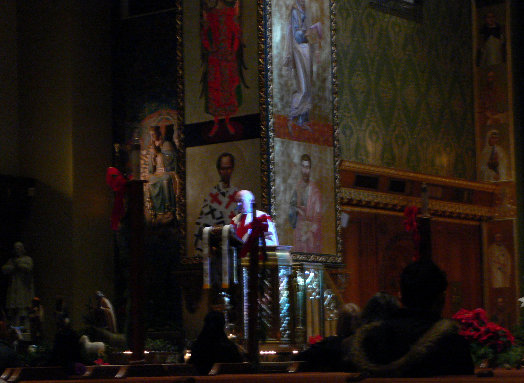
The Feast of St. Sylvester![]() Fr. Rutler preaches, illuminated by the midday winter sun, at the Church of Our Saviour on the Feast of St. Sylvester. And a fine sermon it was, too.
December 31, 2007 7:12 pm | Link | 1 Comment »
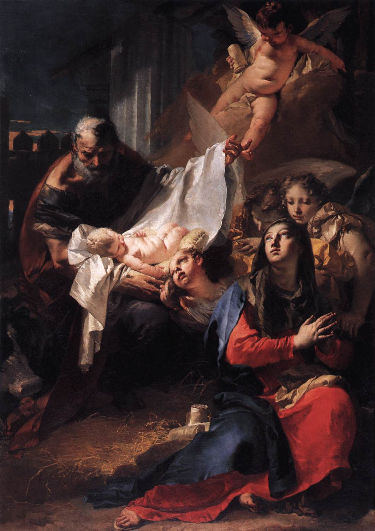
For unto us, a Child is born…![]() Wishing you all
a very happy and blessed Christmas
December 25, 2007 11:51 am | Link | 1 Comment »
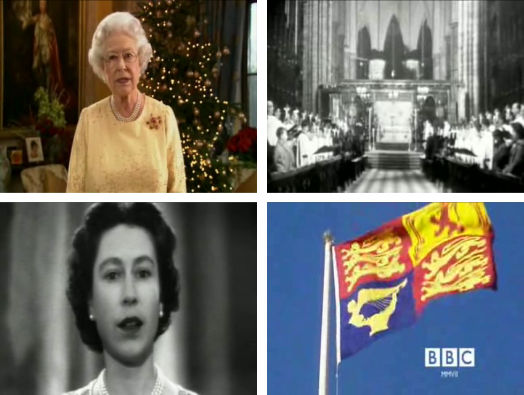
The Queen’s Christmas Message 2007![]() Available here at YouTube.
December 25, 2007 11:48 am | Link | 1 Comment »
Britain: a ‘Catholic country’The Original Church of England Overtakes the New One?![]() Catholics have overtaken Anglicans as the country’s dominant religious group, according to the Sunday Telegraph, as more people attend Mass every Sunday than worship with the (Anglican) Church of England. “This means that the established Church has lost its place as the nation’s most popular Christian denomination,” Jonathan Wynne-Jones reports, “after more than four centuries of unrivalled influence following the Reformation”. Sunday attendance at Anglican services has dropped a whopping 20% since the year 2000. Catholic Mass attendance in the past six years, however, has also dropped a dramatic 13%, a decline assuaged by the arrival of thousands of Polish immigrants since Poland joined the European Union.
December 24, 2007 8:24 am | Link | 13 Comments »
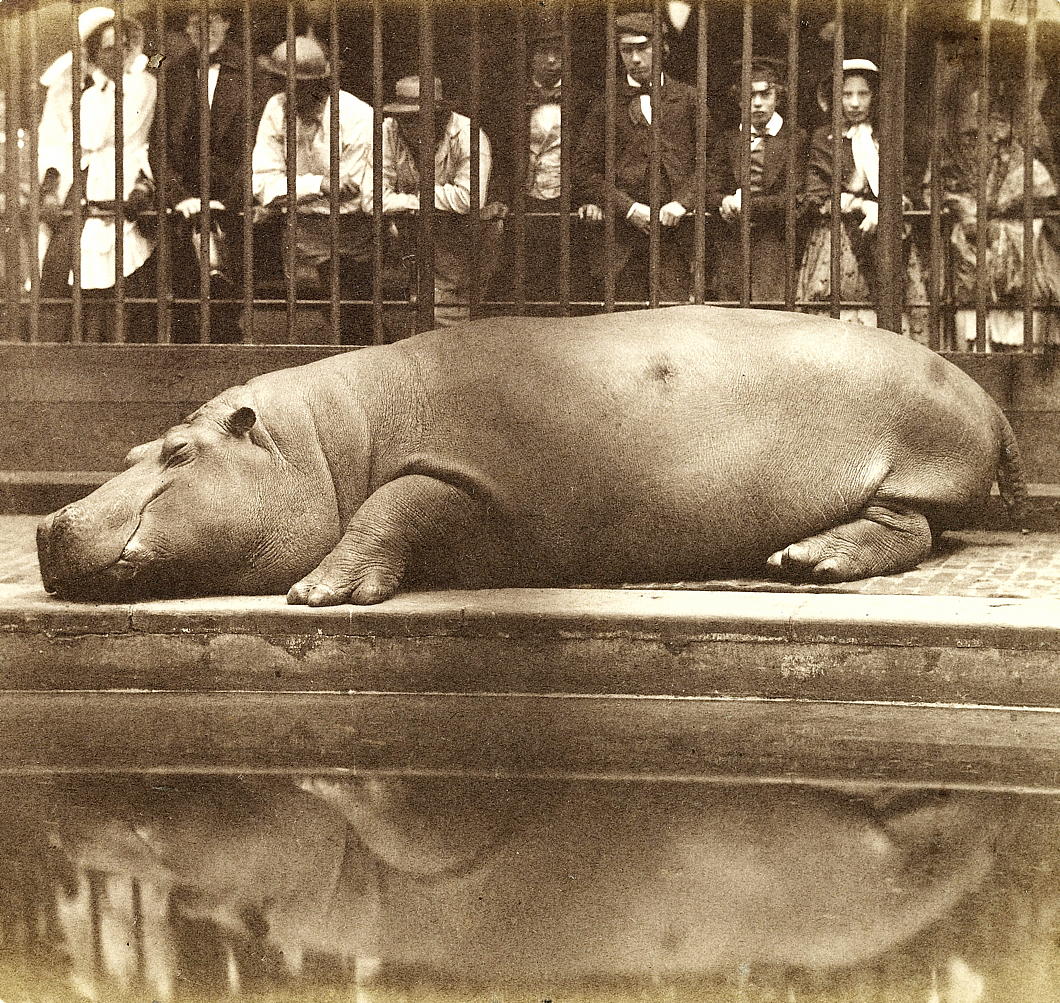
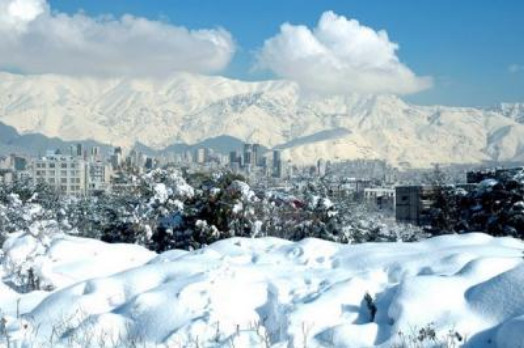
Obaysch the Hippo![]() Obaysch was the first hippopotamus in Britain since prehistoric times. The Ottoman Viceroy of Egypt agreed with the British Consul General to exchange Obaysch for some greyhounds and deerhounds, and the hippo arrived at London Zoo in May of 1850. The above photograph was taken in 1852 by Juan, Count of Montizón, later the Legitimist Bourbon claimant to the thrones of France and Spain.
December 24, 2007 8:19 am | Link | 1 Comment »
Gerald Warner AxedScotland’s Voice of Reason Silenced
Some Gerald Warner highlights on this site: • ‘The Mass of All Time will outlive the Sixties revolutionaries’: When you see a Church of Scotland congregation praying the rosary you may believe ecumenism is a two-way process.
• Martyrs of Spain, Pray for Us! • The Knights of Malta Ball 2006 • Warner on the Gotha
December 20, 2007 8:02 pm | Link | 5 Comments »
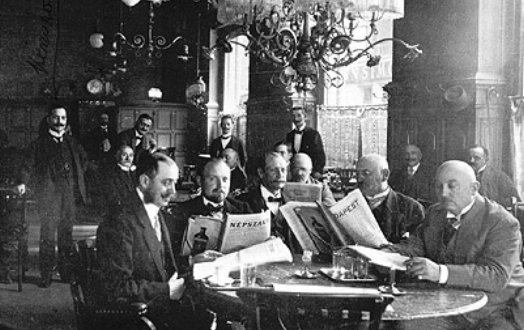
The Café Society of Ferenc Molnár![]() FROM 1887, the Café Central (or Centrál Kávéház, in Magyar) has been a meeting place for artists, intellectuals, professionals, and others located on Budapest’s Károlyi Mihály street. One of its most famous patrons was the novelist and dramatist Ferenc Molnár (born Ferenc Neumann and often anglicized as Franz Molnar), whose 1906 book The Paul Street Boys is perhaps the most widely-read Hungarian novel. His 1909 play “Liliom” was later adapted by Rodgers and Hammerstein into the musical “Carousel”. Both his plays “The Guardsman” and “The Swan” were later made into films (the latter being Grace Kelly’s final appearance on the silver screen), while “The Play at the Castle” was adapted by P.G. Wodehouse into “The Play’s the Thing” and by Tom Stoppard into “Rough Crossing”. (more…)
December 20, 2007 7:54 pm | Link | 7 Comments »
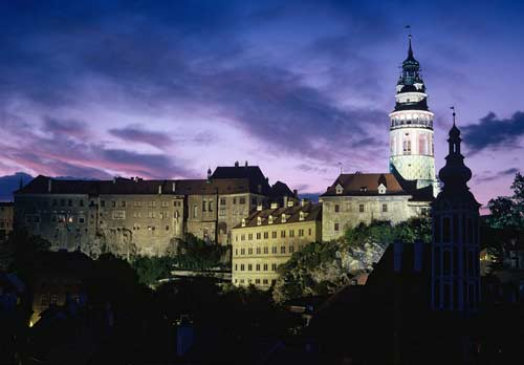
Krummau on the MoldauČeský Krumlov Revisited![]() THE CASTLE OF Krummau in Bohemia stands majestically on its crag in a bend of the Moldau river, presiding confidently over the town below. Český Krumlov, as the town is known in the currently-reigning Czech language, began in the thirteenth century under the Rosenberg family and was purchased by the Emperor Rudolf II in 1602. Yet it was under the princely house of Schwarzenberg (proprietors of Krumau from 1719 to 1945) that the castle flourished. The name Český Krumlov means Bohemian Krummau, to differentiate it from a Moravian town of the same name. (It is also often rendered as Krumau or Krumau-an-der-Moldau). While the advent of Communism deprived the Schwarzenbergs of this great castle and numerous other vast properties of theirs behind the Iron Curtain, the Schwarzenbergs have since regained their natural prominence in Bohemia. His Serene Highness Prince Karl VII of Schwarzenberg, Duke of Krummau, Count of Sulz, Princely Landgrave of Kelttgau currently serves his country as Minister of Foreign Affairs of the Czech Republic, as well as being a member of the Czech Senate which convenes in the Wallenstein Palace in Prague. For the sake of convenience, however, His Serene Highness goes by ‘Karel Schwarzenberg’. (more…)
December 17, 2007 9:12 pm | Link | 9 Comments »
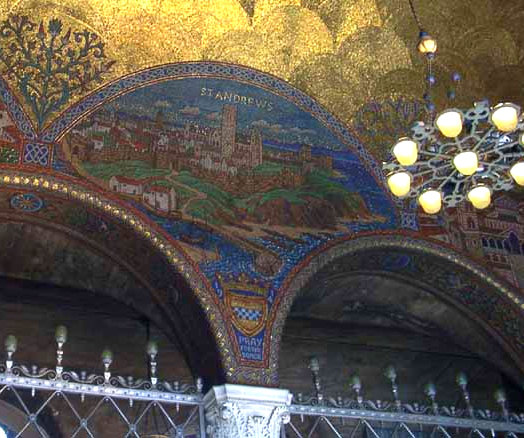
St Andrews in London![]() A LITTLE SOMETHING for our good friends from university who’ve just moved to London from the countryside. I hope that when they are in the Cathedral they will pop into our patron’s chapel, glance at the mosaic of our dear old Royal Burgh of St Andrews, remember good times, and say a prayer for us all.
December 17, 2007 9:07 pm | Link | 1 Comment »
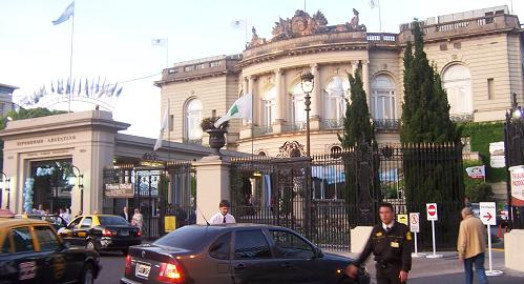
Hipódromo Argentino de Palermo![]() THE PALERMO RACETRACK is the main center for equestrian events in Buenos Aires. It was first built in 1876. In 1908 the current main stand was built to the beaux-arts design of a French architect, Louis Faure Dujarric. The Argentine Grand National, a race of 2,500 meters, has been run here annually since 1885. (more…)
December 17, 2007 9:03 pm | Link | No Comments »
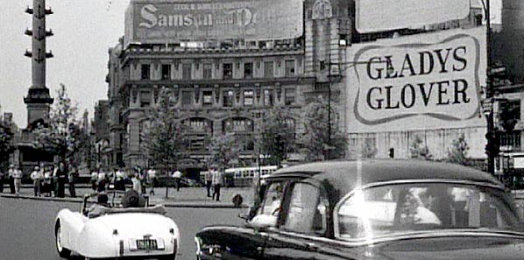
Columbus Circle: A Wider View![]() I THOUGHT THAT since we widened our window of opportunity, I ought to give you a wider view of this capture from the 1954 film ‘It Should Happen to You!’, previously displayed in our exposition on Columbus Circle and the Human Scale. The more recent rehabilitation of this grand public place was discussed in one of my diary entries. (more…)
December 17, 2007 8:25 pm | Link | No Comments »
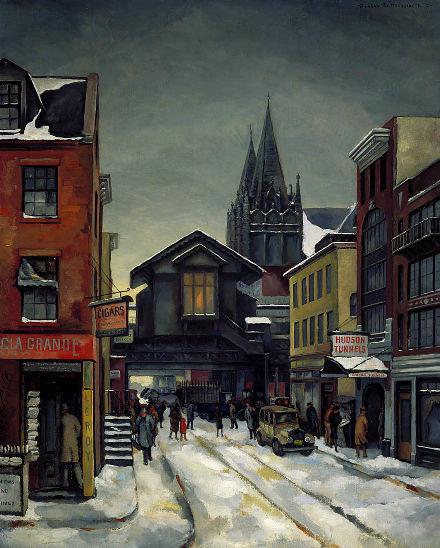
Christopher Street, Greenwich Village![]() Beulah R. Bettersworth, Christopher Street, Greenwich Village
December 17, 2007 8:03 pm | Link | 7 Comments »
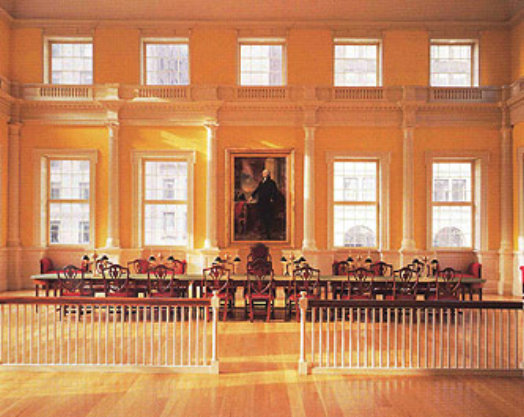
The Old State HouseHartford, Connecticut![]() THE GREAT Russell Kirk once called the main chambers of the Old Connecticut State House “perhaps the most finely-proportioned rooms in all America”. The Senate of Connecticut met in the stately Senate Chamber (above) around a long table, as was the general fashion of the legislative councils which formed the upper house of most colonial legislatures. It was in the House of Representatives Chamber (below) that the famed Hartford Convention of December 1814 and January 1815 met and discussed New England’s possible secession from the Union. The State House was built in 1796 to the designs of Charles Bulfinch, on land which had been granted to Connecticut by King Charles II in 1662. (more…)
December 10, 2007 7:24 pm | Link | 13 Comments »
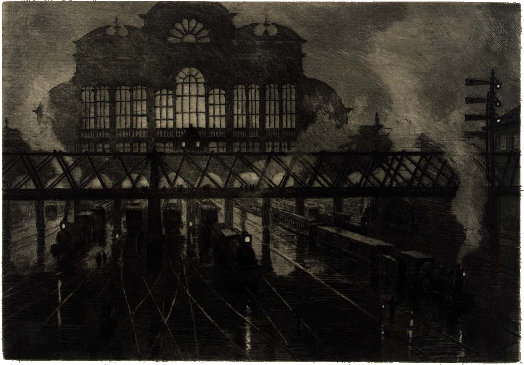
Grand Central Station at Night![]() Charles Frederick William Mielatz, Grand Central Station at Night This, of course, is not the Grand Central we know today, but its immediate predecessor.
December 10, 2007 7:12 pm | Link | 1 Comment »
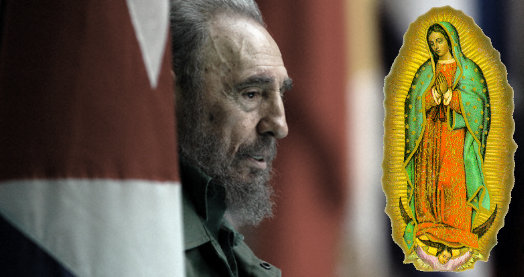
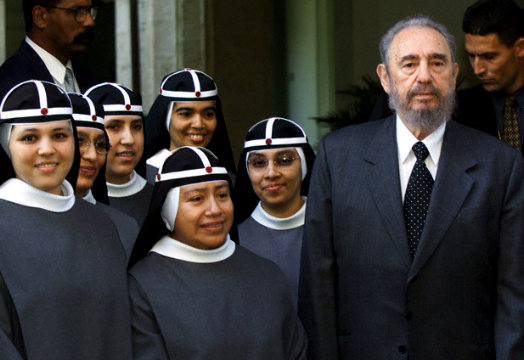
While there’s life, there’s hope![]() IT WAS TERENCE who wrote Modo liceat vivere, est spes, meaning “While there’s life, there’s hope”. This coming Wednesday is the Feast of Our Lady of Guadalupe, and it would be particularly appropriate to remember in our prayers to the Virgin the President of Cuba, Fidel Castro. Castro’s health has been deteriorating greatly of late, so we must earnestly pray to Our Lady that the Cuban president will accept the gracious mercy of Our Lord as he nears the end of his earthly life. (The recent and shocking defeat of the referendum to enshrine socialism in Venezuela has been attributed to the intervention of the Virgin of Coromoto, but rest assured that Our Lady is never too busy to hear our prayers). It would be very foolish and neglectful to think that Mr. Castro, who has been baptized after all, is somehow beyond the grace of God, so please remember him in your prayers: these Brigittine nuns certainly are! ![]()
December 10, 2007 7:05 pm | Link | No Comments »
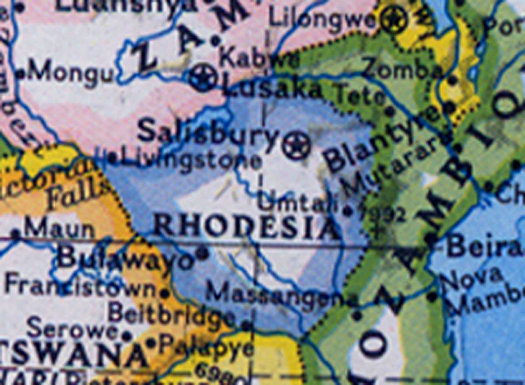
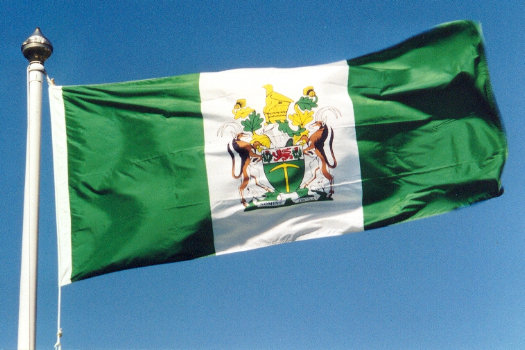
Ian Smith, 1919-2007Prime Minister of Rhodesia![]() The Rt. Hon. Ian Douglas Smith, who died on November 20 (the same day as Franco), was born on April 8, 1919 in the farming and mining town of Selukwe, Rhodesia. The youngest of three children, his father was a Scottish butcher who moved to Rhodesia and became a cattle rancher and horse breeder. Smith attended the Chaplin School in Gwelo from 1930 to 1937, becoming Head Boy, as well as Captain of Rugby, Cricket, Athletics, Tennis, and Boxing. In 1939, Great Britain declared war on Germany, and Ian Smith left the family farm to join the Royal Air Force. Commissioned a Lieutenant in 237 (Rhodesia) Squadron, a crash in North Africa in 1943 injured him so gravely that his face had to be reconstructed, giving him a very fixed look on one side of his face. In July 1944, he was shot down over Italy and evaded capture, linking up with Italian partisan guerrillas and eventually escaping to England to rejoin the RAF. He returned to Rhodesia after the war, and in 1948 married Janet Watt, a widow with two children, Robert and Jean, with their own son Alex born a year later. In 1948, Smith also ran in the general election for the Legislative Assembly as a candidate for the Liberal Party (a party that was, as Lord Blake wrote in his History of Rhodesia, “in accordance with the Rhodesian tradition of adopting the most misleading political nomenclature possible”). “I was the youngest person ever to go into the Rhodesian parliament. I was twenty-nine years old. It so happened that in my little home town of Selukwe, which is a big mining camp, there were people who said ‘Look, surely you don’t expect us to vote for this chap Ian Smith. We remember him when he was in junior school here! And now you’re asking me to accept him as my Member of Parliament?’ Well it so happened that a few of my colleagues in the pub at the same time when the nominations had gone forward said ‘You know, when he decided to go to fight the war for Britain, and that was a number of years ago, you didn’t complain then, did you? What’s your case now?’ Well obviously they did not have a case and that pretty quickly scotched that one!” ![]() In 1964, Prime Minister Winston Field resigned after the members of his party, the Rhodesian Front, felt he was unwilling to take on Britain in the fight for Rhodesian independence. (The British government was unwilling to grant Rhodesia dominion status unless a system of one-man, one-vote was instituted, a prospect considered anathema to Rhodesia’s property-based electorate). Ian Smith, a member of the Rhodesian Front, was chosen to succeed Field as Prime Minister. A year later, in November 1965, Prime Minister Smith and the cabinet declared independence from Great Britain. “We have struck a blow,” Smith told Rhodesia that day, “for the preservation of justice, civilization, and Christianity.” The Declaration of Independence was signed and enacted at 11:00 London time, on November 11 — Remembrance Day — a time particularly chosen to remind Britain of the great sacrifices the people of Rhodesia had made to preserve Britain’s independence in two world wars.
For over ten years Rhodesia prospered, but towards the end of the 1970s, things began to change. Portugal’s Salazar, who had been on such friendly terms with Smith, died in 1970, and Moçambique became independent in 1975 and immediately became a one-party state ruled by the Soviet-backed FRELIMO. While Rhodesia, South Africa, and the United States backed the RENAMO resistance movement in Moçambique, the Communist control of the important port of Lourenço Marques (now Maputo) made breaking the oil embargo much more difficult. Furthermore, South African Prime Minister John Vorster started a policy of engagement with that country’s independent black-ruled neighbors in contrast to the previous policy of isolation. Wooing these countries, however, meant giving the cold shoulder to Rhodesia, and South African economic help trailed off. ![]() Smith soon saw that the only way to prevent Rhodesia falling into the hands of the Communists was to compromise with the country’s non-violent Black moderates, chief among them Methodist Bishop Abel Muzorewa. An agreement was worked out whereby power, once held by the overwhelmingly (but not completely) white property-qualified electorate, would now be shared by white and black Rhodesians alike. There would be an Assembly of 100 members: 72 elected by the non-racial common roll (i.e. universal adult suffrage), 20 elected from the non-racial property role (previously the only electorate, in which voters had to own a certain level of property), and the remaining 8 reserved for white members who would be selected by 92 elected members. A Senate would exist as an upper house: 10 members elected by the lower house, 5 members elected by the Mashonaland council of chiefs, 5 members elected by the Matabeleland council of chiefs, and the remaining members appointed by the President on the advice of the Prime Minister. In 1979, under the new settlement, a general election was held which international observers had confirmed as free and fair. Bishop Muzorewa and his moderate nationalist UANC party gained a majority of seats in the Assembly and so formed the government. Muzorewa became Prime Minister, and changed the name of the country to Zimbabwe-Rhodesia. Out of respect for the old leader and to include whites in the new government, Ian Smith was included in the Cabinet, though only as a Minister-without-portfolio. ![]() The war against the Communists continued, albeit now under black leadership, but remarkably the international community refused to accept the compromise settlement and declined to recognize the new Republic of Zimbabwe-Rhodesia. Neither sanctions nor the oil embargo were lifted and thus the country still suffered an energy crisis. The British government under Thatcher forced Muzorewa to the bargaining table. Thatcher invited both Muzorewa and the Communist guerrillas (the Patriotic Front under Robert Mugabe) to participate in roundtable talks in London at Lancaster House. It was agreed that Zimbabwe-Rhodesia would revert to its previous role as a British colony while elections could be held which were not restricted to non-violent parties. In exchange for being allowed to participate in these elections, the Patriotic Front agreed to abide by a cease-fire agreement, to renounce the use of force for political ends, to campaign peacefully and without intimidation, and to accept the outcome of the election. The black moderates and whites were assured that, should any party violate these strictures the Governor was bound to forbid them from standing in the elections. Predictably, Mugabe’s guerrillas did not abide by a cease-fire, but engaged upon an active campaign of violent intimidation of the electorate. The British turned a blind eye, hoping to hold the elections and then “get out of Dodge” as soon as possible, handing over power to the victor. Mugabe was declared the victor by a landslide and the rest is history. ![]() THE DEATH OF Ian Smith struck me in particular as he was always a sort of hero to me. (I will always remember having his picture on my wall during my university days). He steered Rhodesia clear of both the stagnant racialist waters of South African-style apartheid as well as the destructive materialist waters of Communism and embraced a common-sense approach the chief aim of which was the preservation and advancement of peace and prosperity for the greatest number of Rhodesians. His deep love of his country was obvious, as he devoted his entire life to its service. But most of all, from all quarters, Ian Smith is continually hailed as a gentleman, and gentlemen are fewer and fewer in the realm of politics these days. May God in His mercy grant eternal rest to the soul of Ian Douglas Smith, and may perpetual light shine upon him. Amen. ![]()
December 7, 2007 8:24 pm | Link | 13 Comments »
Remembering ‘Smithy’![]() THE FOLLOWING ARE remembrances of Ian Smith which had been left on various internet sites and Facebook groups dedicated to him. I think these words speak for themselves. “I met Ian Smith when I was 11, at a braai in Shabani. He seemed interested in everything and everyone and took the time to speak to us children and ask after our families. I met him again a few years later and was stunned to find that he remembered me and asked about all of my family members by name! What a remarkable mind and someone who was a real gentleman.” — Ashleigh Dance
“Gosh it was only yesterday that my friend visited us in Salisbury/Harare from England and wanting to impress her I drove up to the Smiths’ house and knocked at the door. Janet answered and asked us in and when Ian arrived home my friend almost choked on her apple pie! They made us so welcome and even let us take photographs which, alas, I do not have copies of any more. Our afternoon tea turned into dinner too and Ian promised to look up my friend in London if he was ever in the country. Unfortunately, it never happened, and my dear friend passed away three years ago, but she retold the story of her visit to all who would listen and was one of Mr. Smith’s strongest U.K. supporters. She wrote many a letter to the Times telling all and sundry what a lovely man he was and how he really cared for his countrymen and women — no matter their colour. Rest in peace, Mr. Smith, you fought the good fight and deserve to be remembered.” — Stephanie Murphy “When I was little, my dad ran State House in Bulawayo and we lived in a lovely cottage in the grounds. Whenever Ian Smith was visiting my dad would let me go over to say hello and he would sit me on his lap in the lounge called the Blue Room and read me stories. I still remember my dad on a mad hunt for his precious ‘Parker Pen’. Turned out I had wrapped it in toilet paper and gave it to Mr. Smith as a present. I was only about five years old, so of course I was forgiven and Mr. Smith got to keep the pen. He was an amazing man and will be mourned by anyone who knew him or wished they had. May he rest in peace.” — Lynda Taylan “R.I.P. – and thank you for always making the time to speak to my dad at various cattle sales. It meant so much to him.” — Elizabeth Thomas “What a legend. During the talks on HMS Tiger & HMS Fearless in Gibraltar, Harold Wilson tried to humiliate and degrade Ian Smith, by billeting him with the ‘lowest form of life’ onboard ship: the seamen. As the Senior Petty Officer said to Ian Smith in their wardroom when making a toast to him before dinner one night, ‘There are 265 officers and crew onboard ship – including you, sir, 264 support you, sir.‘ That sums up the man. Africa is poorer without you. Rest In peace ‘Uncle Ian’.” — George Parkes “It was because of Ian Smith that guys like me joined the army, we were proud to fight and die for him and given the chance would do it again without thinking. One of my proudest moments was meeting Ian Smith whilst serving in Rhodesian Light Infantry. We will never forget the man.” — ‘gombie’ “As a child I met Ian and Janet a few times, and they both made a great impression on me. My parents and I spent time with them during a visit to Portugal and I remember what a gentleman Ian Smith was. I won’t forget his kindness to my mother and I when my Dad died so many years ago. May he rest in peace.” — Tracy Chittenden (née Burt) “I met him personally at New Sarum many years later and then in more recent years enjoyed chats with him at the RAFA in Harare. He always remembered me. He was the most honourable politician in modern history and I was proud to serve in his armed forces. … We will never forget him.” — Dave MacKay “In the mid-1990s I came across Mr. Smith in the Newlands Bookstore and had a short chat with him. Upon leaving he was recognised and the whole square filled with people cheering him. There were a few whites, but over a hundred black folk were leading this genuine, impromptu display of affection and appreciation. Businessmen and shop workers left the buildings and banks, joining the garage attendants, waiters, policemen, and others. Business stopped as people came together to join the excitement. Mr. Smith waved, thanked everyone and humbly walked around to his car. Even at that time in Zimbabwe, he was able to inspire hope and respect from all there; as well as a sense of loss. These are the kinds of memories and feelings we will keep in his memory. He will always inspire the best in us.” — ‘DanaDonn’ “A Prime Minister who was so down to earth that he stopped, saluted, and then spoke to my little boy, who was waiting at the airfield in Gwelo with his father one day many years ago. … That little boy is now 38 and, though only about four years old at the time, recalls that day with great pride and remembers that the Hon. Ian Douglas Smith, Prime Minister of Rhodesia, had saluted him as he was wearing a little jacket with his father’s old rank stripes sewn on the sleeve.” — Margaret Roberts “I had the honor to meet with Ian and Janet Smith at their home in Harare and here in the United States. Janet walked my legs off in Washington D.C.! She was such an exuberant woman and so vivacious. I loved her immediately and have great memories of her. I remember having to show her how to order Room Service while Mr. Smith sat chuckling in the next room. “Their humor was quite unexpected and totally captivating. When I first arrived at their home in Harare, they both made a great big deal about me having my first African meal and how they had made it so special for me. I had visions of crocodile, or elephant on a splendid tray… After we were seated at the table, a large covered tray was brought in and I braced myself to exclaim with delight at whatever it may be. With a flourish, Mr. Smith whipped off the cover and low and behold there was… a pizza! “Such humble, real, absolutely great people. Mr. Smith actually taught me how to brew tea ‘the proper way’ when he visited us. I am so blessed and honored to have spent time with them.” — ‘cathi575′ “My family and I had the privilege of having lunch with Ian Smith. What a man: every word he spoke, you could tell he was a man of serious consequence and a natural leader. … I will never forget the day. R.I.P. Sir.” — Daniel Russell “Ndimi mukuruwemauto. Ndimi mutungamire wedu waiva ne moyo mukuru, pfungwa dzaishamisa chose, ne njere kutonga vanhu venyika nerudo rakakosha. // You are a supreme warrior. You are our leader who had a big heart, amazing insight, and wisdom to lead the people of the country with loving compassion” — Bud Jackson “A man who was tough but fair. He will be missed by many people around the world, but mostly by a huge number of people in Zimbabwe. Remembered with love and respect. R.I.P.” — Penny Campbell-Myhill “I never actually met Ian Smith but I feel like he was a father to all of us in some way, thats the way he made every one feel. He was a good man and he will be missed by all. I write this with a lump in my throat cause I miss home. May you rest in peace, father of our nation.” — Dean Evans “I had the opportunity to meet Smith when I represented Australia as part of the Commonwealth Observer Group for the Zimbabwean elections in 2000. I found his address in Harare, caught a taxi and found the gate wide open. He came to the door himself, made some tea and we chatted for an hour about his life and his leadership of the Rhodesian Front (where clearly some elements were much more reactionary than he was), his dealings with British prime minister Harold Wilson, and his relationship with Mugabe which, early on, had been unexpectedly productive. “When I shook his hand, I felt I had touched the hand of history _ a modest, intelligent man, a farmer, a reluctant politician, a shot-down World War II fighter pilot, and a person who had done his duty and left his little country in marvelous shape. “I caution against being harsh on Ian Smith. I feel privileged to have met him, and my view was backed by the respect given him by many black Africans. That is why his safety was secure while all around him, Mugabe and his cronies trashed a country.” — Australian Senator Sandy Macdonald “Hamba Kuhle Baba, I never knew you, I don’t agree with all that you did, but you have helped shape me, and who I am, and, like any Ndebele, I admire a person who stands for what they believe in, even if it is to the ire of others. Rest in Peace, I only wish I could have met you.” — P.J. Mitchell “Rest In Peace, Mr. Smith. And please pray for your country from up there. It still needs you…” — Matt Du Sart
December 7, 2007 8:19 pm | Link | 1 Comment »
A Glimpse at Smithy![]() From the Australian and the Sunday Times of London, I decided to excerpt these two articles to give our readers a better glimpse at Ian Smith, the man. (All boldface is mine). From Graham Davis, writing in the Australian, 22 November 2007. I recall an afternoon in 2000 with Smith, who’s remembered by many blacks with nostalgia and a surprising degree of affection. It was a modest villa in the embassy quarter of Harare and my first impression was one of surprise. Not only was the front gate open but the front door was also ajar.
A few streets away at the palatial State House, where Smith used to live, his old nemesis, ‘Comrade President’ Robert Mugabe, was obliged to surround himself with tanks for protection against a seething populace. Yet here was the ageing warhorse of the outvoted white minority not only undefended but totally open to anyone passing by. And come in they did. […] ‘Every day, people come to me because things are so bad and they’ve nowhere to turn,’ he said. ‘I do what I can, which is unfortunately not much.’ […] Later, I called on a senior veteran of the independence struggle, James Chikerema, to ask him why so many blacks I’d met agreed with Smith that their lives were better under his regime than under Mugabe. ‘To a certain extent, he’s right,’ said Chikerema, who fell out with the regime when Mugabe sooled his North Korean-trained Fifth Brigade on his political opponents in Matabeleland in the early 1980s. Perhaps 35,000 people were massacred. ‘During Smith’s time, the police did their work professionally but now they’re totally corrupt. It’s a terrible indictment of Mugabe that ordinary people felt safer under Smith than they do now,’ Chikerama ventured. […] His home happened to be next door to the Cuban embassy and I wondered how he got on with his revolutionary neighbours. Cuba, after all, had sent thousands of troops to Africa to help in the liberation struggle and time was when Fidel Castro’s lieutenants would have seen it as their patriotic duty to eliminate Smith. “I get on very well with my Cuban friends,” said the old man. “From time to time, they actually pass me cigars through the fence.” “So the old saying about the only good commie being a dead commie doesn’t apply when they live next door?” I joked. “Well I know some communists who are better than a lot of so-called capitalists in this free world, so let’s treat people on merit,” Smith replied.” ![]() From R.W. Johnson, writing in the Sunday Times of London, 25 November 2007. It is quite common to hear him blamed for having created Robert Mugabe and having thus helped to father the human catastrophe of present-day Zimbabwe. Yet the odd truth is that in retirement after 1980, when Mugabe took over, Smith not only did not fade away but grew both in stature and popularity.
As Mugabe’s regime became steeped in blood and violence, Africans of all persuasions flocked to Smith’s house to consult him. The (all black) student body of Zimbabwe University gave him a standing ovation for his ringing condemnation of “the gangsters”, as he always called Mugabe’s corrupt ruling mafia. Visiting him at his house in Harare (next to the Cuban embassy, the hammer and sickle flying) I marvelled at the fact that, after the death of his wife Janet, he lived alone with just a cook and minimal security. When he walked the streets of Harare, Africans would almost queue up to grasp his hand and wish him well. How could this be? […] Paul Themba Nyathi, a leader of the opposition Movement for Democratic Change, who had fought Smith’s regime tooth and nail, told me that in retrospect Smith’s Rhodesia had been “a paradise”. In material terms that was certainly true: everything then was better for Africans than it is now – education, healthcare, standard of living, life expectancy and employment. But as people saw Mugabe cloistered behind high walls and Kalashnik-ov-toting guards, venturing out only in armoured cars and vast militarised motorcades, they also remembered how Smith had lived a simple, unguarded life. When he needed to travel abroad he drove himself unescorted to the airport, parked his car and carried his own bag. Just before the last presidential election in 2002, Smith said to me: “If Mugabe and I walk together into a black township, only one of us will come out alive. I’m ready to put that to the test right now. He’s not.” I never understood the Smith phenomenon properly until I attended the launch of his book, The Great Betrayal, in Durban in 1997. I’d been unsure about going, not wanting to be taken for someone applauding an old white supremacist, but I needn’t have worried. It was a family occasion for old Rhodies and I wasn’t part of the family. Transparently, they all loved him, hung on his words as he talked about what a fine country Rhodesia had been, how it had been fully worth the fight. As people queued for him to sign their copies you could see big men shaking with tears. “They’re stateless, you see,” an old Rhodie said. “They belong to a country which no longer exists. They’re lost. We all are.” I was left wondering, why do no South Africans feel like that? For the strange fact is that even people who were hidebound Afrikaner nationalists evince no nostalgia for their old leaders or for the apartheid period, which is now seen as having led the country into a disastrous cul-de-sac. A month ago I had to meet a high-ranking Afrikaner policeman, a man of the old regime if ever there was one. He insisted we meet in his new home, an ex-serviceman’s “shell-hole”. There on the walls were pictures of the motorcycle escort for the 1947 royal visit, of a youthful Ian Smith, of Hurricanes, Spitfires, Lan-casters and of Jan Smuts. Amazed, I asked what of Malan, Strijdom, Verwoerd? His opinions were unprintable. But why Smuts? Afrikaner nationalists always saw him as a sellout to the English. “He was a fighter, he was a general. In the backroom we’ve got the other Boer generals, De La Rey, Louis Botha and Kruger. All fighters, like Ian Smith. Not sellouts like De Klerk.” Thus is collective memory reformulated. For black and white alike, Smith is now seen as someone who fought in the last ditch for “white civilisation” and, given how things have turned out, it’s difficult not to respect his fight. […] His time with the partisans meant he spoke fluent Italian, loved opera and could quote great reams of Shakespeare. […] When Mugabe gained power in 1980, Smith abandoned all his previous feelings about the man and rolled up every day at Government House to offer his help. He had, after all, run the country and economy surprisingly well in the face of tough international sanctions. He was incorruptible, the country he handed over was in good shape. The only thing that mattered now, he said, was to make a success of the new Zimbabwe. Mugabe was delighted to accept his help and the two men worked happily together for some time until one day Mugabe announced plans for sweeping nationalisation. Smith told him bluntly he thought this a mistake. Their cooperation ended on the spot. Mugabe, furious at being contradicted, never spoke to him again. From time to time Mugabe made threatening noises, suggesting Smith ought to be locked up and “punished” for his opposition, but Smith’s attitude was contemptuous: “I’d like to see him try.” He never did. When Smith’s delegation met Harold Wilson’s in their long and fruitless talks, observers were struck by the fact that the white Rhodesians were all older men who had fought for Britain in the war, tough guys who thought their opposite numbers naive. Wilson was taken aback and railed at him as a “tinpot dictator”. Smith turned his back on him in a long silence before replying: “Look here, Harold, if you and I are to get on you can’t talk to me like that.” It was Wilson who had to retreat. […] Interviewing Smith in the sitting room of his Harare home a few years ago, I was reminded of how the French left-wing intellectual Régis Debray described being sent by François Mitterrand on a mission to Hanoi. The communist leaders welcomed him with open arms and poured out their devotion to France – but, to his embarrassment, it was the France of Jean Jaurès and Victor Hugo, bearing almost no relationship to the urbane Paris of the 1980s that he had just left. It was the same with Smith. He had, he told me, been bitterly disappointed by the Britain he had encountered in the permissive 1960s, but he’d just been to London for an RAF reunion and he’d been to the last night of the Proms. “And, my goodness, to see some of those young people sing Land of Hope and Glory – why, I think they have the spirit I thought was gone. Such fine young people, it will all come again, they’ll carry it on,” his bony old hands making emphatic gestures of enthusiasm as he spoke.
December 7, 2007 8:12 pm | Link | 2 Comments »
|
Recent PostsRecent Comments
Monthly ArchivesCategoriesDonateClick here to make a financial contribution towards the expense of maintaining andrewcusack.com.RemembrancesRecommended
|