
About Andrew Cusack
 Writer, web designer, etc.; born in New York; educated in Argentina, Scotland, and South Africa; now based in London.
 read more
News
Blogs
Reviews & Periodicals
Arts & Design
World
France
Mitteleuropa
Knickerbockers
Argentina
The Levant
Africa
Cape of Good Hope
Netherlands
Scandinavia
Québec
India
Muscovy
Germany
Academica
Wallabout Market

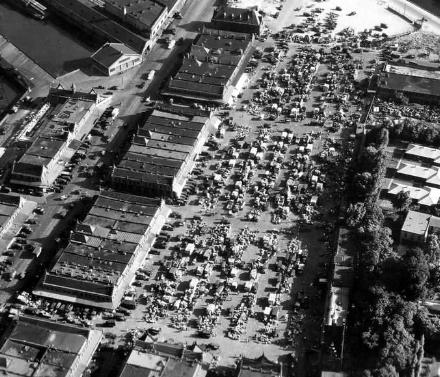
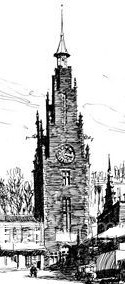 New York’s Wallabout Market was once the second-largest market in the world. From about 1884 onwards, vendors would gather in this district adjacent to Wallabout Bay in Brooklyn and sell their various wares. It was then that the market vendors had been banned from Fulton Street for making too much noise, and so took up their trades further down by the Wallabout Canal, next to the New York Naval Shipyard, more commonly known as the Brooklyn Navy Yard (founded 1801, decommissioned 1966).
The market featured permanent two-story brick structures designed in a nostalgic Dutch style, commemorating the Netherlandish origins of New York and Brooklyn, centered around an open plaza known as Farmers’ Square where stalls were erected. The centerpiece was a tall clock tower, seen at right and further below.
The market buzzed with activity from about midnight until just after dawn, by which time trading had died down. During the majority of the daylight hours the vast market stood empty.

Wallabout Market was an unfortunate victim of World War II when the Navy Yard expanded to seven times its previous size, gobbling up the land the Market was built on. New York’s primary market today is in Hunts Point – the largest terminal produce market in the world – though Brooklyn still has its own terminal market at Foster and Remsen Avenues between 83rd and 87th.
Search
Instagram: @andcusack
Click here for my Instagram photos.Most Recent Posts
- West Point July 30, 2026
- Brunel’s Unbuilt Capitol February 3, 2026
- Cricket at Fordham January 27, 2026
- Palacio Barolo Revisted January 14, 2026
- Learning to Love Liguria January 14, 2026
Most Recent Comments
Book Wishlist
Monthly Archives
Categories

When I lived there I always felt like a big chunk of neighborhood was somehow missing. And now photographic proof! It’s difficult to imagine how many times the sliver of a neighborhood that’s left has been requisitioned and repurposed over the past 400 years. It would be so nice if the Navy Yard still contained a nice market, definitely seems like a lot of ‘Vinegar Hill Adjacent’ waterfront is squandered in the way the Navy Yard complex is presently used.
In 2007 I lived a block from the Navy Yard on Cumberland Street. There are only two blocks North of Park Ave/The BQE/Walt Whitman Houses and they were/are almost completely devoid of restaurants, delis, laundromats… really anything.
The lack of ’stuff’ definitely does more to kill the quality of life than the BQE, methadone clinic(s), power plant, or being surrounded by half-empty decaying Housing Projects on 3 sides. Consequently, most people do all that they can to avoid living there. Conceptually… it would be a very nice place to live, if it had ‘stuff.’
During a story, my grandmother (born 1899) mentioned that someone had called her “a Wallabout Market dock rat.” Must have been a prominent feature in her day.
My g-g-g-g-grandfather John Henry and his son William had a ropewalk and heckeling loft in Williamsburg near the approach to the Wnsbg Bridge. Dated approx 1815-30
and many of my ancestors talked of Wallabout mkt. It is assumed the ropewalk was purchased to be demolished as it straddled the planned development of blocks near the river and the construction of the bridge. If you have any info I would be very interested.
Any information concerning merchants at Wallabout Market, specifically P (Philip) Silberman and Sons would be greatly appreciated.
A very informative article, except the photograph credit lines seem to be missing or am I just not seeing them? The photograph at the top is from Brooklyn Public Library–Brooklyn Collection, call # NEIG 1626
http://bk.ly/uai.
Would like to hear from anyone who has info on my grandfather’s or father’s (Jacob/Milton Sorgen) fruit and vegetable business in the market during the first half of the twentieth century, Thanks.
My mother’s family were Irish immigrants who migrated to Brooklyn to work in the Navy Yard in the 1850’s. My father owned and operated a trucking business in the Wallabout Market from the late 1920’s and moved with the Market to the Brooklyn Terminal Market during WWII. Farmers Square was never the same.
If one knows the origin of the Wallabout name one should also know where Vinegar Hill got its name.
Looking for a picture of Wallabout Market, corner warehouse belonging to my great grandfather. The sign which stretches the length of the facade says “P Silberman and Son”
I have two photos of Wallabout Market Baseball team and Minstrell Show, would like to share this family history (Weinmann, Herman and Phillip) with your site.
My maternal great grandfather Angelo Campo and his brother Dominick were said to have operated a produce business in the market till the time when it was reclaimed by the government. Looking for info on this business.
Frederick I have some info for you, Angelo and Domenic were my grandfather’ uncles, my great great uncles..I have a pictue of their truck with Campo Brothers on it and a few other pictures you might be interested in. Get in contact with me anytime..Tony
Looking for info on Julius L. Radecke’s Wallabout hotel and market and Franke Brothers fruit market…later Franke & Schott
My grandfather, Joseph Preston Ebbets, was a guard at Wallabout Market, and also ran the clock in the clock tower. He was tragically killed when a truck slipped on the ice and hit him in December, 1933, I believe. My Aunt, Anna Marie Ebbets, wrote a beautiful poem dedicated to him that was published in the New York Post, I believe; I have a copy of it which I should share with you some time.
Jim Rohan was your dads name PatRohan, my dad worked at the market and organized the truck drivers, his name was Paddy Sullivan
My maternal grandmother’s family had an olive oil company in Wallabout called Sasso Oil.