About | Contact | RSS

Fund. A.D. MMIV (a.u.c. MMDCCLVII)

Top Sites

Top Blogs

Friendly Blogs

Reviews

Periodicals

Church

Art & Design

Cape of Good Hope

France

Netherlands

Mitteleuropa

Scandinavia

Livonia

Muscovy

India

Argentina

The Levant

Knickerbockers

Academica

Miscellaneous

Bon Voyage

Heading to Scotland for a little bit, then down to Somerset for a spell. Dino Marcantonio, you’re in charge!

Thursday, February 15th, 2007 6:00 am | Categories: Great Britain Heraldry Ireland
111 Comments so far
  1. 15 February 2007
    10:21 am

    Non sum dignus!

    Dino Marcantonio
  2. 15 February 2007
    2:19 pm

    What’s your take on this news?

    CC
  3. 15 February 2007
    10:02 pm

    I don’t expect any permanent effect. I expect Mass attendance will drop over the years as the immigrants and their families take on the habits and attitudes of the local culture.

    On the other hand, if the Church hierarchy decides to revise its approach of the last forty years, England may once again become a Catholic nation.

    Dino Marcantonio
  4. 16 February 2007
    11:17 am

    @Andrew:
    May you have a wonderful trip!

    @Dino:
    Nice to meet you. Very nice architectural work on your site! From your comment above regarding the Church in England (i.e., “if the Church hierarchy decides to revise its approach over the last forty years…”), I gather that you’re of the traditionalist flavor. Well, in that case, very nice to make your acquaintance! I’d be interested in knowing what you (and others) thought of my own site, http://www.miserere.org.

    Warmest regards.

  5. 16 February 2007
    11:18 am

    Congratulations on your great good fortune, Andrew. A new job & already free to go abroad. Have a safe journey.

    kd
  6. 16 February 2007
    11:26 am

    Oh God, let’s hope Britain doesn’t become Catholic. Do we really want to acquire Italy and France’s culture of corporatism and sloth?

    CAWP
  7. 16 February 2007
    6:57 pm

    Alessandro, it’s a pleasure to meet you. I’ll certainly have a look at your website. The title sounds promising (but it doesn’t seem to be Firefox-friendly at first glance).

    CAWP, Britain will become Catholic again only if she wishes to save her soul. I don’t see that that necessarily entails corporatism and sloth. Was Britain that way pre-Henry VIII?

    Dino Marcantonio
  8. 16 February 2007
    7:23 pm

    @Dino:

    Sorry – there was a problem with the site today that went unnoticed since last update. It should work fine now. (And actually, it’s designed for Firefox ;-)

    http://www.miserere.org

    Warmest regards!

  9. 16 February 2007
    9:28 pm

    Britain’s soul isn’t Catholic; its language, values, law, traditions, cultural achievements – and those it has bestowed to the New World – have almost nothing to do with Catholicism, save for what it has in common with the Reformed Protestant faith, a faith which preserved them from further perversion, and set them securely in the original, sacred framework they had (by which I mean scripture).

    Wherever Catholicism has “saved a nation’s soul” (e.g. Old, non-Anglo Saxon Europe, e.g. Latin America), we find a distinct inferiority to the Anglosphere’s achievements. We find indolence, hypocrisy, arrogance, duplicity, obnoxious institutions like ‘civil law’, and an uppity, meddling, disloyal clergy. Heck! Look at Cardinal O’Brien’s advocacy of the SNP and independence for Scotland: the Roman church is STILL trying to undo the British crown’s glory and authority.

    The fact is, for all the laudable ways it has reformed in line with the victories of the Protestant Reformation, it remains a meddlesome, devious organisation. It has wonderfully refused to let go of many essential Truths in the face of secularist, debauched modernity; but it is annoying and corrupted still.

    CAWP
  10. 17 February 2007
    8:22 am

    Er, that was a bit rude. I think the Catholic faith very great; very great, actually; and of course it is nothing like it was at the Reformation, having purged itself of so many of the corruptions it then possessed. But I think the Anglosphere’s achievements explicitly contrary to Catholicism, in many ways, and Britain would hardly do well to return to it.

    CAWP
  11. 17 February 2007
    9:08 am

    I didn’t consider your comment rude. In fact, I appreciate your directness.

    Now I will be direct. FWIW, I see very little in common between Protestantism and early Christianity. The Bible, for starters, didn’t even exist then as a consolidated entity, not having been put together until the 4th century (by the Catholic Church hierarchy).

    The Church’s hierarchy (the human element of the Church) has always been, and always will be, riddled with corruption and venality. I would go so far as to say that, as a general rule, the priestly class is always the most corrupt in any society. The question is: are the Church’s official claims true. To my mind, Her Priesthood and the Holy Sacrifice are true.

    Sadly, Anglicanism lost that priesthood IMHO. If you wish to put the crown and any other temporal benefits above that priesthood, I think you’re making a serious mistake that has consequences both for your own soul, as well as for the soul of the nation.

    Out of curiosity, which of the Anglosphere’s achievements are explicitly contrary to Catholicism?

    Dino Marcantonio
  12. 17 February 2007
    10:19 am

    The Protestant Deformation has nothing to do with Scripture… and Britain does not either. If Lutherans claim that they go only by Scripture, then Anglicanism and AngloSaxons do not… since they claim the same thing. REMEMBER CAWP that the main reason why England joined the deformers was because the king was not allowed to divorce his wife! (Is that really a good reason to abandon all that was once considered sacred?) How come, if there was so much corruption in the Church, the king and his followers did not see it before? How come they only saw it when the king wanted to see it… and then get rid of it… as he did with his many “wives”?

    The glory of the crown of England just like that of Spain DOES NOT EXIST anymore. These people are only figure-heads of a nation that does not listen to them anymore. Do you really think that Elisabeth is the head of the Anglican church? Then why is there such a scandal with what the “Archbishop” of Canterbury does or does not do? What he accepts and what he doesnt? I have never heard the “queen” say anything related to the ordination of women, the ordination of public sinners (homosexuals, adulterers, lesbians, female bishops, etc.)

    Hypocrisy, indolence, etc. is found anywhere, even where there is no Catholic Church (if there is such a place). Remember that these things (indolence, arrogance, etc.) did not start after the Divine foundation of the Church of Christ. Henry VIII himself was an arrogance and proud man who did not want to obey what the Pope was telling him. Even if the Pope himself had not been a holy man, Henry still knew that there was no such thing as divorce, but HE DECIDED to overlook that (out of pride and LUST), and went his way.

    CAWP, give me a few examples of how corrupted the Church still is… but first look at Britain and see if they are free from that… unless you cannot see that corruption because of all its glory and authority… if you can see such a thing…

  13. 17 February 2007
    1:01 pm

    Britain’s soul isn’t Catholic; its language, values, law, traditions, cultural achievements – and those it has bestowed to the New World – have almost nothing to do with Catholicism…

    What bosh! Please do go and read a proper unbiased history of England, and you’ll see that its ancient soul is through and through Catholic, and is the reason for its past greatness. Why, up until the 17th century it remained profoundly Catholic, although its repression and persecution by the Queen drove it underground, while its numbers dwindled.

    I think the Catholic faith very great; very great, actually

    Thanks for the patronizing gesture, but for someone who claims Holy Mother Church “remains a meddlesome, devious organisation”, your compliment strikes a distinctly false note. It’s quite alright, though; I, too, was once fearfully ignorant of and prejudiced against the Catholic faith. By the grace of God, I’ve since come around.

  14. 17 February 2007
    9:55 pm

    Ouch. Do you really want to me to reply to all that? How can I take on three posts by three different people? I think many people of the years have covered all your arguments sufficiently.

    I would like to. However, a point by point rebuttal would, I fear, be tedious.

    There’s so much!

    You see no similarities between the early church and Protestantism. But of course, Protestantism’s focus on and loyalty to scripture reflects not only the disciples and the early church’s constant concern with the scriptures – think of all the times they recall Christ’s ministry through OT texts – but defeats your argument in another way, too. For the NT is largely written to and about the early church. In focussing so much on scripture, then, the Protestant church not only imitates the early church, but places itself in their position (as audience, for instance, to Paul’s letters, just like the churches in Ephesus, Corinth, etc) too.

    I don’t quite think your statement that the clergy will always be corrupt leads very smoothly into your belief that the Catholic one hasn’t been corrupted. I think the changes that have taken place in your church – slowly enacting much of the Reformation – is proof of this, and a distinct spanner in the works.

    Anglosphere’s achievements VS Catholicism? Stress on importance of the individual as a unit in society, stress on English language, stress on church not being an arm of government (Establishment is different, as you know), etc, etc. Look at Catholic countries, compare them with Protestant countries. One sort gave us so much that is good in the modern world; the other, little better than the achievements of the Muslims on a good day. One promoted active faith, the other (largely) automatized it, reduced it to routines and complacency, with tricks (selling of blessings, pardons, etc) not engagement with our Saviour and his Word as the key to getting along. So Protestants abolished slavery, and Catholics didn’t. So Protestant revolutions (e.g. American) enshrined the citizen as a free, responsible, duty-bound, engaged member of a common interest and small state, thus extending the governmental and philosophical structure of Britain, itself suffused with these Protestant ethics (for they are exactly that in the religious realm). And so, on other hand, revolutions in Catholic countries (e.g. France) merely appropriated and extended the Catholic mentality of corporatism, physical coercion, and the controlling, authoritarian, centralising, forever-correct governing body (the State, totalitarian or welfare, sclerotic and corrupt always, being the natural successor, in so many ways, to the Catholic church).

    LatinMass83 – you’re a bit mad, really. Too much to disentangle; too many boring old canards repeated; too emotional. Maybe another day. But I think even fellow Catholics will see through most of what you’ve said. E.g., everyone knows the Protestant reformation wasn’t simply about a return to scripture, but about the importance of the individual’s active relationship with scripture (within the guiding framework of tradition and the church as authorities, of course, but with difference of interpretation a fundamental right – partly as a means of avoiding the institutionalizing of perversion as in Catholicism… I realise this has caused problems, but only in recent years, with dishonest people themselves bringing in such perversions. The clergy have failed to assert their authority; a number are themselves corrupt.)

    Etc, etc.

    Now, the C of E isn’t perfect at all. It has done many silly things in the past 50 years; the Catholic church has been the saner of the two, in this time. But the C of E has, properly, a form more perfect, holy, apostolic and traditional than any other. It is the Primitive Church maintained, saved from Medieval-era Catholicism, always before the throne of the Father, in touch with him hourly, dependent on his Word, blessing his name, practicing the Faith given to the apostles as the apostles did. The Roman church has some of this, but fused with too many worldly accoutrements, decorations, appeals and demonstrable doctrinal falsehoods (prayers to saints! prayers to Mary!).

    I wasn’t being patronising about Catholicism being a great faith. I really believe it is. I have felt, at times, drawn to parts of it (and remain astonished, and incredulous of others). But, whether we like it or not, much of its dogma is presently false; and the C of E by far truer to the Church we have read Christ creating. The Catholic church is today very different, and in a very different position politically, to the Catholic church historically – so perhaps in the future it might be a different force for different things. But I believe it very hard to argue it has been, or holds much definite chance of being, a force different to the one I have argued it to be in the past. I haven’t mentioned much of its brilliant achievements against the Muslims in the East, or its excellent missionary work, and I apologise for such omissions. But such positives do not negate its own very serious, and (thankfully, in this regard) separable faults.

    There may be spelling mistakes in this; also grammatical ones; sorry; no time to thoroughly check.

    CAWP
  15. 17 February 2007
    10:02 pm

    EDIT: The Catholic church these days has SOME doctrinal falsehoods. Not loads. Sorry. A few. I am arguing largely against the Catholic church historically, not presently. It IS a great faith, and I do mean that, and I don’t care if it seems patronizing to say so.

    CAWP
  16. 17 February 2007
    10:39 pm

    I am not upset! I just said what I thought, which is true. Now, it seems that you have not been to a Catholic church in a long time because now they are less decorated than before. When you refer to the C of E, which one are you talking about? The High or Low section? One desires to look Roman, the other protestant…

    The C of R is NOT the primitive Church! The Church NEVER had female bishops nor advocated the ordination of women! The C of E did! That is a mayor error and corruption of the Faith, the True Faith. They got rid of the Sacraments that the Church had from Its very beginnings… and again… its beginning counts… Henry VIII was the founder, you can judge the group by the founder. Henry was not a Saint, Luther was not a Saint, Mohammed was not a Saint, Calvin was not a Saint… but Christ is since He is God.

    The Deformation did not bring people closer to Scripture. In fact, it led to a wide and false interpretation of Scriptures that led to contradictions and divisions… the C of E being only an indirect result of that. Also, the C of R has not had problems only in the last 50 yrs. This shows that you really lack knowledge of history! It is natural to have problems, but to change the essentials of a religion as a consequence of those problems does really show whether that church or religion is true or false. The C of E has fewer Sacraments, essential changes in rites and ceremonies, moral issues, which should ALWAYS be the same ones and NEVER change.

    CAWP, the Church STILL holds the same articles of Faith that it had in the past. So when you say that today it has fewer falsehoods, you are wrong or blind… or you just look at the external stuff… and in that case I wonder what you have to say about the other thousands of protestant sects and denominations… I wonder…

    latinmas1983
  17. 18 February 2007
    8:00 am

    Haha!

    Look, you’re flatly wrong about the Reformation not bringing people closer to scripture. No serious person would dispute this; the Catholics today use Bibles translated into their own tongues only because of the Protestant’s first gaining such a right. The Catholics (especially post Vatican II) now consider a personal engagement with scripture as very important.

    As for Henry VIII founding it, I’m afraid that repeating that reinforces an unfortunate stereotype of the ignorant, vicious Catholic taking on the Prods with a number of popular falsehoods. Trotting that argument out is a stupendous act of idiocy, as any honest Catholic will (again) tell you. The Reformation was not instituted by a single man; it was a movement spanning continents; Henry VIII, as the man in charge of England, may have legally brought the C of E into existence (and for his own selfish reasons), but it was forces (ie. the people) throughout Britain, Germany, the Low Countries, France and elsewhere that meant such an institution could be made to exist. Clerical and popular discontent with Catholic abuse – and the beginnings of the Reform – can be traced back to Wycliffe, in the Middle Ages. If anything, Henry VIII hijacked it; I suppose you could say the Reformers took advantage of his personal inadequacies; but in either case, you should always remember, further, that the C of E developed significantly over the next century. The church was built over a longer period of time than the seconds it took for Henry to sign it into law. The Book of Common Prayer wasn’t settled till 1662! And it was a REformation; a REturn to the institution as Christ founded it; not a new church, but the apostolic church cleansed from the sickly nonsense and corruption that the Catholic church today, itself, disowns. (Largely).

    You say it is natural to have problems, but unnatural to change the essentials of a religion because of those problems? But what if those problems are obvious, demonstrable perversions or alterations that have been made to the essentials of a religion? What then?

    As for women in the clergy, I would refer you to the bit where I said that in the last 50 years the C of R has been far saner than the C of E.

    The C of E has not got rid of the Sacraments. Don’t be stupid. Confession was all that was really modified, to remove the Catholic corruptions then present (purchase of blessings, license to sin, etc). The other six are still widely and officially practiced, even if only two are counted Sacraments with a capital S (because provably gospel-based).

    I shouldn’t wonder what I would say about the thousands of Protestant sects. I have already said that the C of E TODAY has a significant number of problems, largely because the balance between authority and the individual has been corrupted, with ‘a la carte Anglicans’ not being disciplined or guided correctly, but allowed to flourish and corrupt segments of the church. This is, however, a very recent phenomenon. Given church attendance is declining in the most liberal, falsity-filled C of E churches, and growing hugely in the Bible-loving, dedicated, doctrinally traditional ones, I have hope it will soon be corrected.

    The Catholic church today is radically different (as well as similar) to the Medieval Catholic church. I like it a lot. I admire its commitment to tradition and not letting go of certain of its beliefs in the teeth of clearly ungodly secular opposition. But Catholic Britain wouldn’t have been – and won’t be – the Britain we know and love.

    CAWP
  18. 18 February 2007
    9:00 am

    Well, Sacraments: Only two are officially practiced?? And why not the others? If they are not based in Scriptures, then they cannot be or should not be Sacraments at all. The main characteristic of a Sacrament is that it was instituted by Christ or the Apostles! You cannot just “modify” them to the point of making them disappear!! What are you thinking?? That the C of E is more than the Tradition of the Apostles??

    Orders: Your ordinations, as you might already know (but still deny), are not valid! And a proof of that is the ordination of women, too. Of course, by the time you started to ordain women, your ordinations were invalid in the first place, but still, all of them are invalid.

    The Deformation DID NOT bring people closer to Scripture. I say it again! IT brought them closer to what they thought were Scriptures… and their OWN translations and interpretation of them… that is something else. Also for your information, before the acutal “movement” that you mention, there were various portions of the Bible in English. The Douai Rheims version, for example, was in existence before the KJV… and in case you do not know, the Douai version was in English, not in Latin.

    Now, it might be true that the people might not have been happy with people (leaders) in the Church, but that was not the Deformation. Luther began it, Henry followed suit because of his personal interests, and ENGLAND was forced to accept everything the king wanted. So, you are a member of the C of E because your ancestors were willing to remain alive and not be killed by the king of England!

    Now, give me an example of thsoe problems or alterations that are clear perversions of the true religion because that will make it easier to understand what, according to you, makes the C of E really Apostolic… again, according to you.

    Now, the book of common prayer… it was a return to the institution as Christ founded it? Are you sure? Didn’t they use Latin instead of the vernacular for that book? Didnt it include many rituals and ceremonies that Christ and the Apostles NEVER used? Didn’t it make the queen a cheap version of the Pope they wanted to stop obeying? Doesn’t it include ceremonies that in a way look Roman, but are a cheap copy of the Roman way of doing things.. so you know that they are not Roman Catholic ceremonies?

    If anything, the only thing that is great would be the coronation of a king or queen… but that’s not enough.

    Now, do you think that the Apostles wore vestments the way the anglicans do? Did they wear that cross and other stuff that anglicas religious leaders wear today?

    One last thing: Anglicans have a theory in which there are sister churches. How can that be? If the Church was sooo corrupted and still is, as you make it sound, then why should it still be considered a sister church and not a complete creation of medieval men with not Divine foundation to support it? Why doesnt the C of E claim complete and absolute Truth, if according to you, it is the Apostolic church?

    When you claim something, you should go all the way because Truth is not counted by halves, it is either complete or it is not at all.

    latinmass1983
  19. 18 February 2007
    9:27 am

    My my, such division.

    It amuses me greatly that followers of the Christian God bicker amongst themselves, slaves to pedantry and myth.

    He does not exist. Get over it. Live life.

    James
  20. 18 February 2007
    11:22 am

    I was not raised a Catholic, & my exposure to the spirit of Catholicism has been mostly throught the arts. And it has been an overwhelmingly positive one. From reading Thomas Merton as a teenager, to an interest in St. Francis of Assisi, to admiring the paintings of Italy, to most recently watching the majestic films of Robert Bresson & Roberto Rossellini. It seems the spirit I’ve so deeply responded to in the works of these great artists have little to do with worldly bickering, pedantry, ritual, & power politics.

    Overall, I much enjoy Mr. Cusack’s explorations of culture & history — even his politics have caused to be think, re-examine my own position, which is a good thing — but the somewhat militant (should I say it?) tone of some the comments here are disconcerting. They remind me, to some degree, of articles I’ve read in First Things, a publication whose political tone I find rather disturbing — in that (perhaps wrongly?) I read them as staunchly neo-conservative.

    kd
  21. 18 February 2007
    12:28 pm

    KD is quite right. It’s rather absurd for us to be bickering in this way, since Catholics and Anglicans have much more in common than otherwise.

    CAWP
  22. 18 February 2007
    6:22 pm

    It’s not bickering, it’s arguing over things that matter. And it’s been going on since the dispute over circumcision was settled at the Council of Jerusalem.

    Dino Marcantonio
  23. 18 February 2007
    6:24 pm

    If you think that Apostolic Tradition and Truth is not something to focus on or absurd to discuss or talk about, then… there is in fact no point in making commets at all. Besides, everything has already been decided. Anglicans do not have valid Sacraments (except for Baptism).

    KD, your intentions of not arguing at all sounds nice and appealing, but the thing is that Catholicism and Truth are not just a thing about art, beauty and movies… no matter how beautifully they portray the Church. There is much more to the Church and Her teachings. This is not about neo-conservatism, liberalism, or any of those things. Admiring the Church is not enough. If you just stop there because it is what makes you feel good (as opposed to reading or talking about the real and more important teachings and articles of Faith), then you have admired the artists of those works, NOT the Church. Italian artists, Bresson and Rosellini are not here anymore, but the Church is.

    Also, this is not about politics, although it has to be involved since the king of the C of E linked them together when he created his own church (making himseld the head of that church).

    latinmass1983
  24. 18 February 2007
    9:22 pm

    Er, LatinMass, stop being such a fool.

    You keep on doing the very sly, pathetic thing of responding to claims or statements I never made, and ignoring those I did.

    I haven’t said that Apostolic Tradition and Truth aren’t things to discuss or focus on. I suggested that we stop framing this so oppositionally and aggressively; ¨bickering¨, and all that. I hope my lengthy posts are testament to the fact that I do value such a focus and discussion.

    Of course, nothing has been decided in the manner you claim; I have countered all of your points, and you have failed to salvage them from these attacks. Merely proclaiming victory without continuing rational dispute is a childish and unworthy act. Where on earth have you made a point, made it soberly, and kept it convincingly in the face of reasoned disagreement? Not once in this discussion.

    I’m more than happy to continue this little back and forth amongst us all, but it will take disputants who aren’t so staggeringly ignorant as yourself to make it a worthwhile endeavour for any of us. Are you really saying that religion and politics weren’t linked till Henry VIII? Do you know nothing of the pre-Reformation concept of Christendom? Have you never read about the Crusades? Do you even know how the King of England – the political head of state – came to be embroiled in a religious conflict, and yet, somehow, in his actions that followed, managed only THEN to bring the two into a relationship? What. The. Heck. Are. You. Talking. About? Or are you someone’s idea of a parody?

    I am sure that I cannot be the only one thoroughly unamused by your consistent and malignant brand of stupidity. Deformation indeed!

    CAWP
  25. 18 February 2007
    10:09 pm

    I find it puzzling, CAWP, that you condescend while both Anglicanism and Great Britain are dying. Some among the Anglican leadership are apparently taking another tack.

    http://snipurl.com/1an5z

    Dino Marcantonio
  26. 19 February 2007
    2:09 am

    CAWP… WHO is really upset now?

    CAWP, in my last post, do you see your name anywhere near what I wrote? Don’t be so defensive. It’s not my fault that Anglicans do not have valid orders or the true interpretation of the Bible.

    Again, let us go back to divorce. There is no such a thing! It came from the Divine mouth of Our Lord! Yet, divorce (in a sense) was the main (or direct) reason why Henry decided to become a protestant.

    CAWP, you have not countered all of my points, especially the one about ceremonies, vestments, etc. used by the C of E today and the idea of “sister” chruches.

    CAWP, before the “re”formation, politics and religion were mixed, but according to the “reformers” that was ONE of the corruptions in the Catholic Church. Indirectly, of course only indirectly, the “reformers” advocated separation of Church and State because politics made Church leaders corrupt… or something like that. Along those lines, if you really defend the “reformation,” you should not defend Henry and the fact that he became the head of the state and the church in England.

    The Crusades: Do YOU know anything about the crusades? If so, enlighten us!

    Protestants abolished slavery… but why did they have it in the first place?

    Now, explain to me how the “reformation” brought people together to God? I really want to know this.

    In my opinion, it brought them closer to themselves and their own desires. Why do you think Luther and Calvin could not really agree on the same interpretation of the Bible – besides the fact that one cannot infallibly interpret what one did not write?

    Now, CAWP, you focus mainly on the Church and the C of E when you talk about the “reformation.” Where do the other sects or denominations stand? Remember that one of the almost immediate results of the “reformation” and their erroneous translations were divisions and separations because of differences of interpretation. In England this did not happen because the king was there to tell them what to believe, NOT the Bible. Regardless of what people read in their bibles, if they had them even after it was written in English, the people HAD to go with what the king/queen said because he/she was the head of the state as well as of the church.

    Now, you are a monarchist. Where in the Bible, even the ones in English, did Our Lord say that His Church was going to be ruled by a king/queen? If it was a corruption to do that when the Pope used to be crowned and look like a monarch, why was it not after the “reformation” or even today since you still have a queen? So, when you say that the C of E has not been that sane only in the last 50 years, you have made ONE BIG miscalculation of years.

    By the way, have you seen all the jewels of the English monarchs and how much money the English crown has? If it was corruption for the Popes to have crowns and money, it should also be for the heads of the C of E.

    latinmass1983
  27. 19 February 2007
    2:41 am

    Yes, some people still believe the Crown is a glorious thing, and not just a temporal symbol for a godless public. Her Majesty is Defender of the Faith, and plays second fiddle to nobody who claims otherwise, not even the equally self-styled Vicar of Christ.

  28. 19 February 2007
    7:28 am

    Dino – amusing that you posted that. I was about to, as well!

    I’m unsure as to why you think I’m condescending, and you lot aren’t. You all have been throughout this exchange. And the official Catholic position towards the C of E – claiming it isn’t a proper church – and the individual attitudes of Catholics towards Anglicans is by far and away the most condescending of all! At least we respect your fundamental existence.

    Besides, I thought you agreed these were serious matters a moment ago? Why introduce such a dismissive accusation, a link without comment, and leave it at that? Odd.

    I won’t deal with LatinMass, as I think it clear that I’ve engaged with all of that before; and fruitlessly, since he still is not capable of either honestly discussing things or remaining sober in doing so.

    CAWP
  29. 19 February 2007
    8:05 am

    I think you’re condescending because no one here but you has employed ad hominems such as “stupid,” “idiot,” and “fool”. And this is a website run by a Roman Catholic, after all.

    I posted the link without comment as I thought it spoke for itself, and would bring this discussion to some kind of civilized close. You believe the Church founded by Christ was lost a few centuries after Pentecost (in what year and under which papacy?) and recovered a millenium and a half later. Catholics, on the other hand, believe the Church He founded enjoys divine protection until the end of time (protecting Her primarily from Her all-too-frail human element). The RC Church holds fast to the Scriptures, obviously, but Scripture is and must be protected by the institution. I believe the Council of Jerusalem, as narrated in the Acts of the Apostles, is evidence of that. It’s simple logic to my mind that Scripture depends upon an institutional vehicle for its faithful transmission.

    If you believe the Church was essentially lost, or obscured, for a millenium or more, then there’s no reason to think it won’t be obscured again. Prince Charles has declared his wish to be “Defender of Faith” not “Defender of the Faith,” and he may get his wish. I’ll put my money on the organization that claims immutability.

    For the record, I am a Canadian subject and a monarchist. I think it’s a marvelous thing that the English have maintained the monarchy in the face of the modern trend toward republicanism.

    Dino Marcantonio
  30. 19 February 2007
    9:53 am

    Latinmass,

    Perhaps I should claify. The spirit I’ve found so appealing in the work of Merton, Bresson, et al, has more to do perhaps with the teachings of Christ (& the artist’s understanding) than with the Church. Since I was not raised as a Catholic, it has been Christ & His teachings that have made more impact on me than the Church & Her teachings — & this primarily through the Bible & through works of art created by persons connected with the Catholic faith. Thus, for me at least, your discussions are not more “real” or of “more importance” than the work of these great artists.

    At any rate, I should probably have not entered the fray. My apologies.

    kd
  31. 19 February 2007
    9:56 am

    Also, my apologies for poor typing. In the first sentence “claify” should of course be “clarify.”

    kd
  32. 19 February 2007
    11:28 am

    But Catholic Britain wouldn’t have been – and won’t be – the Britain we know and love.

    No; it would be a much greater and more glorious Britain.

  33. 19 February 2007
    12:27 pm

    KD, It’s clearer now. You are not used to these discussions about Faith and morals, and transmission of Tradition, etc., just to how things are depicted in artistic works.

    Regarding art, I did not mean to put it down. In fact, it just proves what the Church has always said or supported: That art, true beauty, symmetry, etc. do have and express a sense of the sacred that points toward Him Who is True Beauty, God Himself (Christ).

    The only thing is that by just looking at Catholicism through the lense of art, music, paitings, etc., will give you the wrong impression about what is of importance in the Church. Some works of art are so beautiful and so inspiring that sometimes they might just express the ideal situation, which might not be the point attained by most Catholics (leaders and members). Or, they will give you the impression that if things in the Church do not reflect what you see in those works of art, then the Church (or Her members) somehow are not being true Catholics.

    Whichever way, at least in those works of art, you see the proof that the Church of Christ did not really disapper for about a thousand years… as some non-Catholics boast to claim!

    CAWP, Mr. Marcantonio is right! You have used *ad hominem* attacks. I did not want to point it out because:
    1) I don’t care. I don’t pay attention to personal attacks due to the fact that you cannot change something that has already been declared (invalid orders in the C of E). If in fact the theory of “sister churches” is true, the Anglicans would still have to accept the Catholic Church as the *oldest sister,* and the C of E would be the one to need Sacramental, theological, philosophical, and political correction!

    2)You don’t have to deal with me at all. I simply posted my comments. I had the right to do it. If you felt uncomfortable by them, it was your choice. However, in reality it is not about dealing with me personally. Eventually, you will have to deal with all those points (or questions) I made because, considering the article introduced by Mr. Marcantonio, some of those issues will soon become hot topics again. The C of E will eventually have to deal with the whole question about the validity of their orders (instead of being in denial about them), the whole idea of who is really the head of the Church, the “ordination of women, and the idea of “sister churches.”

    In the end, whether you like it or not, it is going to be the Church that will be the one to decide – have the last say. This is because a divine institution cannot succumb to the whims of an organization or institution founded by the human desire of certain people or leaders.

    Now, I am a monarchist, too. I firmly believe that the best form of government is the monarchy, which is why the Church has never stopped being a hierarchy. However, my desire to have a monarchy does not blind me to just go after any monarch. The English crown appropriated for itself a role that does not belong to it (head of the church). Those are desires that go beyond the desire to have a monarchy, it touches on divine things that cannot just be taken – they have to be given! Christ did not make the king or queen of England the Head of His Church. He made St. Peter the head of the Church: a man, a Catholic, a Priest (Brishop). There were no women involved in this.

    Accepting the idea that the king/queen is to be the head of the church, then the Catholic King and Queen could also claim the same thing, yet they do not do it. Spain, not even under its most glorious Kings and Queens, did not claim to be something that the Pope could not and should not touch.

    Also, it would follow from all this that the end of a monarchy (France, Germany, Italy, etc.) would also mean the end of the Church in those countries,… unless you would defend the illogical idea that presidents should then become the head of the church in their nations.

    See how illogical things go from what you have had in England… again, not just 50 years ago…

    latinmass1983
  34. 19 February 2007
    12:58 pm

    Well said, LatinMass. Though I’m not used to discussions of the Catholic faith & tradition, I have (as probably most thinking persons have) engaged in myriad discussions of faith & morals. You are right — in many instances these discussions have occured in the context of art. Perhaps because I am a poet with a background in the humanites. I have participated in discussions of faith &/or morals with persons of varied faiths & religions.

    Your comments on art are beautiful. In fact, many, & not only Catholics, feel that art is most powerful when directed toward the Sacred.

    It is true that the Catholic artists I mentioned are important to me, though not because of what they say about the Church, but what they say/express about the Sacred. I’ve even wondered if these particular artists are well regarded by the Church. Perhaps not.

    Well, it’s certainly true that the Catholic Church has not disappeared!

    Best regards.

    kd
  35. 19 February 2007
    3:02 pm

    CHRISTINE — I address you directly, on here at least.

    Catholic Britain ‘much greater and more glorious’?

    Utter delusion. What difference on earth could changing affiliation in worshipping a mythic non-entity make?

    Dear oh dear.

    James
  36. 20 February 2007
    10:16 am

    James,

    I was trying to ignore you because addressing your comments would cause a deviation from the main topic, but you keep insisting on being so atheist.

    A change in worship (of religion) does and should bring a change in a person and in a nation.

    With the change of religion, a new idea of conscience would have to be formed, especially if the change is to the Catholic Church. A new idea of what is sin or virtue will have to be adjusted to. A new way of worship and acts of veneration that will be visible and invisible, but that will affect the way people will think, act, and speak.

    Now, if you are trying to imitate Nietzsche by saying that God does not exist, you are wasting your time and more than likly you risk losing your soul.

    James, do you ever go to church at all?

    latinmass1983
  37. 20 February 2007
    6:00 pm

    This topic is very relevant considering I just finished writing a twenty page paper on the Reformation in England. After undertaking extensive research, it became very clear to me that Protestantism was imposed from above, and was not a movement from below. Catholicism was thriving in Britain until Henry broke with Rome. I don’t have time to regurgitate my thesis here, but the evidence is quite powerful. Parish records throughout England indicate that an overwhelming majority of individuals were including the church in their wills. These wills asked that the money be used for purchasing new icons and statues, chasubles, altar linens, charitable causes, and most importantly, prayers for souls in purgatory. England was Catholic through and through before the Reformation, and Henry’s “Inquisition” was met with the largest single popular uprising in English history, the Pilgrimage of Grace. The reason people aren’t being taught these facts in primary school/high school is that historians up until recently advocated the “Whig” model of History espoused by AG Dickens. If anyone wants to see an entire copy of the paper (I doubt) I’ll be glad to post it.

    C Moreland
  38. 20 February 2007
    6:46 pm

    Please post it. Twenty pages might be too much for these comment boxes, however. Do you have a web address where you can upload it?

    Dino Marcantonio
  39. 20 February 2007
    8:29 pm

    C Moreland,

    Please, post it. I would very much like (and enjoy) reading your thesis!

    I would not mind reading 20 pages! I love reading, especially interesting things and topics such as this one.

    Thank you in advance!

    latinmass1983
  40. 21 February 2007
    1:34 am

    Catholic Resistance to the Reformation in Northern England

    The English Reformation was imposed on an unwilling populace and was met with widespread resistance, especially in the northern counties. The Catholic Church that Henry VIII suppressed was a thriving institution that held sway over the spiritual and social lives of the English people. The suppression of the church and the spoliation of the monasteries resulted in the largest uprising in English history, the Pilgrimage of Grace, which confronted Henry with his greatest domestic crisis. , Individuals from all ranks of society rose to the defense of the Church and resisted the imposition of the Reformation through both violent and non-violent means.
    Henry’s Reformation was a radical departure from the traditional relationship between the Catholic Church and the English State. At the time of his reign, Catholicism had existed in England for almost a thousand years and was considered an intrinsic part of English identity. The country had been home to great theologians such as St. Albertus Magnus, Roger Bacon, and Roger Grossette, and crusader kings such as Richard the Lionheart and Edward Longshanks. Additionally, England supplied the church with one Pope, Adrian IV and legions of saints and martyrs. At the beginning of his reign, Henry VIII followed in this orthodox trend by publishing A Defense of the Seven Sacraments which repudiated Lutheranism and upheld Papal Supremacy. The King’s work was widely distributed throughout Europe and was well received by Pope Leo X who in 1521, conferred upon Henry the title of “Defender of the Faith.” , Despite his initial orthodox sentiments, Henry would later instigate the destruction of the English Church.
    The split with Rome was not a result of Henry’s religious preferences, but of his inability to receive a divorce from Pope Clement VII. The English King began contemplating divorce from his wife, Catherine of Aragon, around 1525. Henry was thirty-four at the time and deeply troubled by his lack of a male heir. Catherine had given birth to one daughter, Mary in 1516, but all of her sons had died in early infancy. Henry’s attempts to find a suitable husband for Mary were repeatedly met with failure. Originally she was promised to the son of the King of France, and then later to the future Holy Roman Emperor, Charles V, but both marriage contracts were rescinded. By 1527, Henry sought recourse in his mistress, Anne Boleyn and began to openly press for a divorce from Catherine.
    The legal proceedings of the divorce proved to be lengthy, complicated, and a subject of international discourse. The Pope’s unwillingness to grant the divorce stemmed not from religious prohibitions but from political realities in Rome. In the same year Henry argued for his divorce, Rome was sacked by the troops of Charles V. The Pope was completely under control of the Emperor, who as nephew to Catherine, had a vested interest in impeding the divorce. Henry grew increasingly frustrated and decided to take matters into his own hands. He had his newly appointed Archbishop of Canterbury, Thomas Cramer, declare the marriage with Catherine invalid and then proceeded to marry Anne in 1533.
    A month later, the Vatican demanded that Henry renounce his marriage to Anne and return to Catherine under pain of excommunication. Henry, however, had no intention of obeying the Papacy and continued to further his break from Rome. By December of that year, it was declared that the Pope no longer held any authority in England. A year later, Parliament passed the Act of Supremacy, which stated that Henry, not the Pope was the Supreme Head of the English Church. The King’s subjects were administered an oath acknowledging this act and those who refused were threatened with treason. Henry’s former Chancellor Sir Thomas More, and Bishop John Fisher, both of whom were later canonized, were executed for refusing to take the oath.
    Even at this point, the majority of the English people were far from contemplating significant resistance in response to the King’s actions. The divorce, however was unpopular and Anne was commonly known as “Nan Boleyn the Whore.” , In contrast, Catherine was respected for her piety and was cheered in public. Although discontent with the divorce would help fuel resistance to the Reformation, it was not the primary cause. Rather, it was the dissolution of the monasteries that led to the northern uprisings.
    The destruction of England’s monasteries was carried out by Thomas Cromwell, who was named Henry’s vicegerent in 1535. In this position, Cromwell was given the authority to implement reforms and ensure that the King’s supremacy in religious matters was upheld. Cromwell’s powers were vast, and he was given the right of visitation, or monastic oversight, that was formerly reserved to bishops and prelates. The visitations, carried out by Cromwell’s commissioners were not an honest inquest into monastic reform, but an excuse to dissolve the monasteries. Through the use of bribes and threats, Cromwell’s commissioners were able to produce evidence that the monasteries were full of “abominable living.” , This information gave Henry the pretext he needed to seize the wealth of the church and destroy the remnants of its influence in his realm.
    The suppression of the monasteries entailed the destruction and looting of numerous religious houses. The very buildings themselves were torn down, or left unusable by dismantling the roofs. Church valuables such as Eucharistic vessels and vestments were dispatched to London. The roofs and bells were also melted down for other construction or for cannonballs. Lesser items of value, such as candles, furniture, and the very doors and windows themselves were put up for local auction. Some of the former monasteries and abbeys were not destroyed, but converted to secular use, but this was not a common occurrence.
    While other regions met the dissolution of the monasteries with resistance, it was only in the north of England that this resistance became a threat to Henry’s reign. The northern counties had a tradition of religious orthodoxy and their geographic distance from London hampered royal authority. The economy of the region was primarily agrarian and thus more dependent on monastic landholdings. The number of monasteries in Yorkshire and Lincolnshire was particularly high, even for England. Furthermore, the north was less wealthy, developed, and urbanized than the south.
    The beginning of the widespread resistance to the Reformation in the north took place in 1536. In Cheshire, Cromwell’s commissioners dissolved Norton Abbey and expelled the abbot. When they finished looting the Abbey of its valuables they were attacked by several hundred local peasants and monks. Led by the former abbot, the band barricaded the commissioners in the abbey tower. In celebration, they roasted an ox and built campfires, but this celebration was cut short by the arrival of the local sheriff.
    A more successful resistance took place at Hexham Abbey. Upon approaching the town, the commissioners learned that the monks had armed themselves and the townspeople with halberds, bows, and cannon. The commissioners sent out a smaller party to discover the truth of the matter and found that the townspeople and the monks had fortified the abbey and taken up defensive positions. As the investigative party arrived at the abbey gates, they noticed a monk dressed in armor and carrying a bow. He called out to them, “We be twenty brethren in this house, and we shall die all or that shall ye have this house.” The monks refused to accept the royal authority of the commissioners and expelled them from the town. When Henry was given news of Hexham’s resistance, he ordered that the abbey should be taken by force and its monks hanged from the steeple.
    Resistance spread to the town of Louth in Lincolnshire. On October 1st, Cromwell’s men arrived in the town and were both seized. One of the men was hanged while another was tied up in cowskins and fed to the dogs. The rebellion quickly spread to other towns such as Caistor, where the commissioners were met with similar fates. At Horncastle the chancellor of the Bishop of Lincoln, who was loyal to Henry, was unhorsed and beaten with staves. The various towns amalgamated their forces at Horncastle, and formed an army of forty-thousand including eight hundred clergymen. Resistance to the reformation had shifted from isolated incidents to a full-fledged rebellion. The members of the movement that would become known as the Lincolnshire Rising took an oath to God, the Catholic Church, the King, and to the common people of the realm.
    The rebels marched on the county seat of Lincoln under banners displaying the five wounds of Christ, Eucharistic vessels, and a plough. , At Lincoln they drew up a series of articles to present to the King. In these articles, the rebels demanded a return to Catholic orthodoxy, the restoration of monasteries, and the removal of heretics such as Cromwell from power. Henry responded to the petition with a mixture of threats and self-praise. He stated that the monasteries were full of vice and abomination, and that it was presumptuous of the “rude commons” to pass judgment on his councilors such as Cromwell. Furthermore he noted his own generosity to the common people and then threatened the Lincoln rebels that if they would not disperse he would destroy their “wives, children, lands, goods and cattle…by force and violence of the sword.” The rebels were sufficiently cowed by the King’s threats and dispersed around October 12th.
    While Henry had successfully quelled the Lincolnshire uprising, he was faced with a much greater threat. The rising that would become known as the Pilgrimage of Grace was led by a lawyer, Robert Aske. He assembled an army of forty-thousand men who took an oath similar to that of the Lincolnshire rebels. Unlike previous rebellions, such as the Peasants Revolt of 1381, the Pilgrimage of Grace was not compromised of one class. Peasants, townspeople, clergymen, and nobility alike flocked to the banner of the Pilgrimage. The revolt spread through several counties, including Howdenshire, Mashamshire, and the North, East, and West Ridings. , The whole north of England was in open revolt, and the army of the Pilgrimage outnumbered anything Henry could muster. Aske marched his army to the royal castle of Pontefract, held by Lord Darcy, who surrendered the castle and joined the Pilgrimage. On the 16th of October, Aske rode into York and the revolt began to spread even further to the counties of Lancastershire, Westmoreland, and Cumberland.
    Henry was facing the greatest domestic crisis of his realm. The only army he had at his disposal was of seven-thousand men under the command of the Duke of Norfolk, who was actually sympathetic with the Pilgrims of Grace. Furthermore, the Scots, the French, and the Holy Roman Emperor were all seriously considering invading England to assist the rebels. , The English people, even in areas not under the control of the Pilgrims, expressed support for Aske. There were reports of people praying for the success of the revolt and other commoners stated that they were “of one mind” with the northerners. In another incident a shopkeeper in London gave a discount to a northern visitor, expressing his hope that a similar uprising would occur in the south. A butcher and a priest were also hanged for similar sentiments in Windsor. Despite its distance from the north, individuals in Cornwall displayed banners with the five wounds of Christ. It was clear that the English people were displeased with Henry and Cromwell’s reforms.
    Ironically, Henry would be saved from certain disaster by Aske’s loyalty to the King. The goal of his pilgrimage was not to overthrow Henry, or present an alternative candidate for the throne. The pilgrims were sworn to take an oath to the King, who they believed had been misled by evil counselors such as Cromwell. Aske’s forces marched on Doncaster where they encountered the royal army under the control of the Duke of Norfolk. Norfolk’s army, was significantly smaller than that of Aske’s and some of the commanders wanted to join battle with Norfolk and march on London. Aske however, simply wanted to present the King with his petitions. Norfolk and the leaders of the Pilgrimage held a peace conference, that promised that the King would address the concerns of the North.
    Henry reluctantly granted a pardon to the northerners on the advice of Norfolk. The King had wanted to execute Aske and the other rebels, but Norfolk insisted that this was impossible. Henry then decided to invite Aske to London for further talks. Aske agreed and spent that Christmas as Henry’s guest and was treated exceptionally well. Henry promised to Aske that he would hold a parliament in York to address the concerns of the Pilgrims in the summer. Henry had no intention of actually doing so, feeling that he was under no compulsion to honor promises made to a traitor.
    Aske returned to the north to share the good news with his followers. His success, if he had won any at all, was quickly undone by another uprising. In 1537, Sir Francis Bigod instigated another rebellion in the town of Beverly in Yorkshire. The rebellion was uncharacteristic of the area, as Bigod was a Protestant. Bigod’s argued that the Archbishop of Canterbury, rather than the King, should be the head of the Church of England. Although Aske attempted to put down the rebellion on the King’s behalf, Henry felt that even this unconnected uprising was enough of an excuse to have him executed. Henry spared Aske the usual death for traitors, which would have entailed hanging, burning, and disemboweling. Aske was instead subjected to a somewhat less barbaric execution. He was dragged through York on a hurdle and then hung in chains to die of exposure and starvation. Aske’s loyalty to his King proved not to be his salvation, but his undoing.
    With the death of Aske, The Pilgrimage of Grace came to an end. It was not the final revolt against the Reformation, but it was certainly the most significant. Henry’s quashing of the Pilgrimage did nothing to halt sympathy for the rebellion throughout the country. There were abortive attempts to form pilgrimages in Norfolk, Walsingham, and Cornwall, but they came to nothing. Priests urged their congregations to sell off church valuables so that the King could not seize them. In Kent and the Isle of Wright, Henry was criticized as a new Nero and called a despoiler of the Church. Two years after Henry’s death, another uprising took place in Cornwall. It was based on similar grievances as the Pilgrimage of Grace, but with the additional complaint that the new prayer book should be in Latin, not English. This rising came somewhat close to the Northern uprisings in scope as it spread to the counties of Berkshire, Buckinghamshire, and Oxford before it was crushed.
    Both religious and economic factors led the north to resist the imposition of the Reformation. The dissolution of the monasteries especially outraged the northerners. Aske, in his testimony to the King, stated that the dissolution of the monasteries was the greatest cause of the Pilgrimage of Grace. In addition to their almsgiving, Aske mentioned the aesthetic qualities of the monasteries, describing them as “one of the great beauties of the realm.” He also testified that the monasteries were centers of learning and that they undertook repairs of bridges and seawalls. ,
    Aske’s support of the monasteries was unsurprising as they were an integral part of the economy and provided employment and numerous social services. The various religious houses were unable to function without lay help. Although monks and nuns did undertake manual labor, they were unable to do everything unaided, especially when so much of the day was taken up by prayer and contemplation. Commoners worked in monastic fields, cooked meals and tended to the infirm. Others worked as cleaners or domestic servants to the abbots and abbesses. In an age where most commoners were still laboring in the fields, monastic employment was desirable.
    The Monasteries were the only institution in England that consistently endeavored to help the poor and the sick. Almost all monasteries contained infirmaries, where the ill could be tended to free of charge. Almsgiving was mandated by monastic law, and the monks and nuns gave food and clothing to the indigent. The war song of the Pilgrimage of Grace acknowledged the benefits of monastic charity and ran in part, “For they had both ale and bread, at time of need and succor great in all distress.” Additionally, the monasteries provided a form of insurance to pensioners known as corrodians. Corrodies provided food, lodging, and sometimes money to the elderly. The purchase of a corrody ensured that individuals would never be abandoned or go hungry in their old age.
    The monasteries obviously held spiritual value to the people of the north. It was not uncommon for entire generations of families to bury their ancestors on monastic grounds. Monasteries were often the beneficiaries of wills well into the 16th century. These wills not only conferred material benefits to the monasteries but requested that prayers and masses be said for departed souls. The members of the Pilgrimage of Grace feared that the dissolution of the monasteries would reduce the amount of prayers said for souls in purgatory. There were also concerns that relics would be profaned and that religious education would diminish.
    The Pilgrims were also united by their hatred of Thomas Cromwell. The war song of the Pilgrims explicitly mentioned him along with Thomas Cramer, the Archbishop of Canterbury. He was a useful scapegoat for the rebels, who could not conceive of Henry as a heretic. They despised Cromwell’s lowborn background and demanded his execution or banishment. , During the peace negotiations between Aske and Norfolk, the first question the army asked was if Cromwell had been expelled. On another occasion during the uprising a parish priest declared that he would use his club to “beat out” Cromwell’s intestines. Lord Darcy, who had joined the insurgents, accused Cromwell of being the “original and chief causer of all this rebellion and mischief” and then accurately prophesied that Cromwell would soon lose his own head. Aske reported to the King that the common people of the north held a “great grudge” against Cromwell and considered him the most evil man in the world. , On another occasion Aske remarked that the commoners were filled with horror and hatred towards Cromwell and would “eat” him. Even Francis Bigod, who was a Protestant, called for the death of Cromwell during his failed uprising. Clearly, hatred for the King’s vicegerent transcended class and religion.
    Hearsay also fueled the Pilgrimage of Grace. It was widely reported that new taxes were planned on white bread, pigs, and cattle. The same rumor stated that baptisms, weddings, and funerals would also be subject to taxation. It was also said that golden and silver vessels from churches would be replaced with those made of tin. The Pilgrims had also heard of the prophecy of the Maid of Kent, a nun who foretold that Henry would die after marrying Anne Boleyn. There were also the so-called “Prophecies of Merlin” that supposedly predicted the rise of Robert Aske and the fall of Henry. Even Henry took such prophecies seriously and had one of his followers, Richard Morison create a counter-prophecy based on The Book of Esdras to disprove those of Merlin’s.
    Although the religious motives for the Pilgrimage of Grace were the most powerful, there were economic grievances. Harvests in the North had been particularly poor in the years before the uprising. Wheat prices had increased by eighty-two percent in 1536, which drove the commoners to depend more on monastic charity. Increased taxation on the monasteries frightened the northerners, who feared that the monasteries would then have to cut down on lay staff. Increased taxation also affected the gentry and nobility through the implementation of the Statute of Uses. This dissatisfaction was noted in Aske’s testimony, where he stated that the Statute was harmful to the common wealth of the people. The nobility particularly disliked the provision of the Statute that forbid mortgages. The dissolution of the monasteries also led to unemployment, both for the ejected clergy and their former servants. ,
    The various factors that led to the northern uprisings were testament to the reality that the Reformation in England was not widely accepted by the common people and had to be imposed from above. No other motivation, besides that of religion, could have led peasants, clergymen, and nobility alike to take up arms and rebel against their King. The Lincolnshire Rebels and Pilgrims of Grace marched under religious banners, sang religious songs, and swore religious oaths for the defense of their church from destruction and heresy. Although anti-reformation sentiments were common throughout England, it was only in the northern counties that these sentiments coalesced into a significant threat to Henry’s reign. Even after the end of the northern risings, resistance to the Reformation continued to linger on well into the reign of Elizabeth I.

    C Moreland
  41. 21 February 2007
    1:39 am

    I’m surprised the entire thing actually posted. The footnotes are missing though.

    C Moreland
  42. 21 February 2007
    3:10 pm

    Mr. Moreland,
    Thank you.

    James: As to your comments,

    Utter delusion. What difference on earth could changing affiliation in worshipping a mythic non-entity make?

    Dear oh dear.

    Oh dear, indeed. Arrogance is one thing, and ignorance another. But arrogance coupled with ignorance is a rather fearful spectacle. It’s clear you don’t believe in God because you are not open to believing in God. In short, you don’t want to believe, for whatever reason; I surmise your lack of belief is based on the desire to live as you wish, and to be master of your own destiny. Well, my dear James, talk about utter delusion.

  43. 21 February 2007
    3:30 pm

    James,

    To question the reality of God is one thing, but to say that a change in religious affiliation makes no difference “on earth” is quite another. The fact is, religious doctrine has often had an effect on the social & cultural aspects of a society. Indeed, it can make a difference. Whether or not it is an altogether positive one — well, that’s yet another matter. But it is not something to be shrugged off simply because you believe it to be mythology.

    kd
  44. 21 February 2007
    3:52 pm

    KD, you are right!

    Christine, you are right, too!

    Moreland, thank you for the post! How long did it take you to write that thesis? We’ll see what CAWP has to say about your findings regarding the era of the Reformation in England and Henry’s decisions.

    latinmass1983
  45. 21 February 2007
    5:16 pm

    My, my, you folks have been chatting up a storm in my absence.

    Job well done, Dino!

  46. 21 February 2007
    10:39 pm

    Can’t say I’ve done much, as you can see. Back to you, Andrew!

    Dino Marcantonio
  47. 22 February 2007
    6:01 am

    Andrew, they’re doing it again…

    Abby
  48. 22 February 2007
    8:29 am

    C Moreland – are you a Catholic? And what academic institution are you allied with? Where have you been educated?

    CAWP
  49. 22 February 2007
    9:21 am

    CAWP, it does not really matter where Moreland went to school. What would matter would be the sources she used for that – WHICH, as we can see, were not written by Cranmer or Henry!

    Also, has anyone seen the pictures of the image of St. Peter with a Tiara?
    CAWP, that statue looks much better and more impressive than the ‘queen’ of England with hers!

    latinmass1983
  50. 22 February 2007
    1:06 pm

    CAWP, do you have any comments on the substance of C. Moreland’s paper?

    Dino Marcantonio
  51. 22 February 2007
    1:27 pm

    Few.

    I realised some time ago that there was little point arguing with people so thoroughly determined to ignore the enormous substance of traditional history, and recorded and verifiable historical facts, in pursuit of an ideologically, emotionally congenial narrative. This applies both to his paper and to your opinions re: Anglicanism.

    I assume he hasn’t been to University. Not a good one, at least. It isn’t a serious historical paper: it completely lacks circumscription, analysis, authoritative positioning of his argument amongst the wider field of debate, and is prone to repetitive assertions rather than decent argument.

    It reads like a rather apathetic polemic – all sloppy, tiresome sentences, marshalled with little vigour towards a nonetheless wholly partisan, political, preposterous conclusion. It’s wishful thinking; a fantasy; and it doesn’t even read like he’s captivated by it. Bad content, bad prose. Bad altogether.

    What is there to say about it? It wasn’t even worth the copying and pasting.

    CAWP
  52. 22 February 2007
    1:57 pm

    So you don’t have any comments on the substance. Anyone else?

    Dino Marcantonio
  53. 22 February 2007
    2:39 pm

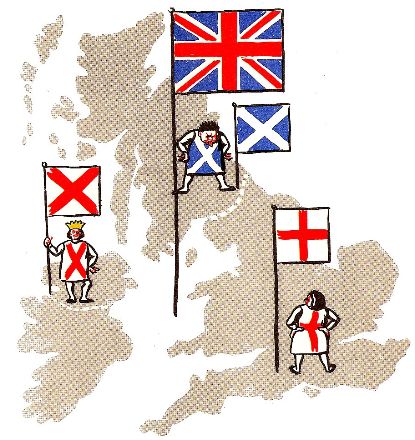
    are you now working for the EU? as you to have missed wales off a map! doh. you are silly. it is a ‘real’ country you know, it has a flag! what more do you want? iw ould be very happy if you could add a welsh dragon onto the picture. Also the flag of ireland under the union jack is very offensive! have you not read anything about english and irish history. Ireland is now 2 countries -st patricks flag is not appropriate under the union jack.
    so please either delete your pics, or change the st patrick’s flag for a st david’s flag and out it where wales is. thanks
    its just americans will get confused – i think this happens most easily. so you have a big responsibility!

    kenny
  54. 22 February 2007
    3:24 pm

    CAWP, you are being very negative and unnecessarily critical to such a point that by doing that you show that you have not really read Moreland’s paper carefully and in an unbiased manner. In fact, your comment shows pain and anger due to impotence: not being able to change history, and this leads you to denial of actual and factual history.

    Now, since you talk about “preposterous, prose, content, etc., et.c,” then I challenge you to write a paper of your own where you refute what Moreland posted. Instead of negative comments, write a paper and show off your university degree, if you attended one!

    You have got to stop those *ad hominem* attacks. As I said before, it does not really matter whether Moreland goes to school or not, or which one he attends or attended, what matters is the sources he used tp write that paper.

    Now, write that paper to refute Moreland’s points, or apologize for your overly negative and unnecessarily critical post.

    latinmass1983
  55. 22 February 2007
    3:27 pm

    One point that I would like to bring up about Moreland’s paper:

    Moreland, you say that the Pope had more than just the religious reason to deny Henry’s request for divorce. This might be true, but the way you mention it in the paper, it makes it sound that if the other(s) reasons had not been there, he would have granted Henry’s request. Is that your point?

    Can you clarify that point for me? Thank you!

    laitnmass1983
  56. 22 February 2007
    6:24 pm

    Snore, snore, snore.

    Ad hominem? Not quite. That would be ignoring his paper and just attacking him for his own personal failings. Instead, I criticised his paper as ludicrous and criticised his failings as the writer of it. If that’s too close the ad hominem bone for you, I apologise; but I would suggest that you have some smelling salts near your PC in future, to palliate the shock.

    You want me to respond to it in every detail? And if I don’t, that somehow proves him correct? I’m sorry, but the enormity of someone’s post by no means corresponds to the strength of its truth (though I realise Catholics have a fey, weak-kneed habit of conflating visible power with invisible truth). And I haven’t the time to issue a complex, precise refutation against such a lengthy piece. I have tried to be as brief and comprehensive as I have time. My points are precise and any idiot will recognise them as being accurate. What about them is false? Care to say? Even generally? Or are you being guilty of ad hominem attacks in simply dismissing me as being guilty of ad hominem attacks – etc…?

    The paper reads like it was written by a 14 year old. It is assertive often without foundation; it offers insights into motive and emotion without explaining why they are justified; it assumes it can make a justified, revisionist reading against traditional history, without every convincingly engaging with that immense body of work.

    And I can’t believe you think his academic qualifications and religious affiliation are not relevant to a putative academic paper on religious affiliations! Typical Catholic logic, one supposes.

    CAWP
  57. 22 February 2007
    6:25 pm

    What I am saying, is: it simply isn’t worth bothering with. It is transparently useless, and any serious, informed person would realise this. There is nothing of worth there to tackle.

    CAWP
  58. 22 February 2007
    6:46 pm

    Kenny, you’re mad. Good to see you on Saturday though. Everyone seems healthy and well.

  59. 22 February 2007
    6:55 pm

    Quite. Wales isn’t a country, it’s a principality. And the old Irish flag and the little Irish man is only attached, in the picture, to Northern Ireland – where it remains one of the country’s official flags. Surely you cannot prefer the Republic’s ghastly tricolore?!

    CAWP
  60. 22 February 2007
    9:30 pm

    I realise Catholics have a fey, weak-kneed habit of conflating visible power with invisible truth

    Hmm. That may be because we’re only following the fey, weak-kneed habit of our Master and Lord, who said that on this rock, Petrus, I shall build My church. (But I understand the Anglicans to have a novel interpretation of that verse.)

    CAWP, I say this most respectfully: you parrot the same tired Protestant canards that have been passed down since the Reformation. It’s clear you’ve only read Protestant versions of British history and thus naturally are biased in that direction. Have you ever looked at the work of some of your great British Catholic authors? Chesterton? Belloc? Newman? Knox? Or are you so completely sold on your version of history that you won’t bother?

    I read Theology at Oxford, focusing on Patristics, although I did a fair bit of study of Reformation history. Luther and Calvin were my heroes. I thought the Reformation the best thing to happen since the inception of Christianity. I argued with Catholics in much the same way you do today. It was only some years later I realized my understanding of history was grossly one-sided, filled with misconceptions and outright falsehoods.

    I’m not sure engaging you at this point makes much difference; there was a time in my life I was utterly closed to the truth of the Catholic faith. You seem to be at that point now. But who knows? Ten years from now, things may be very different.

  61. 22 February 2007
    10:55 pm

    CAWP, you play the role of the Anglo chauvinist brilliantly.

    Dino Marcantonio
  62. 22 February 2007
    11:34 pm

    CAWP,

    You seem to take a lot of pride in being and defending everything “anglo”? Don’t you know that at one point in history (before Christianity: before the Church converted those lands) to be “anglo” meant to be a barbarian?)

    So much for your monarchs and their lands. The glory of England is not there anymore, and it will not come back while the Anglican church is the national church of England. Every monarchy that separates itself from the Church will eventually lose its glory. It is stupid to defend the Divine Right of Kings (or something somewhat similar), when the Church does not support it or defend it, at least indirectly.

    Everything falls under its own weight. That is why monarchies, when they tried to stand on their own, fell. The ones that remain are just ghostly images of what they used to be, even if they keep the same titles and claims.

    I wonder when will be the day when the “queen” of England will declare herself the supreme bishopess of England all its territories… That day will be the funniest one of all!

    latinmass1983
  63. 23 February 2007
    9:18 am

    Ah, so these responses are your own attempts at substance? Congratulations! I stagger with the power of your blows! Oh! Ow! Stop! Please! How can I fight against such truth – I am incapable before you. Such arguments: one day I may change my mind, in fact I am a chauvinist, and sensational immature squeals about Her Majesty, the necessity of Catholicism for glory (yes, I would love Britain to be like Italy or Ireland, such glorious countries). Ludicrous! And I believe you will find that the Catholic chauvinist (“One true church! Infallible! Anglicanism not even a real faith!”) a far more common creature.

    Far from being thoughtlessly closed to Catholicism, I am, in fact, about to go to Mass this evening with a very good friend of mine. I do this fairly regularly. I am not fishing for the truth, or considering conversion – I have weighed a number of denominations, and found Anglicanism the purest, least worldly and most truthful. Catholicism in its two British strains – conservative, traditional, ancient, and trendy, hard-left, liberal, Marxist, sex-mad is too full of untruths and heresy. You have lost enormous chunks of your church – the Orthodox, the Anglicans, the other Protestants – and still are immune to self-analysis. I would try it. It might help.

    Quasi-conspiracy theories, attacks irrelevant to my arguments, and LatinMass’ special needs brand of hysteria, are rather lame ways to carry this on.

    CAWP
  64. 23 February 2007
    11:57 am

    I can assure you there is self-analysis aplenty in the Catholic Church, and more with each passing day. And at the highest levels. As Providence would have it, however, reform comes slowly.

    By the way, have you ever read Edmund Campion’s “Ten Reasons”?

    Dino Marcantonio
  65. 23 February 2007
    12:34 pm

    CAWP,

    you are really funny. You make me laugh!

    Just remember: You are a monarchist, NOT the monarch. So, behave and speak accordingly. The reason why you are not fishing for the Truth is because you do not know where to look for it. I do not even believe that you think it is in the Anglican church. How do you find the C of E to be the purest form of Christianity, yet frequent other churches? Isn’t that heretical, dangerous, illogical?

    Now, a church or denomination that has a “king” or “queen” as its head, CANNOT be the purest form of Christianity. NEVER! You are ignoring this fact, but it doesnt help your cause for making us believe that anglicanism is the way to go.

    Now, there is self-analysis in the Chruch, but it won’t happen the way you want it or whenever you want it!

    Another thing, if you think that this self-analysis will take us to anglicanism, you are wrong again! It cannot take us to it because it is wrong and a heresy. We would lose our Faith and our Sacraments. There would be an end to Apostolic Succession, and we would lose our souls.

    Now, the fact that other groups separated from us does not in fact point to something wrong in our beliefs. It might be true that leaders int he Church did not and do not always do what they SHOULD do, but that is not an excuse for anybody to separate. In fact, those who did were heretics and instead of doing away with the corruption, they did away with Apostolic teachings and morals.

    This is not a way to do a reform! Do you know anything about the Ten articles and the Six articles? Why was there a conflict between Henry VIII and Cramner on some these issues? In addition, why is Transubstantiation not a believe (in its purest sense) in the C of E, when Henry and Cranmer (at the beginning) considered the denial of such a belief a heresy (treason)?

    Cranmer and Henry, as well as Luther, were heretics because of LUST. THEY WANTED TO GET MARRIED. They all had problems being chaste or faithful. Period! You follow a brand of Christianity that is not pure (as you claim). In fact, it is based on the opposite virtue.

    Sensational immature? Hmmm… I was not making fun of the ‘queen.’ I was just pointing out a fact. Your queen does not look impressive at all, even when dressed like a queen. Plus, she is just a figurehead. That is not my fault… and you should accept that. The last time she looked like a real queen was when she was crowned in the 50’s. Although, that coronation did not look “purely” Christian at all because it is not in the Bible, right?

    CAWP, you are very defensive and offensive! Try harder at expressing better when talking to other people or about them. Or just get another hobby!

    latinmass1983
  66. 23 February 2007
    4:24 pm

    Er, see? Does everyone see what i mean? LatinMass, you can’t be serious. No sensible person talks like that. You’re hysterical. Could you find it within yourself to stop screaming with every sentence you write – to tone down the unmistakeable and very unattractive element of hysteria throughout your posts?

    I’m sorry, but once again there is nothing serious in what you have written to address. You either contradict or seriously undermine yourself in making a point (e.g. when you say there is nothing wrong in what you believe, but that the Church leaders were once wayward… that’s an interesting hair-split of an argument, since I thought infallibility was a key Catholic doctrine). Or you just talk nonsense (e.g. lust. Because of course Cranmer went to the stake because he couldn’t live without sex…).

    You aren’t being credible. What’s all this crap about the Queen not looking very good? I mean, does anyone else here really want me to address such ludicrous points? And the Catholic church should be very wary about accusing other Churches of lust, in this day and age, since it doesn’t seem to have been much of a barrier for thousands of their priests to do what they wanted to innocent little children.

    At least you provide an insight into the kind of maniacs that existed in Cranmer’s time – and which I had thought since extinct. It is fascinating to see the brains of a man who would happily, no doubt, set the faggots alight again, displayed before us. You should donate yourself to science. Some studies in your peculiarly Catholic brand of psychosis would provide a useful advance for humanity.

    CAWP
  67. 23 February 2007
    5:53 pm

    CAWP… ha ha ha… this is beyond funny.

    When I talk about leaders in the Church not doing the righ thing, I do not mean to imply infallibility! You do know that infallibility does not apply to every single action of every day of every single minute. Only the Pope is infallible, but not in matters of every day affair!

    You are mixing stuff because you do not really understand Catholic beliefs. THIS IS WHY YOU HAVE NOT FOUND THE TRUTH.

    CAWP, I will scream whenever I want to. Although I have not. When I capitalize something it is to EMPHASIZE something. I can do that any time I want. Is that a problem?

    Now, I never said that there are not lustful people and leaders in the Church. It would be stupid to pretend the opposite or even ignore it. However, WE, CATHOLICS, have not gone after any of those leaders the way YOU, PROTESTANTS, have!!!!!!!

    THAT IS THE DIFFERENCE!!!!

    Got it? Do I need to EXPLAIN it better????

    CAWP, you really need help!

    latinmass1983
  68. 23 February 2007
    7:15 pm

    Oh dear. I rest my case.

    (Infallibility should be addressed, though. I didn’t mean Papal Infallibility, which has to be invoked explicitly, but the Catholic argument that the Reformation was a Deformation, that the gates of hell have never prevailed against it, it has remained perfect, and always will be, uncorrupted, no matter what: i.e., infallible.)

    I can hardly believe you even exist, really.

    CAWP
  69. 23 February 2007
    10:15 pm

    CAWP,

    In general, we already knew that you have a problem with believing… it just shows!

    latinmass1983
  70. 23 February 2007
    10:21 pm

    Infallibility should be addressed, though.

    Read Edmund Campion’s “Ten Reasons”
    http://snipurl.com/1b6gd
    (scroll half way down for the English)

    Dino Marcantonio
  71. 24 February 2007
    6:58 am

    I have. Despite being highly delicious prose, a very winning style, and ingenious and persuasive at times (though scarcely more so than Latimer or Cranmer), it has problems. Surely even you’ll admit it contains outdated and wonky scholarship? (E.g. the argument that men have simply removed books from the Bible, such as the Apocrypha, that they didn’t like. Don’t we all know that the Apocrypha is rather a special case? In that, there is serious historical and linguistic evidence for its non-canonical status? Greek rather than Hebrew, unknown to Jewish OT or tradition, never quoted or alluded by Christ, etc? Since his justification of key heretical Catholic teachings – such as prayer to saints – depends upon the Apocrypha being legitimate, what is there more to say?)

    And just how is a 16th century work going to address the 19th century additions to your faith (e.g. Mary’s perpetual virginity and sinlessness)?

    CAWP
  72. 24 February 2007
    7:49 am

    CAWP, you’re a tough nut to crack. It’s curious that you give more weight to skeptical Biblical scholarship than to, by then, over a thousand years of tradition.

    As for additions to the Faith, they are no such thing. All that happened in the 19th century was a definition of an article of the Faith that already existed. Surely you don’t believe that Christ’s dual natures was an article of the Faith added in the fith century when it was defined by the Council of Chalcedon?

    Dino Marcantonio
  73. 24 February 2007
    9:21 am

    Curious? It’s not the skepticism I applaud in itself; the so-called gay Christians are skeptical of St Paul, these days, and they are clearly dangerous and wrong about that.

    It’s that Wycliffe, Cranmer, Latimer, Luther and others (the last no doubt rather imperfect, I know), identified provable and significant abuses and falsehoods that had grown up in the church over time. Addressing prayers to anyone other than the Father (indeed as Christ teaches us); the ludicrous treatment of the Bible and liturgy, regarding something obviously originally written to be read and known and understood by many as unfit for such purposes; the dangerous, often idolatrous, attention paid to Mary; etc, etc, and so on and so forth. I won’t list all the complaints because I’m sure you know them. There are quite a few. And the argument was always that such corruptions were corruptions because they had no foundation in the early church (because they are not mentioned in scripture, the record and teachings of that body – sola scriptura is very precise, sound, and logical principle in that regard). Thus they were obviously additions, and a number rather terrible, corrupting ones; not merely additions-as-traditions consonant with Biblical principles and examples (as some of the sacraments, which were never condemned intrinsically, only in how they were defined and instituted), but ones antithetical to the church Christ founded.

    So they were (after much martyrdom) deleted.

    CAWP
  74. 24 February 2007
    9:21 am

    CAWP,

    that is a typical PROTESTANT thing to say, which only goes to show complete and ABSOLUTE denial!

    Mary’s perpetual virginity was not invented in the 19th Century. It has always been a believe of the Church. Before Blessed Pius IX declared the dogma of the Immaculate Conception, the Church had already had a Mass to celebrate that very day (Dec. 8th) for centuries!

    Mr Marcantonio, all heresies are hard to crack, but more than the heresies, the followers because accepting the opposite would mean that they are WRONG. CAWP does not like or want to admit that she is wrong… plain and simple.

    Now, if we give her books, works in which Fathers of the Church or Saints or Doctors of the Church talk about Mary’s Immaculate Conception, she wouls still not accept it.

    I won’t do that, but I will tell you something CAWP:

    HAVE YOU EVER HEARD ABOUT OR SEEN Murillo’s painting of THE IMMACULATE CONCEPTION???????

    The Church never rejected that and never will.

    Latinmass1983
  75. 24 February 2007
    9:57 am

    Yeah, interesting, I’m not really going to bother with LatinMass any more, if that’s all right with everyone else? I hope all can see what I mean when I say there’s little point in discussing something with anyone so hysterical, weird and childish (he knows I’m not a woman, so what’s with all this ’she’, ‘her’, etc? Very mature).

    Anyway, I never said they invented it in the 19th century; they ADDED it. It may have been embryonic theology before then (beginning in 1476 – quite some time after the Church began!), but it clearly wasn’t absolutely certain or necessary theology (why bother with making it so if it already was?). So: it was added. It became dogma, not optional. It now requires, therefore, defense – for it is an essential part of your faith. Before its validity or not was as a matter of conscience; now it is a matter of Truth. Knock it down before, and there is small consequence; knock it down now, and the whole system of the Roman faith, by extension, shakes. I am a little worried you do not understand the importance of this. It is the same with a number of other so-called traditional, then dogmatic, Roman beliefs. You have to defend them with more than “tradition!” as your battle cry. For the whole point is that they may once have been tradition (often, as here, quite late tradition), but they aren’t any longer. What matters is, are they correct? Why were they once not considered dogmatic truth, but now are? What changed? Is longevity all that matters?

    CAWP
  76. 24 February 2007
    11:05 am

    Come now, LatinMass; as a fellow traditionalist Catholic, I must say you are sounding a tad over the top.

    CAWP, you misunderstand the communion of saints (just as I once did; I’ve raised precisely the same objections). Is there anything wrong with asking your fellow Christian to pray for you? Of course not. So why is it wrong to ask a saint in heaven to pray for you? Or do you think that, after having toiled on earth to help our fellow brothers and sisters, once we get to heaven we must no longer do anymore good for them?

    When we speak of “praying” to the saints, we mean it only as a form of communication, not of worship. If I were to ask you to pray for me, e.g., all I need do is send you a note or ring you up. If I ask a saint in heaven to pray for me, naturally, I must ask interiorly–thus, prayer.

    Your next question is no doubt this: why not ask God directly, instead of going to the saint? Of course we can ask God directly; but Scripture tells us that “the prayer of a righteous man availeth much.” James 5:16. James mentions the example of Elijah, a righteous man, who prayed for rain, and it was granted him. Elijah was, in a sense, an intercessor for the Israelites because of his close relationship with God. He was a man to whom God listened and answered prayers.

    We also know from Scripture that sin impedes our relationship with God, and hinders our prayers.

    The saints in heaven are cleansed of all sin and stand perfect before their Father in heaven; their prayers are powerful and efficacious, and nothing hinders their intercession on our behalf. This is why as Catholics we may choose to ask a particular saint to pray for us, because we know that our own prayers before God may not be as efficacious.

  77. 24 February 2007
    12:03 pm

    How refreshing to have a normal person to respond to!

    I don’t misunderstand the communion of saints, though. And my objection to prayer to saints is not simply what your’s was. I know that both Catholics and Orthodox Christians ‘pray’ to saints not as worship but, so they say, in the same way as they would send an email to their Christian friends on earth for their prayers, or write a note, or simply ask them in conversation, or what have you. But it isn’t “natural”, as you say, to ask saints interiorly; it is – of couse, as you know – supernatural. So there is actually a very big difference.

    This difference is smudged by the Roman understanding of the communion of saints. The idea that we can as legitimately ‘pray’ to the saints, as telephone our Christian friends, depends upon the Roman/Orthodox argument that since the Church is one, therefore every member, living or dead, is in equivalent practical relationship with every other. But if this were the case, we could pray in silence to our Christian friends or family on earth, and they would surely, given such logic, just as readily hear us as the saints do. But, of course, they don’t. In this way, I think it very simply proved that the analogy between the living and dead church is false, and the RC understanding of the communion of saints rather unsound. I don’t deny the unity of the Church; the eternal communion of true believers; but I think it clear, whether we like it or not, that it does not follow that ‘prayer’ (or what have you) to the saints is either possible or prescripted.

    Prayer to saints, and prayer to Mary, are still risky, too, in the conventionally argued way – because hailing Mary, extolling her virtues at the same time as Christ’s, being on one’s knees as you do so (e.g. in stations of the Cross), lauding her as a special intercessor (a role Christ gives himself!), etc, etc, leads naturally into a grave misdirection of adoration and worship and love. She is indeed blessed; all generations will and do call her so; but that is not a basis for the place the Romans give her, as otherwise the many praises of other people in the Bible should have corresponding liturgical results. I’m afraid Mary’s place in your church is a corruption, and I doubt she’s particularly happy with it.

    CAWP
  78. 24 February 2007
    12:21 pm

    P.S. my use of ‘dead and living church’ was perhaps clumsy or open to opposition. I know God is the God of the living; and that we all have eternal life through Christ; I hope my use of such a phrase is taken as being merely biological not spiritual.

    CAWP
  79. 24 February 2007
    4:28 pm

    CAWP,

    You keep missing the point. You do not have to deal with me at all or with the other contrinutors. You have to deal with the things pointed out by many commentators.

    Jokes aside, it is even more childish for you to focus on whether I capitalize something or not, or whether I add exclamation points, etc. That is just an excuse for you not to talk at all about those things I (or other commentators) mention.

    And you are right CAWP. You do not misunderstand the Communion of Saints. You just don’t accept it… which, regardless of whether one is a traditional Catholic or not, it is a heresy. Christine, there is nothing over the top in saying that. There are heresies and heretics even in these times. Politically correctness have made the words heresy and heretics sound offensive, but they still exist.

    The main thing about heresies and followers of heresies is that if they accept to be wrong, they have to change many of their opinions and behaviors.

    CAWP, I did not know you were a man and I do not really care about what anybody in here is. I had never seen you here before, so do not just expect me to *know* that you are not a woman.

    Also, let’s say that I have been “childish, foolish, stupid, etc…,” I have not been the one you have not wanted to deal with. Mr Marcantonio has also mentioned things to you, and you have just dismissed everything he points out.

    You have already set your mind to accept and follow history only the way it is portrayed by British historians – if they can be called that in this case. That is a very intentionally biased behavior, which shows inmaturity and childishness, and of course, blindness.

    You are more a monarchist than a Christian because you think that the monarchy (not the Church, even if it were the C of R)is actually the glory of England. This is going way beyond what is in the Bible, especially since you prefer a “sola scriptura” way of doing things.

    You have not told us how you can reconcile a monarchy with Christian purity. Stop focusing on how things are said, but why they are said and whether they really make sense. You just dismiss everything from the very beginning. You do not want to accept the authority of the Pope because it would put an end to the monarchy as you would want it (absolute).

    How do you really reconcile all this with Christianity?

    Re the Virgin Mary: Why would you want choice? Even before Marian dogmas were declared, devotion to Mary was required! From the very first centuries of the Church devotion to Mary has been a big part of Christian worship. Before dogmas were declared, they coudl not be thrown away as you claim. One thing is not to believe it, another thing is to attack it.

    People (like yourself) who think that it is risky to pray to Mary, would have attacked people who would have chosen to venerate Mary – if it had been a choice (before it was declared a dogma). Or they would have gone the Lutheran way: venerate her, praise her first, then oppose devotion to her. Have you ever read what Luther had to say about Mary before his “reformation” and what he had to say after?

    latinmass1983
  80. 24 February 2007
    5:19 pm

    I’m glad this isn’t a private conversation, since your incoherency and idiocy is being displayed for all, and no one has to take my word for it.

    Once again, you have not responded to my arguments. Arguments – you know, connected logical statements, to be responded to in kind by connected logical statements, or relented to in defeat? Thanks for getting all 16th century on me by refusing to address my points (again), and coming out (again), with this pointless and useless argument that you are right because you are right because you are right. I’m wrong because I’m a heretic. Wow. Right on. That really isn’t tautological nonsense!

    You’re giving Roman Catholics quite a bad image, in all this: scared or incapable of reason, incoherent in articulating or defending their faith, hopeless zombies, arrogant, hysterical and itching to bring the matches out again whenever they’re confronted by someone who disagrees and dares to advance good reasons why. It’s a good job I know many real Catholics, and know this stereotype to be largely false. (Andrew C’s blog is also an excellent and affable counter to it).

    LatinMass, I’m afraid you are the heretic (or something of one) as it stands.

    And for the record, nowhere have I ever said what you claim I believe about the monarchy. If I was a true monarchist, I would surely love the pope; for he is the last absolute monarch in the world. No, I am a loyal British subject, and by birth, law and constitution am ruled by the British crown, to which I pledge both my allegiance and affection. This is wholly Biblical – it is honouring and obeying “the powers that be”, as St Paul wrote. The Queen is head of the Anglican Church because that was the one successful historical method of preventing Catholic tyrants such as James II from eagerly betraying their people (the majority Protestant) into beggary and persecution. Uniting government with religion was a necessary geopolitical prophylactic against the tyrannical, corrupt transnationalism of the Roman Catholic church, which would eagerly split the government from the people, insight bloody repression of non-Catholics (cf. Mary), and act appallingly and with naked corruption to advance their own geopolitical goals. But of course we know you are no fans of contraceptives.

    Though this strategy had contradictions – the lesser legal rights of Catholics, for example – I believe a dispassionate survey of the system will find it quite the most humane and efficient of all the possibilities, given the times.

    As you quite rightly pointed out earlier, the Queen has no day-to-day administrative role in the Church, so quite why you’re now so wound up by it I fail to understand. Her role is symbolic; she is a figurehead. You know, we don’t pray to her. As much as that may surprise you. It is possible to have a woman in the Church who doesn’t have to be worshipped or liturgically significant; perhaps that’s too alien a concept, but we are capable of such a trying feat. Anglicanism is True, most (no longer all) Brits are Anglican, all Brits are under the Queen: so the alliance makes perfect sense in that regard too.

    CAWP
  81. 24 February 2007
    5:27 pm

    So, er, is everyone finished here? Can we close this? Dino (I think) said we should continue it, even after it had begun to get too argumentative for my liking, because it was important; but surely now the matter is laid to rest. There is little more to do than agree to disagree, or convert ourselves to the other’s position, surely? And since no-one will give in on that, how about an almighty Amen, and have done with it?

    CAWP
  82. 24 February 2007
    6:19 pm

    CAWP,

    If the “queen” is symbolic, then she is not the head of the C of E? It does not make sense. A symbol is not the actual thing.

    Now, if she does not have an administrative role, as Henry VIII did (because he was very active in religious matters, then what really is she?

    I am not saying that we should not give allegiance to the rulers of the nations in which we live. The thing is that in addition to that allegiance, you want us to accept that that leader is the head of the church. This is not how the Apostles did it at all. How many churches would there be? Do you imagine what the American church would be like? And, who would be the leader of the C of the US? We do not have any monarchs here, unless you defended the idea that the US should return to being a subject of the English crown or something like that.

    Remember that the Roman Emperors were NEVER the head of the Church. There was always the Pope. When the Apostles were on earth, they guided the churches (separated by regions) under (in union with) the Pope (Bishop of Rome, well first the Bishop of Jerusalem when Peter was there and then Antioch).

    Women: I am glad you don’t pray to her (the “queen”), and I never beleived that you did, especially because she is still alive.

    Personal (or popular) devotions are not part of the liturgy (the Mass), so in that sense no woman is liturgically worshipped. The Mass is not offered to Mary or to the Saints. Some day, CAWP, you should check the original version of the book of common prayers, which was in Latin, and included a liturgy somwhat similar to the Catholic one.

    I am sure you already know the difference between veneration and adoration. However, you are mixing their meaning. As Christine already pointed out, praying to someone is not worshipping that person. *Orare* (to pray) and Adorare, even though they look somewhat similar, do come from two different latin roots. The first one is to ask, or speak (depending on whether you use *to pray* or *orare* (latin). They in no way imply worship or adoration (unless addressed specifically to God). The second does mean to worship, which goes way back to the old way of worshipping (Adorare = Ad os admovere manus).

    Now, if you cannot or do not want to accept that there is a difference between those two words, that is something else. As to whether it is risky or not praying to Saints, that would depend on the sincerity of the person praying. The Church has officially condenmned the adoration of Mary and the Saints, and no sane and faithful Catholic will worship Mary nor be taught to worship her (or any of the Saints) as God.

    Luther himself wrote (or said) good and beautiful things about Mary. So, the argument that it is dangerous to pray to Saints is useless.

    CAWP, you have mentioned many times that there are incoherencies in what I say, can you please cite some examples where I contradict myself? Also, cite my “heresies.”

    What is wrong with transnationalism? The Apostles did not condenm it, nor does the Bible. Does it? If you defend this, then indirectly you would somehow agree with Hitler’s idea of the purity of a nation or a race. This is not to be found in the New Testament. In the Old Testament there was something like it, but it was for religious reasons.

    CAWP, the reason why Mr. Marcantonio wanted to continue the “discussion” was because you did not directly and substantially answered the real questions and arguments mentioned by many contrinutors. And you still haven’t.

    All this was finished from the very beginning because you closed your mind to reason, and from the very beginning started attacking the contributors as a way to evade the arguments. I admire Moreland who ignored you (and your extremyly offensive comments) and never replied to your offensive comments about his/her posts.

    Now, one last comment on the fallacy of your argument that because you are a British subject you have to submit to the laws and religion (indirectly) of that nation. If in the future, the “king” or “queen” of England decide (by the grace of God) to return to the Catholic Church, then that would mean that YOU, as a loyal subject of the Britisn crown would have to follow suit!? However, if muslims take over that nation and the “king” or “queen” makes islam the official religion of Britain, you would also have to accept that and go along with whatever they do?

    That is an odd form of monarchical system, although it has happened before – sometimes for the better.

    CAWP, no “almighty amens” please, because it would not mean the same to a Catholic than to an Anglican.

    Now, you are not a monarchist? Then why that site that you promote? Besides, to “love” the pope, you do not have to be a monarchist, you just need to be an Apostolic Christian. This means that you have to follow Christ, not any other man (or woman nowadays) who feels like “reforming” the system, but ends up deforming everything in the process to bring back Apostolic purity, which they never return to. That is why there are so many thousands of protestant denominations – all claming to have been founded by Christ (or to follow the Apostles). I don’t mean to make fun of this whole issue, it just is sad.

    latinmass1983
  83. 24 February 2007
    6:24 pm

    Dear CAWP,

    When you have finished reading thirty books on the subject, including the state papers of Henry VIII, the letters of Thomas Cromwell, Hull’s Chronicle, the trial records of Robert Aske, get back to me. It’s obvious that your attacks on my paper are partisan, and have nothing to do whatsoever with its writing. My professors would take issue with your statement that my prose is tiresome. I’ve been told on several occasions that I’m the best writer in the department. I did not recieve my scholarship to university on good looks and charm.

    A fantasy? The events narrated in the paper are verified by primary source documents, including those written by Henry, Cromwell, and Cramer.

    And yes, I am Catholic. What does that have to do with my arguement? How secretarian of you! Dr. Christopher Haigh came to the same conclusion I did in his work, and he is an Anglican.

    You sir, are decieved. Your historical fantasies may be comforting, but they are not supported, and they are false.

    Now do get started on reading those sources! We are all eagerly awaiting YOUR thesis! Twenty pages, 12pt font, double spaced, based on primary materials.

    C Moreland
  84. 24 February 2007
    6:33 pm

    Also, if you would like to see how 14 year old’s actually write, I can provide some examples from my classes.

    Now hurry off. I suggest starting with AG Dicken’s The English Reformation. It’s only about a thousand pages, but since you have gone to university, and more importantly than that a BRITISH university, that should not be a problem for you.

    C Moreland
  85. 24 February 2007
    7:05 pm

    Er, wow. Was any of that ironic?

    I mean, you claim you have great style, and yet write pompous stuff like: “You sir, are deceived”. How very fresh and supple. Then you admit you are a Catholic, and in the same breath ask what it has to do with your argument (which is about Catholicism)?

    !

    Earlier I am accused of chauvinism, and now you tell me to “hurry off”, and write with the most oily, sinister condescension and ridiculous, spurned pride about 12pt fonts, double spacing and “BRITISH” universities.

    !

    And I note you still refuse to tell us where you are based academically.

    I also note that you do the (apparently) typical Catholic thing of ignoring my arguments and simply dismissing them as historical fictions. Nice. But not enough.

    I would suggest that you were somebody’s parody of what the real Moreland might do in reply – the sustained and multiple ironies are so exquisite – but, judging from LatinMass, who posts at very similar times, I (alas) suspect not.

    CAWP
  86. 24 February 2007
    7:28 pm

    LatinMass -

    I am not a monarchist. I am a British Monarchist. There is rather a large difference. You appear not to have looked beyond the website’s URL, which is something of a shame. If you had, you might have avoided making such a fool of yourself.

    As for adoration and all that (and I was using the terms in their general meanings): you haven’t defeated my arguments against prayers to saints and Mary, you’ve merely asserted that improper relationships might form. But doesn’t everything in human nature – and all of God’s many warnings against graven images and other forms of idolatry, especially self-idolatry in pride – tell us that such Catholic ‘bonus doctrines’ (2 for the price of 1) are very dangerous indeed, and likely to lead to such mispractice?There is no Biblical license for them. I think that says enough. Try not simply *asserting* that it doesn’t.

    I’ll assume the Hitler remark wasn’t serious (though I believe it rather indicative of your general level of maturity and intellectual sophistication), so shan’t bother responding to it with the indignance it really deserves. You use “nation” and “race” as interchangeable (“purity of a nation or race”), but of course they’re not: the latter is transnational, the former isn’t. And Hitler’s Arian project was emphatically transnational (which goes a long way to explaining why he invaded Russia and France and not merely the bits of land he claimed were historically German, you dolt).

    Needless to say, if you knew anything about European history, you would also know that the strongest resistance to Hitler, to Fascism, to Communism all came from nationalist movements in other countries (not, incidentally, your pope, particularly in WWII… JPII wasn’t bad on the Reds, though).

    And though, like so many of your arguments, it ignores or misunderstands the content of my previous post (and therefore doesn’t require rebutting), or betrays manifest stupidity, I feel I should reassure you about the Monarch changing their religion (as you seemed to get excited by the idea of a Catholic one coming in and sorting us all out). I – and Protestant Britain – wouldn’t change my faith if the Monarch did. We would change the monarch (go and read about 1688, and the Act of Settlement… you are embarrassing yourself with your ignorance here; this is the last friendly advice I’ll give you). This was rather the whole point I was making about Monarch and Subjects being one in Christian truth, secured in the Anglican and British constitutional structure, (historically) as a defense against the (well catalogued) shits at the Vatican.

    Is there anything I’ve missed? Your posts are always long and mad, and time is precious, but if there is really anything you feel you’ve won the day on, please alert me to it and I will be happy to disabuse you of your victory.

    CAWP
  87. 24 February 2007
    7:28 pm

    EDIT: you asserted that improper relationships would not form.

    CAWP
  88. 24 February 2007
    7:50 pm

    The reason, by the way, I wish to end this, is because I doubt many of us have the time to carry it on for much longer; and because it has strayed, and continues to stray, so far from the original dispute, that it has the whiff of a nightmarishly perpetual, ever-increasingly boring, ever-decreasingly worthy waste of time. (A bit like purgatory. Or saying the hail Mary. Haha).

    By now, my point is, the length of the discussion and duration of the opposition suggests we aren’t going to be coming to any kind of reconciliation soon. My suggestion was and is to come to some kind of amicable ceasefire. I am giving you the chance to retreat from the field – bloodied and defeated – with some measure of grace and honour.

    And because I have really had enough of such self-evidently pointless disputation. REFUTE ME LOGICALLY, or just give it up.

    CAWP
  89. 24 February 2007
    11:04 pm

    Defeated! The Intercession of Saints is all over the early Church, for example (do St. Cyprian, Tertullian, and St. Augustine count?), and Scriptural references abound. Well, if you cannot detect your refutation by St. Edmund Campion, then I doubt anyone here is capable.

    I agree that many of us don’t have time to carry this on. Let’s cease fire and resume once Britain turns Catholic and indolent.

    Dino Marcantonio
  90. 24 February 2007
    11:35 pm

    I’m afraid I’ll be too busy reclining upon couches, nibbling at grapes, and thumbing rosaries. You know how it is.

    But I do agree that it’s over. (In parting: I fear your faith in Campion is a bit misguided; his is addictive, gorgeous prose, the joy of which often depends on the obvious, precarious, sophistical logic it is employing. It’s all performance. His arguments have little weight, and can be easily brushed off. He charms. He doesn’t convince. Test his statements out as you proceed and I think it quickly becomes apparent).

    CAWP
  91. 24 February 2007
    11:36 pm

    That reads like it was rather charmless of me, actually; didn’t mean it to be. I was of course doing it in the merriest spirit possible, and thank you, Dino, for your graciousness throughout.

    CAWP
  92. 25 February 2007
    12:49 am

    CAWP,

    You would change your monarch? Then you would not be a *faithful* subject at all and the monarch would not be a true monarch at all. Forget about the Act of Settlement. A monarch (as has happened) should be able to change the law, otherwise to have a monarch at all would be the stupidest thing (especially to glory in having a monarchy at all, as you do).

    Don’t kid yourself. You are a British Monarchist?? Show me where in the Bible you should just support one particular monarchical system and not the others. If you want to support a monarchy in one nation, and (as you claim) that would be going with what the Bible says, THEN you should also support the idea of a monarchist system in every other nation, no matter how small.

    I did notice in your site that you stick to the British side of things and system, but since you, indirectly at least, think that the idea of being subject to the British monarch is going with the Bible and what it says, then you should also support other monarchies regardless of where they are and what religion they claim to follow. If you do not do this, then you are being a hypocrite.

    About images and Saints: I did not say that “improper relations” might arise. At least NOT in the Catholic Faith. Those who worship images (even if they are “catholic ones”) are not Catholics. They are not recognized by the Church, and these people attribute other things to these images (or gods or protections, etc) that the Church has never attributed to any image of any Saint. Show me a Catholic who prays to an image (as opposed to praying before an image).

    REMEMBER: The original book of common prayer. Dont forget it. Well, I guess you would not be able to read it because it would be in Latin, which is not british enough for you.

    I wonder: Don’t you get suspicious when you hear that. Since the b of c prayer is in Latin, doesnt your mind conceive the idea that maybe the Pope wrote it? After all, the C of E does not have Latin for its language. Nah… once you start reading it, the protestant smoke affects your eyes.

    So, if you do not want anything to do with “transnational,” what do you do then with other “territories somehow still subject to the British “queen”? Do you advocate that the “queen” should give those places up directly and indirectly (have nothing to do with them at all – officially)?

    Are you that sure that the Pope did not do anything during wwii? So, why was Hitler more afraid of attacking the Vatican than attacking Britain? Why was Hitler more obssessed with kidnapping the Pope than getting rid of Churchill and your monarch?

    REMEBER that the Pope is not the head of a nation and does not have a regular army. Well, neither does you monarch, but I digress…

    CAWP, I have not lost nor won anything. But you have lost your patience. Instead of worrying about (British) monarchs and trying to prove that your obessession with the british monarchy is justified by the Bible, you should worry about Christian vitues that will eventually help you more in the end – and when you argue with other people, even if it is on-line.

    Making fun of the Rosary? Is that supposed to make us think that we should not say it, or that because something is boring (to you), it is not biblical or it should be completely discarded? It is illogical, but then again, protestants are good at that. Like father(s) -Henry, Luther, Calvin, etc.- like son(s).

    You are soooo worried about “winning” the ‘debate’ that you think you have already won. You have no clue of real and factual history because you use british lenses that destroy your 20/20 sight to the point that you have no clue about what pure Christianity actually is.

    Last message:

    CAWP, I feel sorry for you… your fanatical defense of a monarchy that is not a monarchy anymore (although it can look like one). Henry VIII would be ASHAMED to be the “king” of Britain these days, although I doubt that Cranmer would not want to be the “archbishop of Canterbury.

    Your monarch is at the mercy of the parliament… and so are your dreams of a glorious monarch(y), too. Just wait 5 to 10 years, and you will see what will become of the monarchy you defend. We’ll see the glory of the monarchy when the next coronation takes place.

    latinmass1983
  93. 25 February 2007
    12:55 am

    You know, I don’t think he’s coming back.

    ja
  94. 25 February 2007
    1:00 am

    Er, I’m really not. At least not to this thread. Of course I shall remain a loyal reader of Cusack.

    LatinMass that was hilarious! Thank you for the comic send-off we all needed!

    Keep up the hysteria, historical ignorance (“Forget about the Act of Settlement” indeed! You’ve scarcely revealed yourself so hilariously before), refusal to engage in debate, and all that. A man of such madness would be dangerous with real facts and half an ounce of wit.

    CAWP
  95. 25 February 2007
    11:41 am

    CAWP,
    In all honesty, you haven’t responded to a single substantive thing Mr. Moreland has written. Instead, you’ve blown him off as so obviously mistaken that it’s not worth your time to engage him, and then you’ve foundlessly mocked his scholarship. I am disappointed by your response.

    As you are so taken with academic credentials, one prominent Oxford scholar in the early 1900s wrote:

    As we approach this long story, there is one thing always to be borne in mind: that the history of it as taught in our schools and universities is an official story and a thoroughly false one. Whether it be to the advantage of the State that official history alone should be taught, and that a criticism of it should be unknown, may be debated. There are those who think that such legends strengthen a nation. Others (and I am one) think that historical falsehood weakens a nation.

    Be that as it may, the history we are asked to accept in the English tongue upon the English side of the Reformation at least (and a great part of the Continental side as well) is no more than propaganda. To read it, one would imagine that Burghley’s [i.e., Wm. Cecil's] England was a Protestant nation with an especially pronounced anti-Catholic twist; that in the midst of such an imaginary English people there survived a few unna-tional, exceptional people whom it was necessary for the sake of national survival to destroy. The truth is exactly the other way.

    The mass of England was Catholic in tradition and feeling dur­ing all the last half of the sixteenth century. Even into the begin­ning of the seventeenth the tradition survived. A good half of the people still had Catholic sympathies in the earlier years of James I. A quarter of them had in varying degrees Catholic sym­pathies (and half that quarter was willing to sacrifice heavily for the sake of openly confessing Catholicism) as late as the fall of the Stuarts in 1685-1688. But during the whole time the steady official persecuting pressure continued; the practice of a Catholic life was rendered impossible, and what had once been the normal open profession of the national tradition in religious things fell to being but a sentiment, and then, from a sentiment to being but a memory, and at last, after 1688, died out.

    So, you see, Mr. Moreland is not the only one to recognize British history as being perhaps a bit more complex than Anglican triumphalists will admit.

  96. 25 February 2007
    11:43 am

    (The two paragraphs following the italicized one are Belloc’s words, not mine.)

  97. 26 February 2007
    9:11 am

    was belloc catholic?

    shall we get this to 100? please?

    ja
  98. 26 February 2007
    10:22 am

    Yes. Read his superb “The Path to Rome” available as an e-book here:

    http://www.gutenberg.org/etext/7373

    Dino Marcantonio
  99. 26 February 2007
    10:20 pm

    isn’t it poor form to support a catholic re-reading of history with an older catholic re-reading of history?

    not that i particularly care. i would like to see this go to 100, tho, since i am bored, and in need of the delight.

    ja
  100. 26 February 2007
    10:20 pm

    i have achieved it.

    ja
  101. 26 February 2007
    10:21 pm

    out of interest, did anyone else here only read about the last ten posts?!

    way too much excess stamina about.

    ja
  102. 26 February 2007
    11:20 pm

    Just one correction to something I said:

    The B of C prayer was not written in Latin, at least not declared the official version. It was in English, although there was a Latin version (at least I found one when I was in college). Also, at first – whent he whole system has not been completely changed – some sections of the english liturgy were still said in Latin (by those priests whose native language was not English, etc.)

    Still, why make a Latin version when they knew that it was the Sacred language of the Church – the True One, of course!?

    latinmass1983
  103. 27 February 2007
    11:02 pm

    isn’t it poor form to support a catholic re-reading of history with an older catholic re-reading of history?

    Not sure why it would be poor form, unless you assume that, because Belloc was Catholic, he is therefore incapable of offering a true account of British history. Based on that reasoning, no Anglican could offer a true account of British history either, because his religion would color everything.

  104. 28 February 2007
    6:21 pm

    it’s not quite the same, since anglicanism *has* coloured everything (in last 500 years).

    plus, i thought this was a revisionist reading that puts catholicism above anglicanism? surely one’s catholicism is at least a complication in making that kind of argument? a doubtful factor?

    as i said, i’m not really bothered, and fear i won’t be able to take part in a debate like the one above. no time!

    ja
  105. 1 March 2007
    7:00 pm

    Ah, but your comments reveal you’ve bought into Anglican triumphalism, just as CAWP has. You assume it’s Catholic “revisionist” history, that is to say, an incorrect rewriting of history according to the Catholic perspective, when in fact it may very well be the case that it is the Anglicans who’ve revised history so thoroughly and for so long that their version has been swallowed wholesale by the majority of the British.

  106. 1 March 2007
    10:40 pm

    Er, okay.

    ja
  107. 1 March 2007
    10:47 pm

    i really meant that anglicanism’s had an important effect in the last 500 years (i.e. since reformation), an effect which catholicism can’t have had, if you see, because it was banned.

    i don’t really care about the minefield of revisionism, since i think it goes in circles after a point – without really plumbing down the depths of the facts, we can always accuse the other side of being one more revisionist step behind us. i do worry about how sane it is to claim the entirety (or a lot) of british history has inaccurately been written against the catholics, tho; i mean, that assumes a pretty big burden of proof. can’t we find a happy medium? perhaps they have been excluded, but it’s extraordinary to try and do the same this time around to the protestants.

    anyway. andrew has some lovely new posts everyone.

    ja
  108. 3 March 2007
    2:36 pm

    i really meant that anglicanism’s had an important effect in the last 500 years (i.e. since reformation), an effect which catholicism can’t have had, if you see, because it was banned.

    That goes without saying. As to your wondering how sane it is to question the Anglican version of Reformation history, how would you respond as a British citizen (I’m assuming you are one) to the American version of the Revolutionary War (you know how it goes: the Brits were wicked for taxing the colonies without representation)? This is the version, after all, which is taught in all the public schools since the founding of our country, the version the majority of Americans accept. Would you say it’s accurate? Would it be “sane” to question it? And if you did question it, are you simply a biased revisionist historian with an agenda, because you happen to be British?

  109. 3 March 2007
    8:08 pm

    the analogy doesn’t quite work. it’s not as if britain is still in a battle for the continent of america; but catholicism is certainly out to conquer anglicanism and england (cf. gummer mp’s recent attempts to change constitution; cf. anglo-catholics and vatican attempts to officialise some anglican-roman rite, etc, etc.) obviously not in any drastic way: but the contestation between the two is still live, something that cannot be said about american and britain.

    it’s interesting you should mentioned the american revolution: as a new book, ‘George III, America’s Last King’ shows, that whole period of history is both what the americans have sold it as, and the opposite; a confused mix, as most of these things are. so it would be wrong to go either way: each would exclude some of the truth.

    ja
  110. 3 March 2007
    8:56 pm

    Oh, come now, JA, that is a disingenuous reply. History and its proper understanding always matter, regardless of the fact that America and Britain are no longer at war. As to your concern that Catholicism is out to “conquer” England–well, you certainly show your true colors in that sentiment. You needn’t worry; Catholics aren’t out to conquer any nation by force, and hardly one that still forbids its monarchs from marrying “papists”.

    In any case, I agree we’re going in circles, so it’s probably time we moved on. You can have the last word; I’ll end here.

  111. 4 March 2007
    9:33 am

    oh, i didn’t mean conquer like that. rather a loaded word, i suppose.

    i meant that catholicism does claim supremacy and superiority; and that it is still in – as i said – live contestation with the claims of anglicanism. hence historical interpretation of the two religious movements is still politicised by the modern day, in ways which the american revolutionary war isn’t quite (tho national identity, etc comes into it there is a confidence in that which allows re-examination).

    gummer, the anglican rite, and things like the vatican asking permission to hold mass in anglican churches and cathedrals (usually held once a month, i believe, in places like canterbury, college chapels, etc), would suggest that this contestation between catholicism and anglicanism is, however, by no means purely academic.

    i am not under any conviction that the jesuits are afoot with devious plans again, nor that spain sets sail in the morning, or anything else like that! but i do think that these interpretations matter for practical reasons still.

    i only really care about the history, not so much about fights between protestants and catholics. i do apologise for having given that impression.

    ja
Post a comment

Name (required)

Email (required)

Website

Comment

Please support andrewcusack.com. Click here to make a financial contribution.


All text © Andrew Cusack 2004–present, unless otherwise stated. | About | Contact | RSS (Atom)